Following my post on textblocks, I will now move on to describe some commonalities in the condition of bindings in the collection. The vast majority of the items in this collection are bound in leather. They range in size from atlas folios (~30 inches in length) to 32mos (3.5 inches in length). Many are bound onto cords – exhibiting the characteristic bumps across the spine. Some have had the leather of the spine replaced, others have been repaired with book cloth. Several volumes in the collection have been rebound, but many remain in (probably) their original binding. I will revisit this topic in a forthcoming post on repairs.
During the survey, my first focal point for evaluating the structure of a given volume was the spine. Books smaller than folio-2 are shelved upright in the stacks at Wilson library. In this position, the faces of the boards are relatively protected. While the edges and corners of the book may be bumped and torn, this damage presents a minor threat to the overall stability and usability of the item. Over the course of the survey, I began to notice very common features in leather volumes from this time period. These characteristics could depend upon the size of the volume and the forces to which it has been exposed; however, it is important to remember that some of these items have existed for 500 years – so the exact causes are unknown.
This first volume has a characteristic “wedge” shape. The exact causes of this condition are unknown to me; however, I can guess that over the book’s life, environmental factors have introduced moisture to the textblock and binding. Moisture could cause the paper to swell where unrestrained by sewing or the boards to warp in such a way that the fore-edge ends up thicker than the spine. Jan also suggested that this shape could be the result of too little sewing or thread that is too thin. The image of the tail end of the book below will illustrate.

Another commonality in leather bindings of this period is splitting of the leather where the boards meet the spine – otherwise known as the outer joint. I’ve noticed several volumes in the collection have minor splitting at the endcaps. While endcap damage could be caused by a reader improperly removing an item from the shelf, it often probably indicates other structural issues. Once the joint is separated at the head and tail, it may be only a matter of time before the rest of the leather in the joint gives way. This depends upon the type of leather and the book’s storage conditions over time. The image below shows a book with splitting in this fashion. Unfortunately, this item has been treated with an unidentified plastic coating (giving it a bit of a shine), which resembles a product called “Liquid Leather”. This coating was probably applied in an attempt to halt further damage, but Jan reports that it is nearly impossible to remove. This limits the possibilities for future conservation treatment to the item.

A third type of damage that came up regularly as I was surveying items was splitting of the inner joint. This damage occurs to the paper of the endsheets on the inside of the cover where the board attaches to the textblock. While damage to the endsheets can sometimes parallel damage to the leather, inner joint splitting is more likely the result of basic use over time. The image below shows an example of a split inner joint.

In this type of book structure, the sections of the textblock are sewn onto cords that are laced through holes in the boards. As deterioration to the binding continues, eventually the cords could be the only thing holding the boards on. Handling a book in this condition is risky because labeling from the spine or pieces of the leather from boards are more likely to come off. Should the cords finally break, the boards will be totally detached – as in the item below.
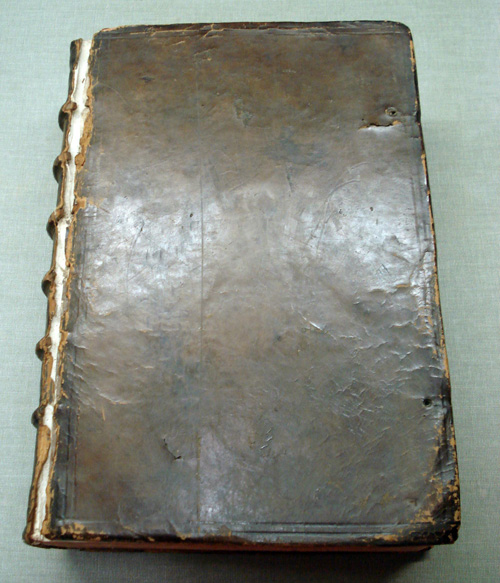
While the first set of images came from octavo and quarto sized books, the item above is a folio sized volume. This format is much larger and the textblock and boards are much heavier. In some cases, the boards are made of wood and are very thick and heavy. As I surveyed volumes of this size (and larger), board detachment appeared to be more common. This could be due to the extra force exerted by the weight of the boards and textblock.
I have also noticed that the front board attachment tends to be in worse shape than that of the back board. I hypothesize that this occurs because the front joint experiences considerably more use than the back joint – the typical reader picks up the volume and opens the front cover to find their place. After repeating flexing of the joint for a couple hundred years, the leather at the front of the volume will be weaker and more prone to damage than at the back.


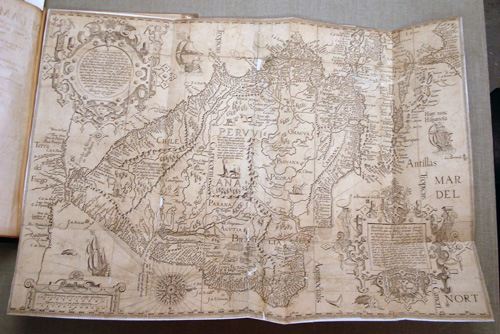
 This particular map, when unfolded, is approximately six times the size of a normal (quarto sized) page in the book. Anyone who has used a large road map will recall the difficult (and sometimes violent) process of unfolding and re-folding large sheets. At times the size and nature of the folds are not immediately obvious, leading the user to pull too soon or in the wrong direction and tear the page. This complicated process is only made worse if the map you are trying to view is tipped into a book! Items in this collection consistently exhibit tears in the same position as in the example above due to the stress placed upon the paper. Damage to these foldouts also regularly occurs along the folds and at the point where two folds cross.
 Work of the Hand