A Note on Collection Size

Surveys

Back in my post on The Pilot, I noted that the original Excel spreadsheet listed 201 items in the collection. Now that I have accounted for all the additional volumes for each title, the final count comes in at 303 items. While most of the titles listed came in sets of 3 or fewer volumes, there were some whoppers. For example, one of the titles listed, Description de L’Egypte, is an 18 volume set (about half of which are massive, massive plate books) housed in the Wilson reading room. These books were some of my favorite to survey because they are full of the most amazing engravings of people, objects, and ruins in Egypt at the turn of the 19th century. Some of these engravings can be viewed through the digital collection created by ISIS in association with the Bibliotheca Alexandrina found HERE.

The view if Ptolemaic temple in Antaepolis (Qau el-Kebir) in Egypt

The view if Ptolemaic temple in Antaepolis (Qau el-Kebir) in Egypt

Common Conditions: Part 1

Surveys

Having all but finished surveying the items in the collection, I thought it pertinent to create a series of posts that explore certain states of condition that occur consistently and predictably for materials from this area and time period. I will start from the inside of the book and work my way out. In the first episode of the series: the textblock.

One of the fields in the survey I have conducted describes the repair needed for an item’s textblock as either “none”, “minor”, or “extensive”. The distinction between minor and extensive was based on the ratio of pages needing repair to the total number of pages in the volume. Because all of the items in this collection were printed before 1800, a common characteristic throughout is strong, high quality paper. Therefore very few of the volumes surveyed exhibited more than a few tears. One particularly common site of damage to the pages, however, is due to one of the selection criteria for the collection: fold out maps and illustrations. The volume pictured below, a 1674 work edited by Henri Justel describing European voyages to Africa and the Americas, shows one of these maps folded into the pages as the reader would encounter it.

textblock01

A close look at the bottom left corner of the folded section (near the gutter) will reveal a large tear running in to the page. A different view of the same volume with the map unfolded appears below – better illustrating the damage.

textblock02This particular map, when unfolded, is approximately six times the size of a normal (quarto sized) page in the book. Anyone who has used a large road map will recall the difficult (and sometimes violent) process of unfolding and re-folding large sheets. At times the size and nature of the folds are not immediately obvious, leading the user to pull too soon or in the wrong direction and tear the page. This complicated process is only made worse if the map you are trying to view is tipped into a book! Items in this collection consistently exhibit tears in the same position as in the example above due to the stress placed upon the paper. Damage to these foldouts also regularly occurs along the folds and at the point where two folds cross.

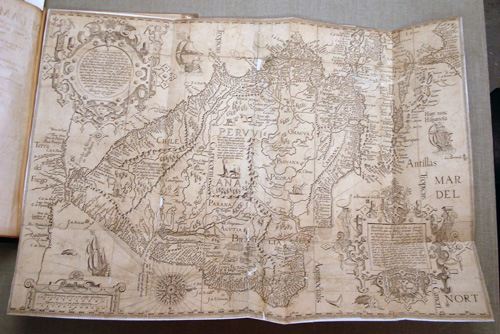
Many items in the collection have been repaired at some point in their lives. The map in the folio-sized 17th century Dutch volume below was separated along several folds in the past, rendering it unusable. When the volume was rebound, the map was backed with a piece of white textile.

textblock03

Only a trained conservator can judge if this repair will ultimately prove beneficial for the condition of the map; however, I can say that the benefits of this  material are that it acts as a strong substrate for the pieces of the map, while being flexible and thin enough to fold flat. Faced with an item in similar condition, the library’s conservators would probably not choose to carry out such an extensive treatment because they would anticipate more careful handling by patrons.The image below illustrates that same map unfolded.

textblock04

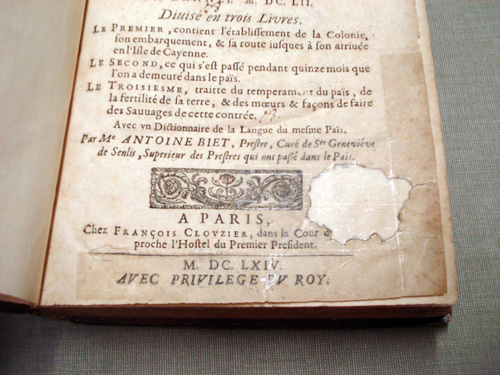
Another area that often sees a lot of wear and tear on a book are the pages at the immediate front and rear, usually encompassing the half-title (if one exists) and the title page. These pages see the most use – being thumbed through almost every time that the book is opened. Many of these damaged title pages have seen some repair and certain of those repairs are, while well intentioned, somewhat overzealous and potentially harmful.   The example below, a 1664 text by Antoine Biet, illustrates different means of repair accumulating over the life of the item.

textblock05

The lacuna in this leaf was originally repaired with paper and unidentified adhesive; however, at some point in the volume’s more recent life, additional tears along the edges were repaired with pressure sensitive tape. More than likely, this tape repair was perpetrated when the book resided in the general circulating collection some years ago.

New Worlds, Collection Context

Surveys

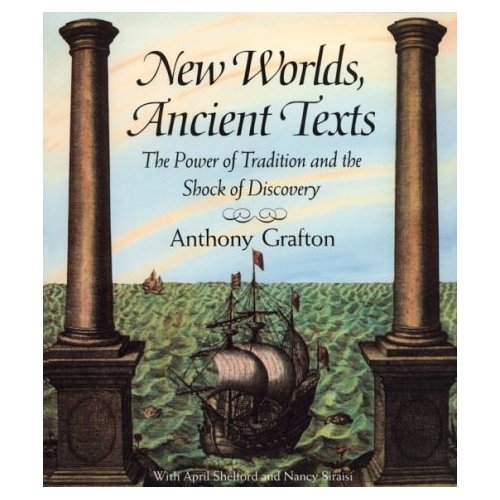
Last week I had the opportunity to examine about 30 items for the survey. In addition, Libby suggested that I read over a book by Anthony Grafton titled New Worlds, Ancient Texts to get a very general understanding of the intellectual value of the items in this collection.

Grafton Cover

The introduction and first few chapters of the book provide a specific view of the time and social context in which these books were written. In brief, the author suggests books printed between 1500 and 1700 in Europe as a result of voyages of exploration document an intellectual shift from book learning to empirical knowledge . Grafton explains that in the year that Columbus departed on his first voyage, it was generally accepted that a very small collection of works were capable of describing the universe and man’s place within it. By 1700, however, the libraries were overrun with volumes of recorded observations that conflicted with the traditional canon (ie the Bible) (3).

In the fifteenth and sixteenth centuries, books were regarded as “the most powerful sources of knowledge and guides to behavior” (9). The earliest encyclopedias attempted to provide a comprehensive list of the intellectual disciplines – many times with one definitive author and volume per discipline (16). Reisch’s Margarita Philosophica, for example, lists Euclid as the author for geometry, Ptolomey for astronomy, and Peter Lombard for theology. Through the translation efforts of the humanists, classical texts were just being republished in the 1500’s (45); the knowledge of the ancient world was new again, neatly organized, and consumed in specific context (24).

Grafton asserts that the discovery of the new world invalidated the biblical history of the development of man (4), and ushered in a new reliance on empiricism for scholarship. Schools began teaching with instruments rather than just books (5). Descartes’s Discourse on Method, published in 1637, is an example of the growing reliance on observation for academics.

While this is just one of the many ways in which this collection of material is academically valuable, it does give me a broad idea of the scope of the collection. Once I have finished surveying the material, I should have the opportunity to get more information on the selection of the individual items from Libby.

The Pilot

Surveys

On Friday, we completed a pilot of our survey. Jan first selected 11 items from the collection list. After printing blank copies of our survey fields, Jan, Andrea, and I then examined each item and filled in the form. When we had each viewed and recorded every item, we compared our responses.

For the most part, our responses to each survey field were the same. In two instances I marked the condition of the textblock as “extensive” while Jan and Andrea considered it “minor”. It was suggested that I think of the condition of the textblock in context of several factors: damage in proportion to volume size, textblock condition in relation to structural condition, and sewing. First, one must consider the extent and location of damage. It is useful to consider the number of leaves that need repair in relation to the total number in the volume. If this ratio is rather small, then the treatment required can be described as “minor”. For the survey, it is useful to consider the damage of the textblock in light of the “Treatment Level” assigned. I should ask myself, “If a conservator will already need to treat the structure, will the textblock repair be minor or major for them?” Finally, if the sewing of the volume has been compromised, this should be described as “Major Treatment” under “Structure” rather than “Textblock”. While the sewing is technically part of the textblock, it is also structural and the survey is designed in part to identify “who” can do the work. We do not want to confuse extensive textblock repair, that could be completed by a technician, with re-sewing that would probably  be done by a conservator.

In one instance during the pilot, I concluded that a 1/2 leather-bound item with a loose endcap did not need an enclosure. My reasoning was that the volume felt quite stable despite the damage. Jan pointed out that the repair to the endcap could take some time, depending upon its priority and available resources. In the meantime, further damage or loss could occur to the split piece of leather. An enclosure could be created for the item much more quickly and would ensure its stability on the shelf. Jan also reminded me that items with red rot should also probably get an enclosure.

Through piloting our survey, we became aware of certain alterations to be made to our instrument. When I first added the new fields to the Excel sheet, I had placed “Treatment Level” as the first field. This occurred because it was the first field that we discussed. After looking at the items, I realized that “Treatment Level” could only really be determined in light of the condition of the textblock and structure. I therefore felt it more appropriate for this field to appear as the last column in the excel sheet. We also determined that several titles listed in the collection had multiple volumes. Jan suggested that as I encountered these, to simply add another row in the spreadsheet and amend the call number to identify the volume number. At present there are 201 call numbers listed in the Excel sheet; however, because some occupy more than one volume, I will not know the total number of items in the collection until the survey concludes.

Survey Fields

Surveys

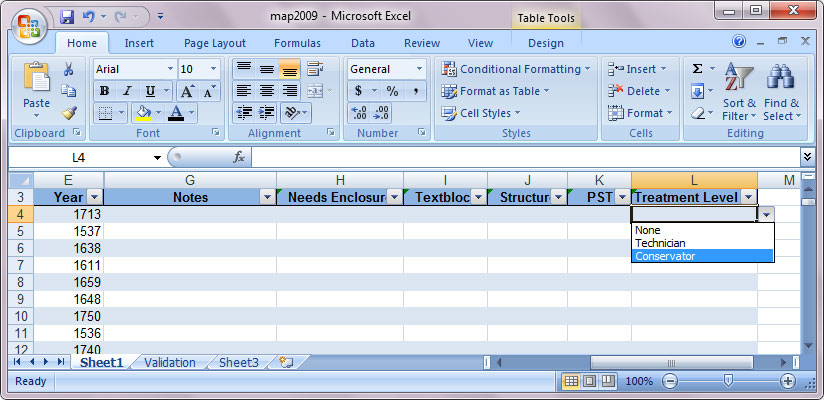
This past week, the initial Excel spreadsheet with identification information on the survey items was finished and loaded onto the library network drive. Jan and I finalized the fields and responses for the survey instrument and I added them as columns. I used the list feature in Excel to create drop-down menus for each cell. This is advantageous for our survey instrument because it limits responses and eliminates typos. In all fields we included a “No/None”  response as a means to visually confirm that an item had been completely reviewed.

Here is a screen shot of our spreadsheet:

Screenshot of Survey Fields

Libby Chenault at the RBC provided call number, author, title, year, and geographic location for each of the ~200 volumes. In addition a “Type field has been included that assigns the item to a particular category, such as “Atlas“, “Travelogue“, “History“, etc. This information will be used at a later date to determine priority within the collection.

The survey fields are broken up into five parts. The first field is titled “Needs Enclosure“. The available responses for this field are “No“, “Tuxedo“, and “Other“.  Tuxedo refers to a quickly constructed style of four-flap custom enclosure that can be made by student assistants in the lab. Tuxedo boxes are appropriate for smaller, lightweight items that need protection and stability. “Other” refers to any other style of enclosure (such as corrugated clamshell boxes or drop-spine boxes) that may be required. This type of enclosure is appropriate for larger and heavier books.

For the next two fields, we separated the description of the condition into”Textblock” and “Structure”. The textblock field has three responses: “None”, “Minor”, and “Extensive”. The possible responses for structure are”None”, “Inner Joint Splitting”, “Outer Joint Splitting”, “Boards Detached”,” and “Major Treatment”. I plan to include photographs of items that exhibit each of these conditions as I come across them.

The fourth field, “PST”, stands for Pressure Sensitive Tape. The possible responses are “Yes” and “No”, indicating if tape is found on the binding or pages.

The final field is “Treatment Level” and identifies the level of training required to perform the repairs. The possible responses are “None”, “Technician”, and “Conservator”.

The next step in the survey process is to run a pilot on a small number of items as a way of checking the design.

Of Instruments and Priorities…

Surveys

This week, I met with Jan to go over my research and clarify my understanding of the project. Here is a brief synopsis of our discussion:

First we have established the means of data capture, organization, and backup for the survey. Libby Chenault at the Rare Book Collection (RBC) is in the process of assembling a list of volumes with their basic bibliographic information in a Microsoft Excel document. When the list is complete, we will add in our survey fields as additional columns. This system offers several advantages: first, the software is installed on all machines in the building. Excel offers easy-to-use sorting features, allowing the items to be sorted by repair/treatment when the survey is complete. Additionally, the spreadsheet will be stored on a department network drive that is accessible by all parties and is backed up regularly. Finally, this solution doesn’t require the intervention or assistance of the systems department – thus allowing us to begin sooner.

Next we discussed the details of the survey instrument. Here, Jan stressed the importance of a lean survey. The fields on the form that we design must capture only the most necessary information to fulfill the goals of the survey. Superfluous categories will make the survey take longer and may even obscure the data analysis at the end. As Jan succinctly put it, “There are only so many conservator hours in the world.” With so many other items in the library’s collection, it is important to critically engage the survey at the beginning to avoid wasted time and effort. Good questions to ask in the development phase of the assessment process are: What is the survey for? The goal of our survey is to develop a strategy to best care for the items in this collection given the available resources. For all intents and purposes “resources” equals time and money.

In order to meet our goal, there are certain things we must know. First, we need to know the condition of each item. Our instrument should be able to give us an idea of an item’s problems that is not too granular, but is useful for eventual batching of treatments and may provide a relative time estimate for the project. Related to this, the instrument must be able to give us a clear view of the range of conservation needs for the items in this group. This feature could conceivably alert the conservators if new lab work flows are needed.  Finally, I must become comfortable with assessing the condition of an item. For our instrument, we decided that it may be better to use fields that describe an item’s specific conditions, as opposed to “levels” or time commitment. Because this is my first experience with assessments, I may not be able to accurately estimate the time an item will require.

Another important topic that our meeting clarified for me was the difference between the priority of the item and the priority of the repair. In the article on the Tsar’s Collection at LoC (see last post) ample money and staffing allowed for every item in the collection to receive top priority. The author’s concern was which types of treatment should be performed first. For this project, the needs of the collection being surveyed must be weighed against the needs of the RBC as a whole. Therefore, our concern is the condition of the item in the context of its importance to the collection. In this case, the conservation lab will be working with the curator to establish item priority based on the needs of the patrons.

I should note a thought that occurred to me as I was doing my research. Should the library have plans to digitize items in this collection, how would that affect the survey? When I brought this up at the meeting, I learned that digitization would likely have no bearing on the treatment of the item, so it was outside the scope of the instrument. It would, however affect the item’s priority.

A few words on grants and surveys: I am learning that it is important, in this stage, to ask oneself if a grant can be written from the information gathered with the survey.  Over the next week, I will be reading through the proposal requirements for two grants and comparing them with what we have already discussed.

Preliminary Research (alt title: Reach for the Tsars!)

Surveys

Before I get too deep into thinking about my particular survey instrument, it seemed appropriate to investigate surveys in general.

I began my research with a review of all the survey material I read while taking Preservation (INLS 753) with Beth Doyle here at UNC last fall. I first picked up a NEDCC paper from 2003 by Beth Patkus. This one is a tad long (~100 pages), but it started me off with some good, broad definitions. My field experience will develop a collection condition survey, rather than a preservation planning survey. Because the collection is small enough, this project will also be item-by-item rather than a statistical (or random sampling) survey. This simplifies things a bit because I do not have to worry about creating a statistically valid sample. By the nature of the collection, I am also assured that  This article also got me thinking about all the variables that a survey could address. I am fortunate in that my survey will be quite focused – all the items are bound volumes, I am not concerned with environmental conditions, shelving, security, etc.

Next I moved onto a short 2007 paper by Margaret Childs. The author describes the overarching goal of a survey when she says, “The information gathered in the condition of the collections… eventually have to be weighed against the resources that can be mobilized by the institution and the technical abilities of the staff available to address the needs identified” (para. 15). As I develop my survey instrument, I must always keep in mind the ends to which the resulting data will be used and endeavor to keep it as efficient as possible.

After reviewing a few more articles on general collection surveys, I consulted a paper by Teper and Erekson on condition surveys for uncataloged special collections. The survey that this article describes is interesting in that it is attempting to gather information on material that is not accessible. The appendix includes a copy of the survey form used. It is a very long form, including boxes for rating damage from 1-5, usability  from 1-3, and bibliographic information. It also includes all manner of options to describe condition, such as binding style, covering material, boards, endsheets, paper, and decoration. While this form is exhaustive in its attempt to describe each item completely, the detail of it is quite inappropriate for my project. In my case, it will be useful to know if an item’s enclosure is in disrepair – but I will not need to record the style of said enclosure. The paper did mention a 2004 article by Green that sounds more closely related to the project at hand.

Finally, I read an article from 2006 by Francisco Trujillo on the Russian Imperial Collection at LoC. This article was the most apt in that it stressed the need of the survey instrument to “establish the division of labor between conservator and technician” (p. 39). Different people with different levels of training will ultimately be doing the treatments for the materials, and a survey must be designed with this in mind. In the case of the Tsar’s Collection survey, specific problem areas that a technician could handle were identified. If a conservator was needed for the treatment, it was identified as “major treatment”. A similar designation would probably be appropriate for my project, however, the specific fields will be refined. This does present a learning curve for me, because while I can easily identify a split joint or board detachment, what distinguishes a “major treatment” at present eludes me.

While none of these readings answered all my questions, I at least feel better oriented intellectually in the subject of surveys. I am confident that as I gain a better understanding of the collection and the purpose of this project the answers to those questions will come.

Works Cited

1. Childs, M. (2007). “Preservation assessment and planning”, a Preservation Leaflet, Northeast Document Conservation Center, MA: NEDCC.

Retrieved from http://www.nedcc.org/resources/leaflets/1Planning_and_Prioritizing/02PreservationAssessment.php

2. Patkus, B. (2003). Assessing preservation needs: A self-survey guide. Northeast Document Conservation Center, MA: NEDCC.

Retrieved from http://www.necc.org/resources/downloads/apnssg.pdf

3. Teper, J.H., Erekson, S.M. (2006). The condition of our “hidden” rare book collections. Library Resources & Technical Services, 50 (3), 200-213.

4. Trujillo, F. (2006). The tsar is dead! Long live the tsar’s collection. Book and Paper Group Annual, 25, 39-42.

Introductions

Writing

Greetings and welcome to my blog!

My name is Henry Hébert and I am a graduate student in the School of Information and Library Science (SILS) at the University of North Carolina at Chapel Hill.  In addition to my studies, I work as  a research assistant in the conservation lab for special collections at  Wilson Library. I am interested in pursuing special collections conservation as a career  and throughout the summer I will be working on a Field Experience with Jan Paris, Conservator for Special Collections. The primary function of this blog is to serve as a reporting mechanism for my progress throughout this project and I hope to document and share my experiences, research, revelations, and results as they occur.I feel compelled to provide a general overview of my project and intentions, as I understand them, alongside these introductions.

The focus of my field experience will be a conservation assessment for a small collection of European expansionist and travel literature. After reviewing available literature on condition assessments, I hope to gain experience in the development of an appropriate survey instrument tailored to the goals of the project. With this survey, I will observe and document the physical condition of each item, providing a fuller picture of the amount and type of work required to stabilize these materials. Where warranted, I will build custom enclosures for items and carry out minor treatments under the supervision of the conservator. At the culmination of the field experience in the fall, I will describe and summarize the survey in the style of a grant proposal.

This field experience provides many unique learning opportunities for me. The first and greatest is also the most ephemeral: the development of a more discerning way of looking at library materials. By physically handling and scrutinizing several hundred information objects over a period of weeks, I hope to gain a greater ability to identify and understand the types of deterioration and damage commonly found in rare book collections. By performing this work under the auspices of a professional conservator, I can begin to develop a methodology in line with the professional and ethical practices of the field. This field experience also grants me the opportunity to participate in the assessment process from start to finish. In addition, my final report will serve as a good exercise in preservation grant writing. After reviewing several library preservation grants, I hope to craft a document that would meet all requirements in content and language.

I am very excited to participate in this project and look forward to acquainting myself with the material. This is my first use of a blog for academic purposes and my first time dealing with WordPress. I am hopeful that this technology will provide an edifying delivery method for my experiences.