Board Slotting

Workshops

Since the 1960’s several different methods have been developed to deal with the joint failure and board detachment issues that often occur to leather-bound volumes, and each offers distinct treatment outcomes in terms of strength, aesthetics, and disruption of the original binding material. Conn (1996) provides brief, but clear descriptions of a range of these techniques in her feasibility study on treatment options for circulating collections.  In the late 1970’s, Christopher Clarkson developed a method of reattaching book boards in which a slot is cut into the board to accept a flange of textile that is attached to the spine of the textblock. He presented a paper on his method at the Institute of Paper Conservation conference in 1992. This technique offers some distinct advantages over others, including that the turn-ins, pastedowns, and covering material are not disturbed. The thickness of the board is also maintained, unlike the usual swell resulting from a traditional leather reback. This can be beneficial in cases where the leather covering the board is highly decorated or chemically degraded (Zimmern, 2000 , p. 24).

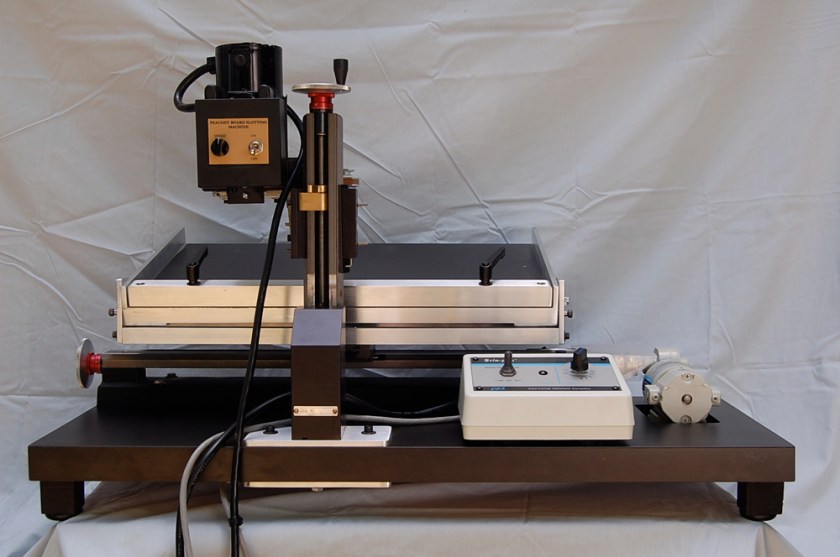
Zimmern states that board slotting with a normal milling machine is “complicated and time-consuming” (p. 22) and, as a result, at least three machines have been developed in recent years to increase the speed and accuracy of the process. We are fortunate to have one of Jeff Peachey’s board slotting machines here at NBSS (seen below) and last week Lou DiGennaro, NBSS alum and Assistant Conservator for Special Collections at NYU libraries, came up to Boston to demonstrate the setup and operation of the machine. I’ll share a few photos and an extremely brief writeup of the workshop here. If you would like to read more on the topic, please see the bibliography at the end of the post.
During his demo, Lou discussed Clarkson’s, Peachey’s, and Alan Puglia’s structures (described below) for board reattachment in instances where the spine material is still intact, as well as the method described by Angela Andres (2008) for books missing their spine covering. No matter the method, the spine of the book is first cleaned and consolidated with paste and Japanese paper and the leather at the board edge consolidated with a 2% Klucel G in ethanol solution.

Lou first went over the basics of the machine’s setup and operation, including setting the carriage angle, blade height, depth of cut, and speed of operation. He also discussed choosing a thickness of saw blade based upon the thickness of the board and flange material to be inserted. Changing the blade and setting up the machine went very quickly. You can find Peachey’s short video on machine operation here.
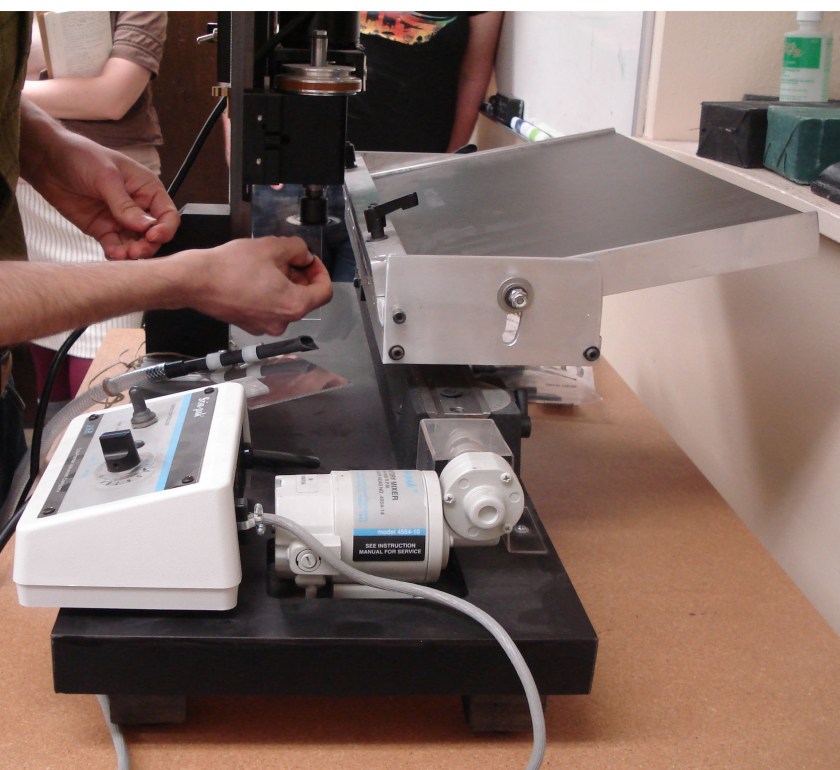
The book board is placed face up in the carriage (here with a waste board on top) and the height of the blade set to just under the covering material.
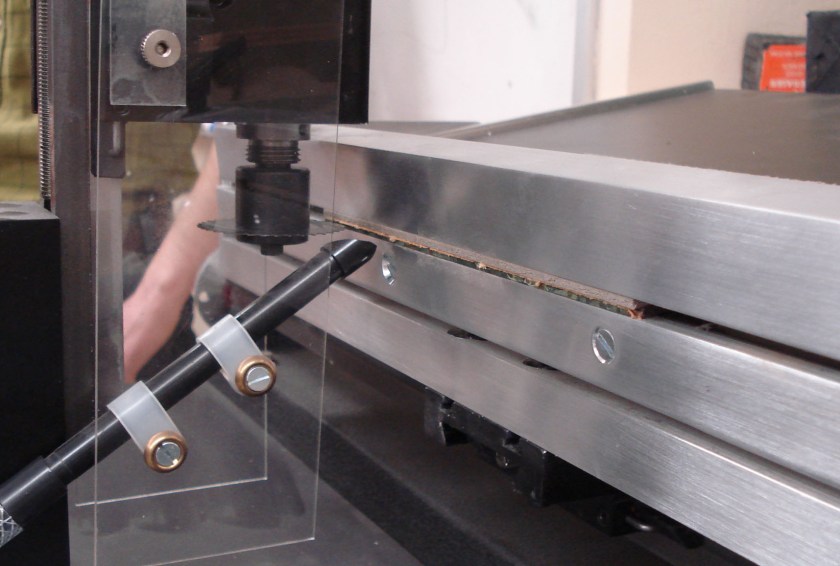
Before slotting, the alignment of the blade is checked at both the head and tail to ensure that the slot would be even across the length of the board. The saw motor is then activated, the carriage cranked in so that the blade is cutting a 5-8 mm slot, and the carriage set in motion. The slot is started and stopped just inside the edges of the board so that the turn-in material is not disturbed. Hopefully the image below is clear enough to illustrate.
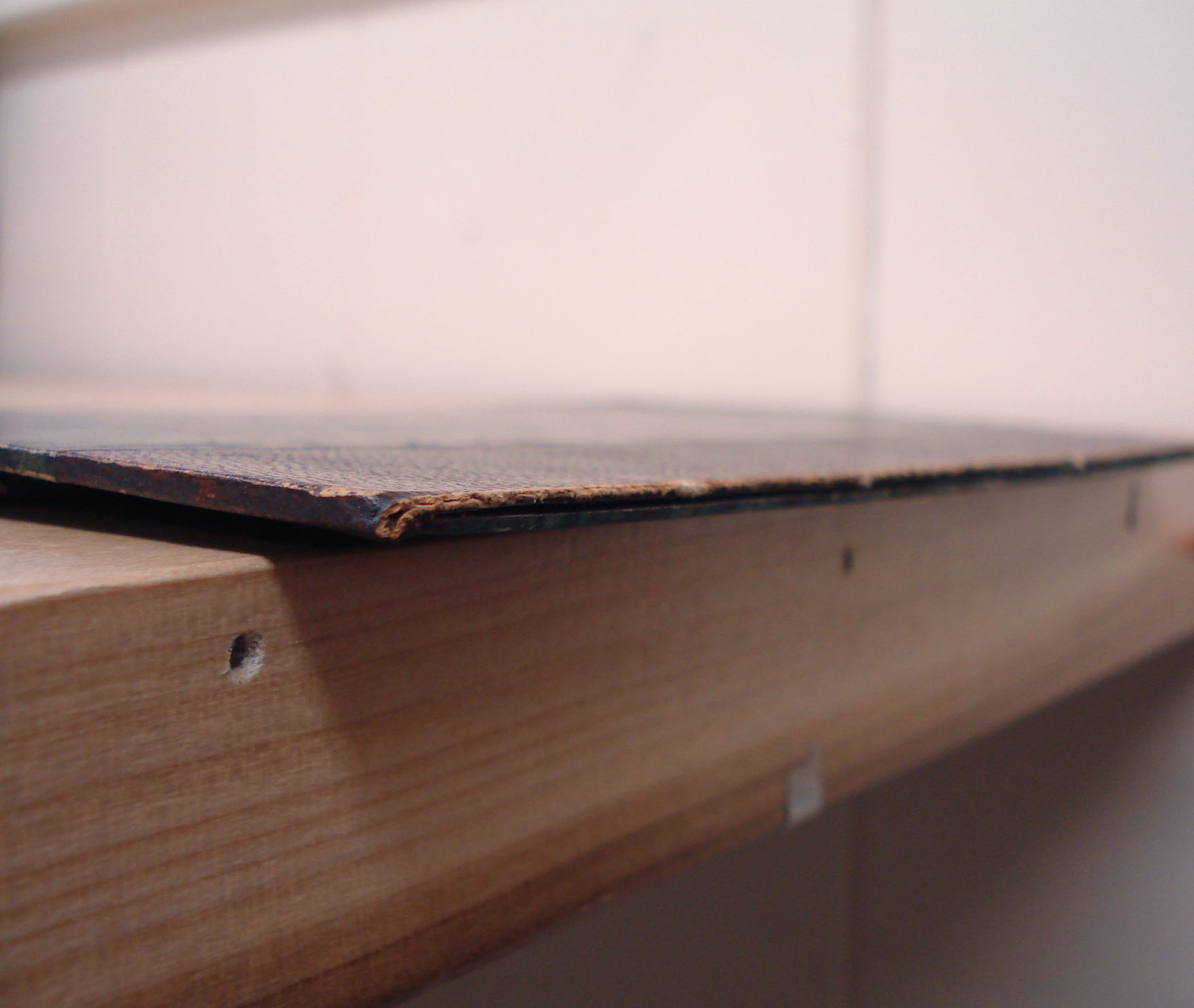
Both boards were slotted in the same fashion. After tapping out a small amount of sawdust and gently clearing the slot with a micro spatula, the front board is placed in a finishing or lying press. Lou used a small syringe to inject a bead of PVA into the slot.
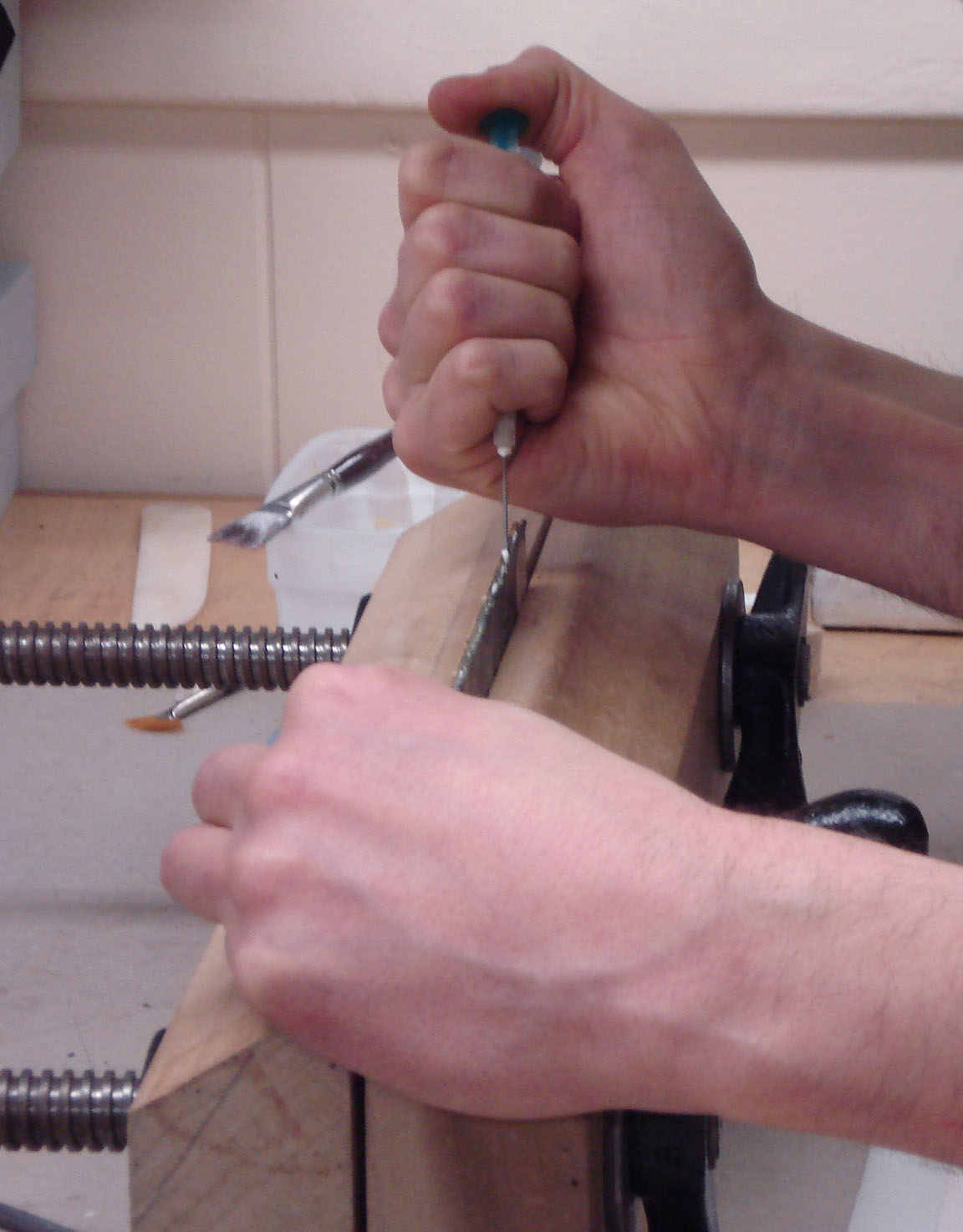
Previously, Lou had created a two-part hinge, consisting of a layer of linen or cotton backed with Kizukishi or Sekishu and a layer of pre-toned Moriki lined with Kizukishi. The two hinge layers were tipped together on one side with PVA and inserted into the slot. [As a related side-note,  Zimmern’s article provides an interesting discussion of the folding endurance of three hinge materials and three kinds of adhesive.]
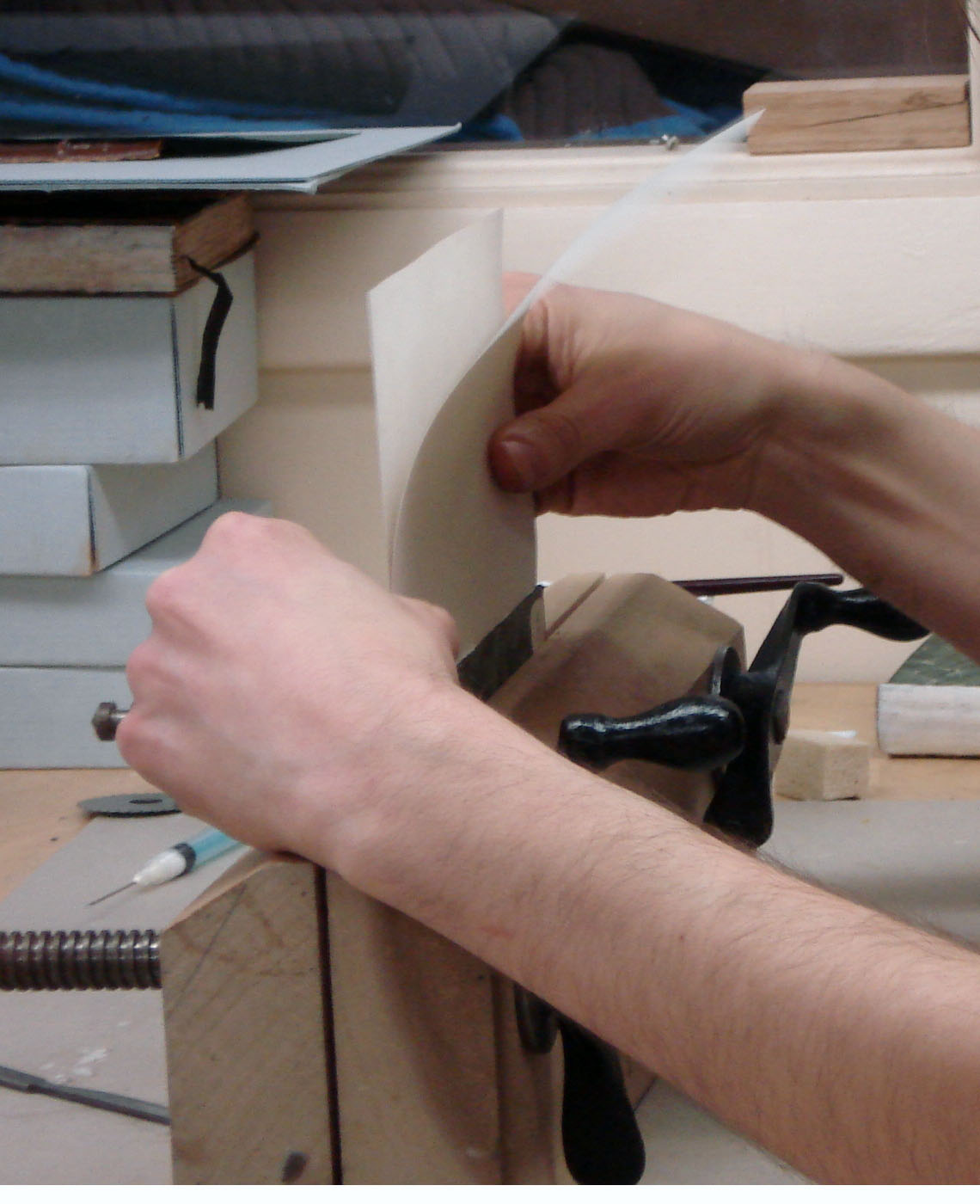
After nipping the board and allowing it to dry under controlling weight, the textblock was aligned on the board and the spine glued up. Lou pulled the first hinge layer firmly around the spine and worked it down with a bone folder.
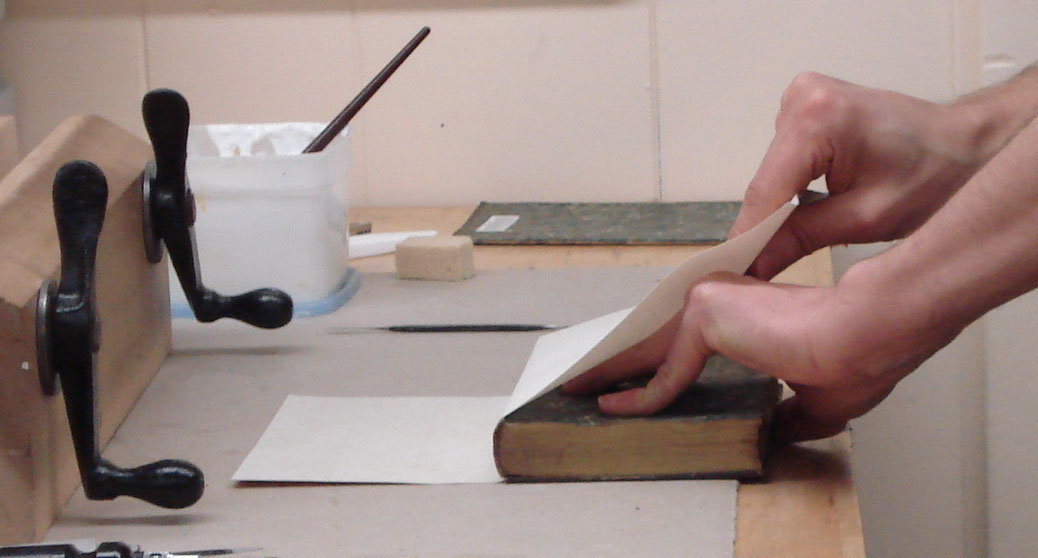
Next, just the shoulder of the hinge was glued and the second hinge layer wrapped around, worked into the shoulder, and allowed to dry under weight. This creates a natural hollow.
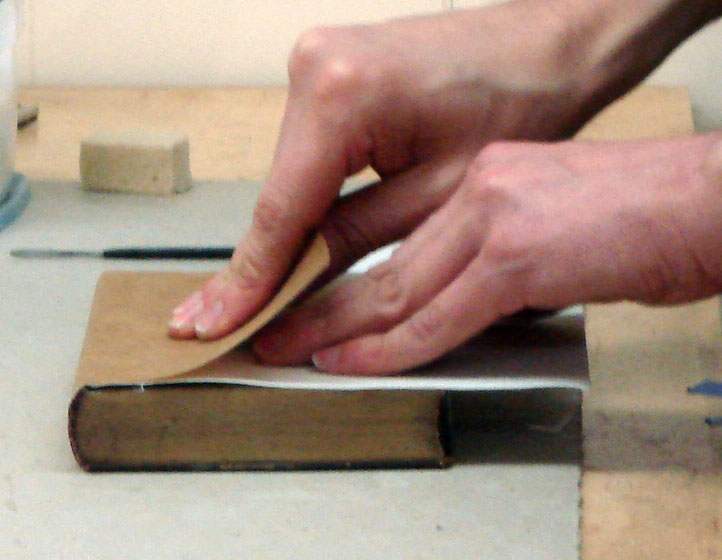
After trimming the resulting flange to the slot depth, Lou injected PVA into the slot in the back board…

… aligned it on the textblock, and inserted the flange with a micro-spatula.
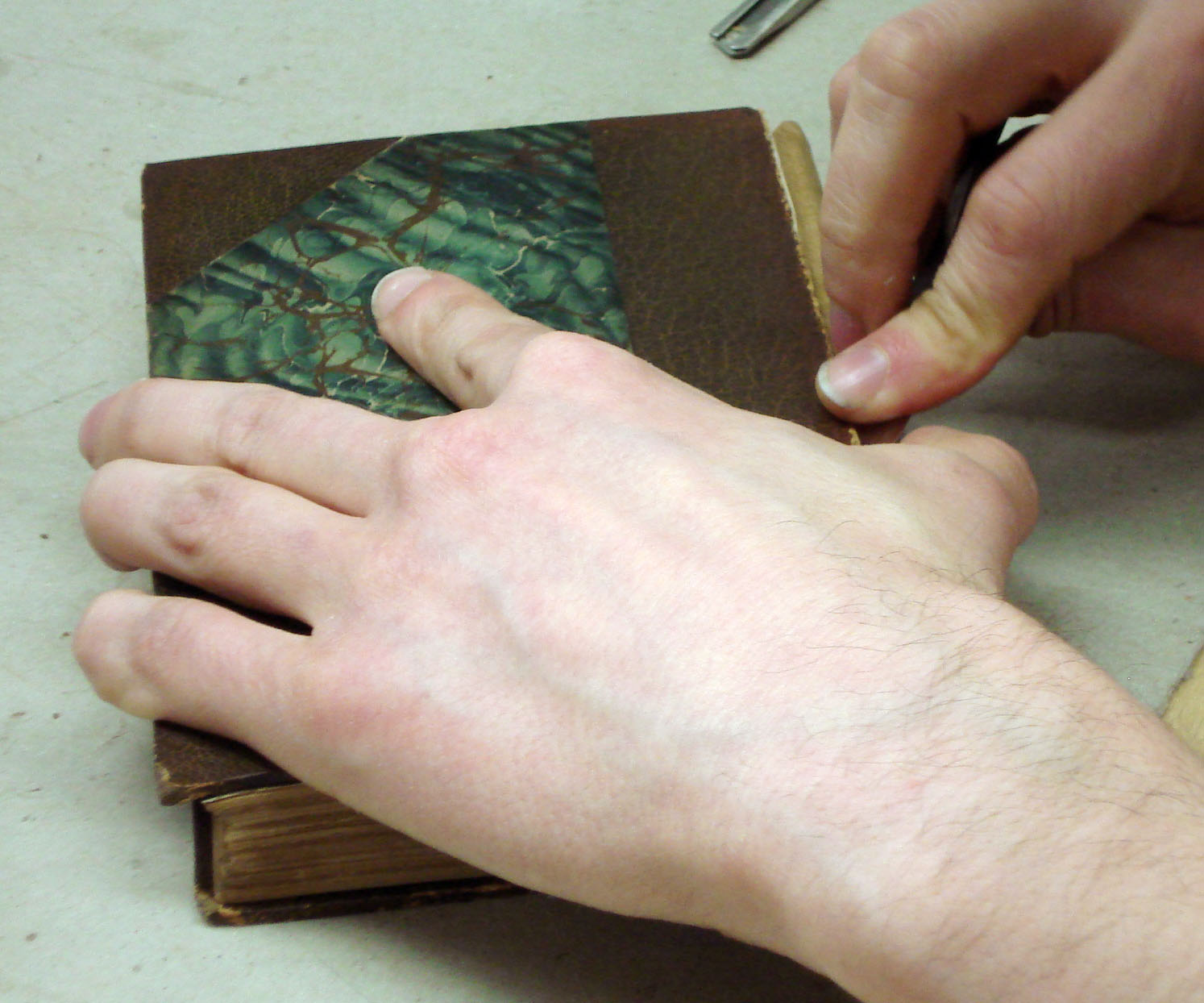
Once again, the board was nipped and allowed to dry under weight.

In the last step, the original spine piece was adhered onto the new spine hollow. After delaminating a few of the layers of paper inside the original spine piece, Lou adhered it to the outer (Moriki) hinge layer.
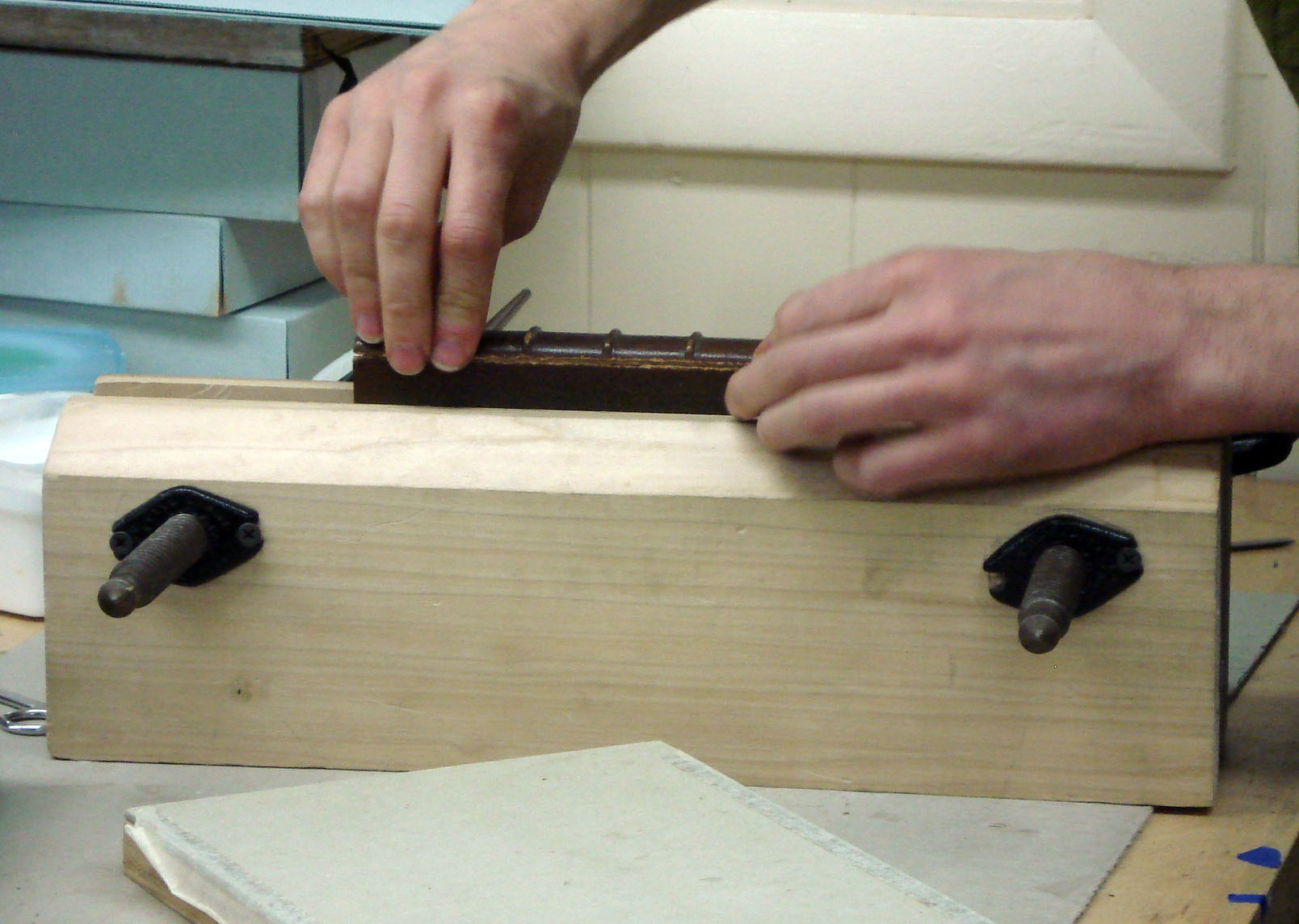
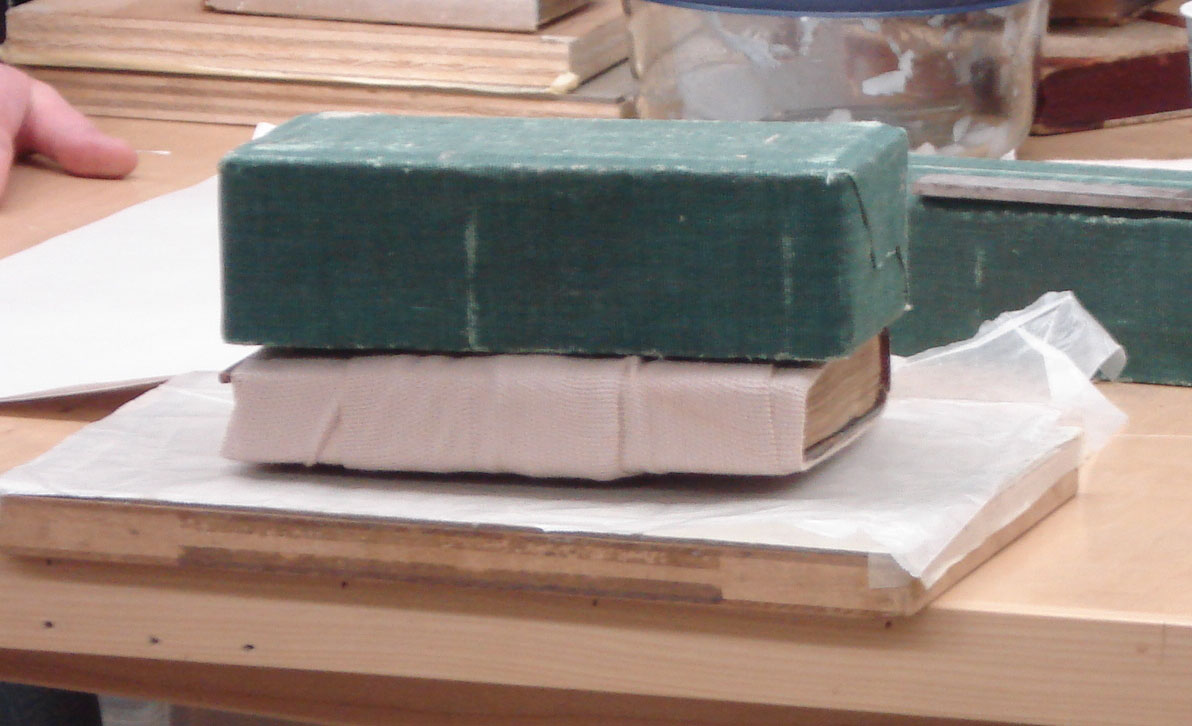
After working it down with a teflon folder, he then wrapped the volume in a compression bandage and placed it under a light weight to dry.
Lou also brought along an example of board slotting on a book that had lost its spine covering entirely. In this example, the boards were slotted all the way through the turn ins and the new spine material was turned in to form the endcaps.
The inside hinge is repaired with a strip of Japanese tissue toned to match the endpapers.
 

At the end of the demo, a few of us were able to try the machine out on our own. Peachey’s machine is incredibly easy to set up and use. Even without any previous board slotting experience, I was able to successfully slot a moderately thin board on my first try. While this machine may not be an economical option for the average conservator in private practice, it does present a viable treatment option for institutions with collections of circulating or medium-rare nineteenth century volumes with board attachment problems. By prepping hinge material in advance and batching treatments, a technician could probably become very quick with these repairs.

As I said, this is an extremely cursory look at board slotting and there is a lot of fantastic material out there on the subject. Including the list of articles below, I’d suggest a blog by Jeff Peachey, Victoria Stevens, and several other contributors (found here) centered around board slotting that deals with a range of topics and links to the relevant academic literature.

____________

Andres, A. M. (2008). A new variation on board slotting: Case binding meets in-boards binding. The Bonefolder, 4(2), 24-26.

Clarkson, C. (1992). Board slotting: A new technique for re-attaching bookboards. The Institute of Paper Conservation Conference Papers, Manchester.

Conn, D. (1996). Board reattachment for circulating collections: a feasibility study. Book and Paper Group Annual, 15, 29–40.

Minter, B. (2006).  A variation on the board slotting machine. In M. Kite & R. Thomson (Ed.), Conservation of leather and related materials(pp. 241-242). Oxford, UK: Butterworth-Heinemann.

Peachey, J. S. (2006) New possibilities for board slotting. The Bonefolder: an e-journal for the bookbinder and book artist, 2(2), 28-32.

Simpson, E. (1994). Setting up a board-slotting programme. The Paper Conservator, 18, 77-89.

Zimmern, F. (2000). Board slotting: A machine-supported book conservation method. The Book and Paper Group Annual, 19, 19-25.

Cases – Pt 2

Bookbinding

After experimenting with case bindings for a bit, we were assigned to make a set of 12 that had common materials, but variations in covering style, endbands, and endsheet structure. I’ll break the parts of my set down in that order. Once again, certain features, such as book dimensions, textblock paper, and sewing supports remained constant. I also made all of these cases as a built-in groove (Bradel) structure and keep the spine linings the same to speed up the production work.

Covering Style

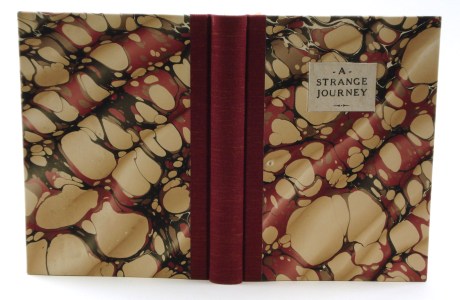
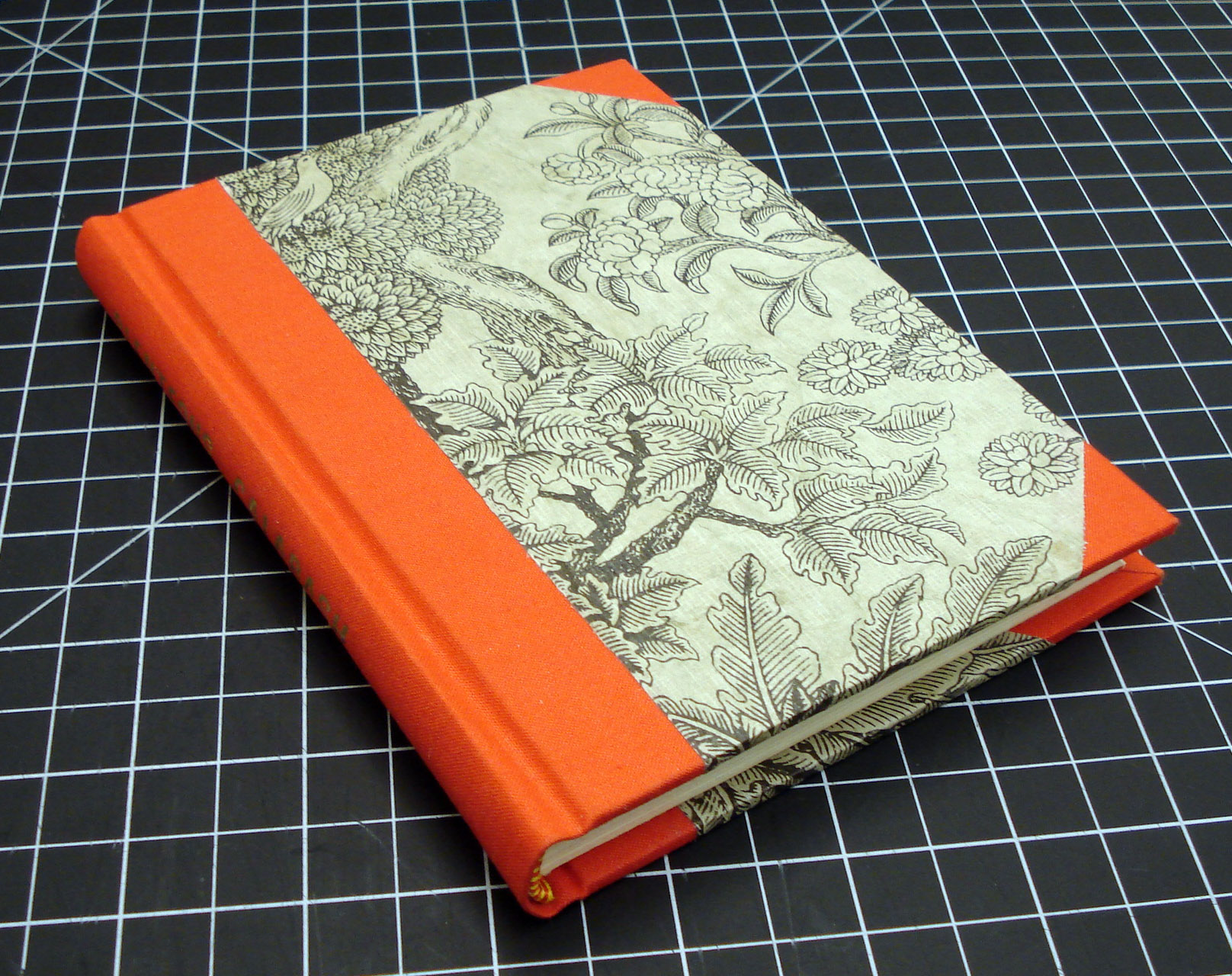
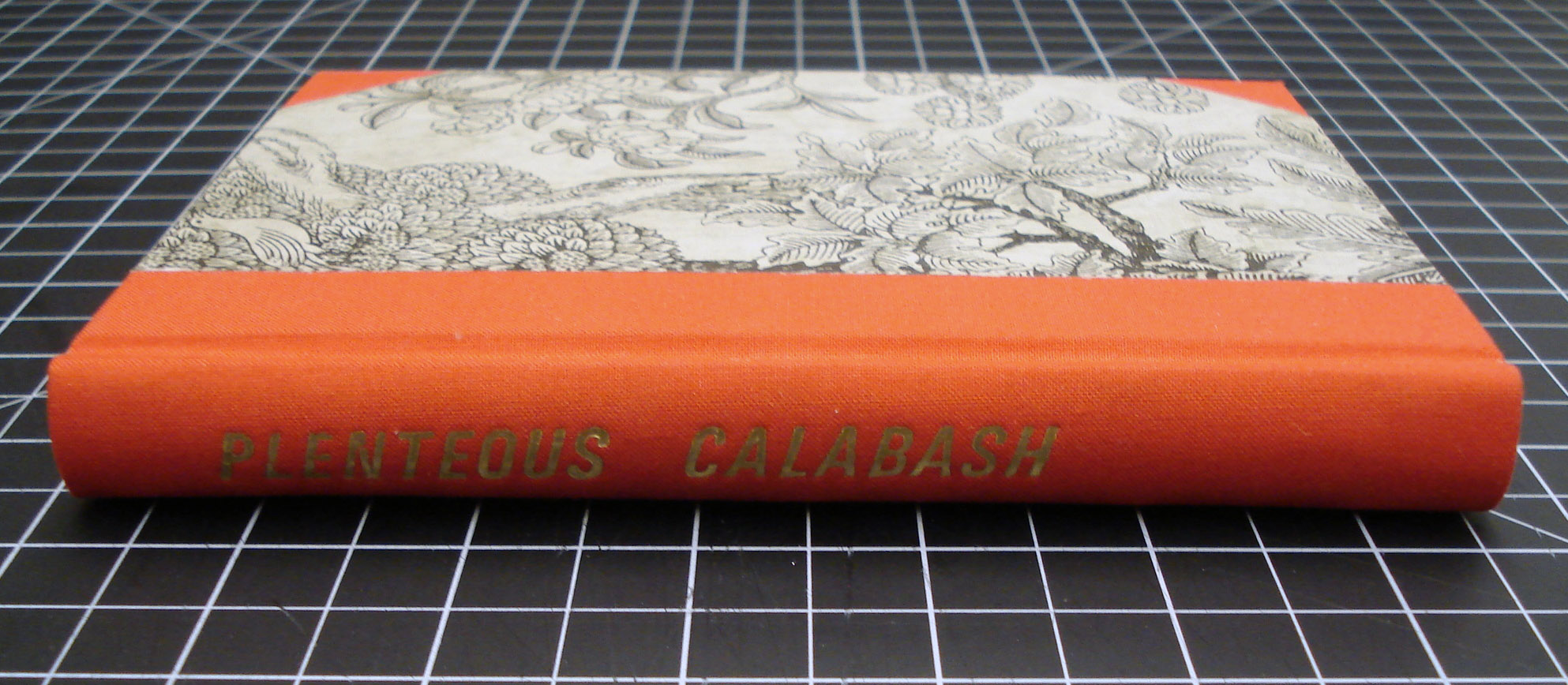
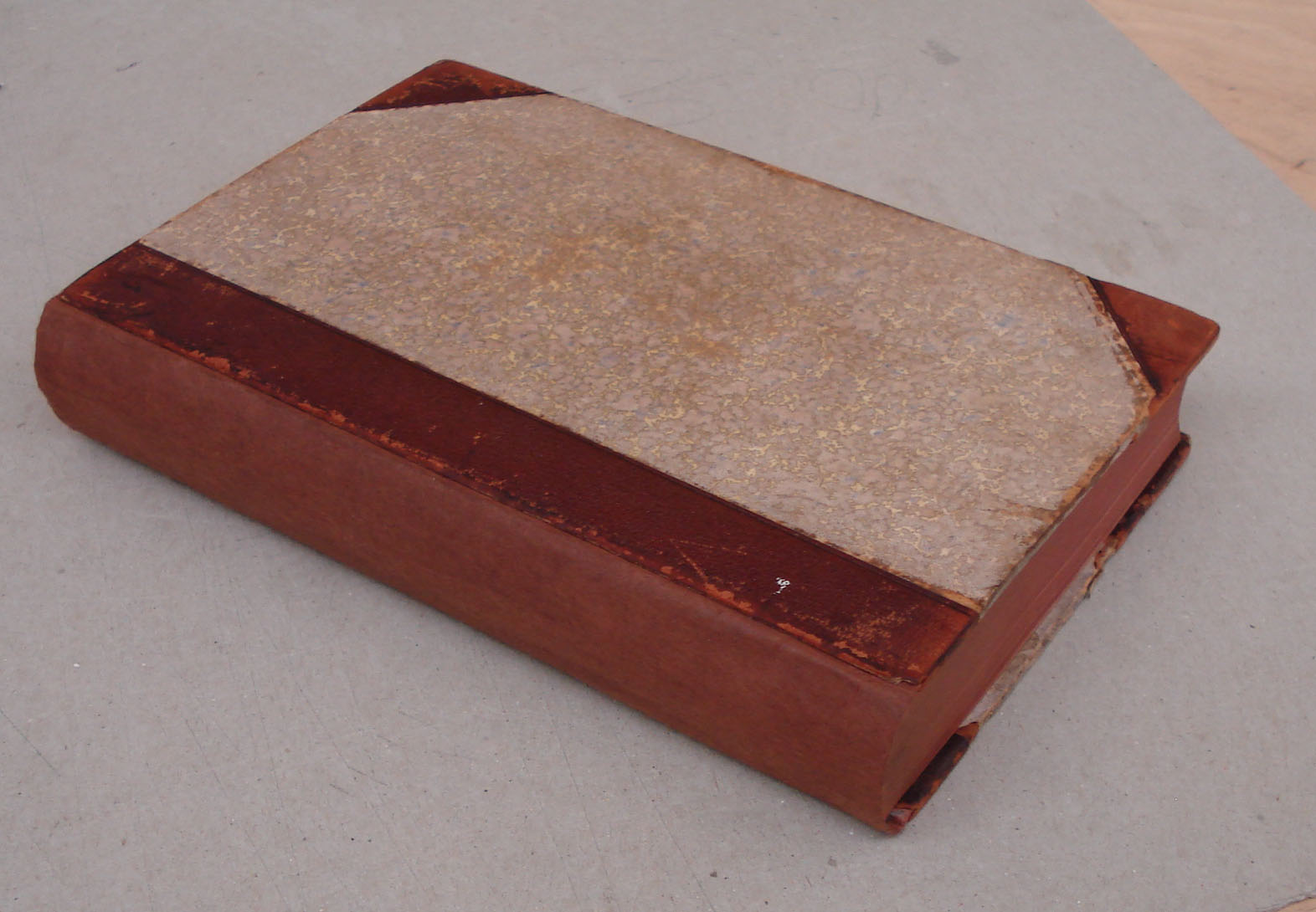
All of the books in this series were covered, in part or in whole, with the same paper-backed Asahi book cloth (available from Talas).  I really like this stuff because of its thickness, nice texture, and variation in color – plus I had quite a bit of it lying around. The books were covered in three different styles:  quarter, half, and full cloth. The quarter style has just a strip of cloth covering the spine and extending about a fifth of the way onto the boards. The remainder of the board is then covered (“sided up”) with paper. This one is sided up with Ann Muir marbled paper.

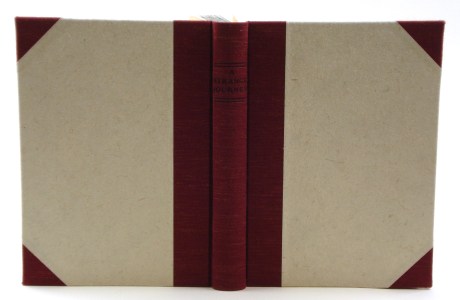
In addition to the cloth spine strip, the half style bindings have cloth-covered corners.  The book below is also sided up with Ann Muir paper.

I tried to create some variation along the series – for instance, the example below is sided up with Egyptian tow flax Cave paper.

Finally, several of the case bindings were covered in full cloth.

Each of the books in the series had to be labeled or stamped, and because typesetting in the Kwikprint takes quite a while, I went with two title layouts and varied the material with which the cover was stamped. The quarter and half style bindings above were stamped on the spine, while the full cloth cases immediately above and below were stamped on the front covers. The book above was stamped with gold foil, the book below was stamped with carbon.

I really enjoy the clean, matte impression that the carbon gives. I also think it is easier to do well. For stamping with foil one first has to make several blind impressions (that is with just the hot brass type), then one or two quick impressions with the foil in place. The gold is difficult to successfully work into book cloth and any movement of the case position on the stamping platen during this process will ruin the job – so great care must be taken. With carbon stamping, the hot type is first “loaded” up with carbon and the case is then stamped with a single, firm impression. As long as you don’t screw up that one stamp, you are good to go.

Another titling technique that I used on some of these books was a stamped paper label set in a label well. The well allows the label to sit just below the surface of the cover, protecting it from abrasion when the book is shelved. These labels are often done in leather, but I found that Cave paper also takes a rather nice impression. I’ll share more about leather labels in an upcoming post on in-boards bindings.

To create the label well, the boards were made by laminating a piece of 20pt board – with the label square cut out – to a piece of thin Davey board. It is important to keep the final board thickness in mind, as it must fit inside the shoulder of the bookblock to create a well working joint. It is also sometimes necessary to line the inside of the board before covering to counteract the “pull” of the 20 pt. When the book is covered, the covering material is worked into the label well with the bone folder. The label material is stamped, trimmed to size, and adhered inside the well. This titling can work on both full and quarter style bindings, however, one must shift the label position depending upon the covering style for it to look centered.

Endbands

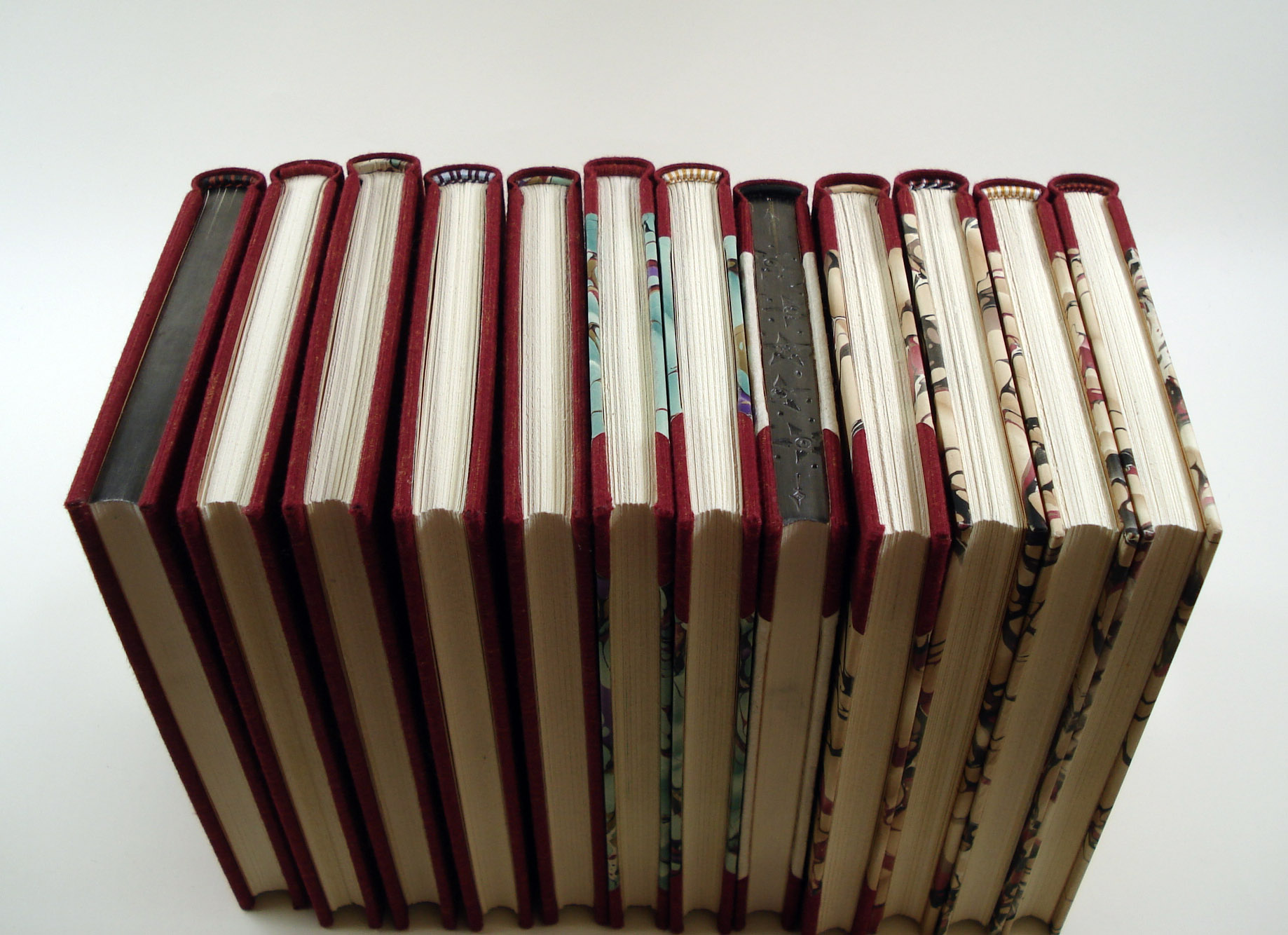
Across the 12 case bindings, I tried several different styles of endband to go along with the endsheet and covering materials.

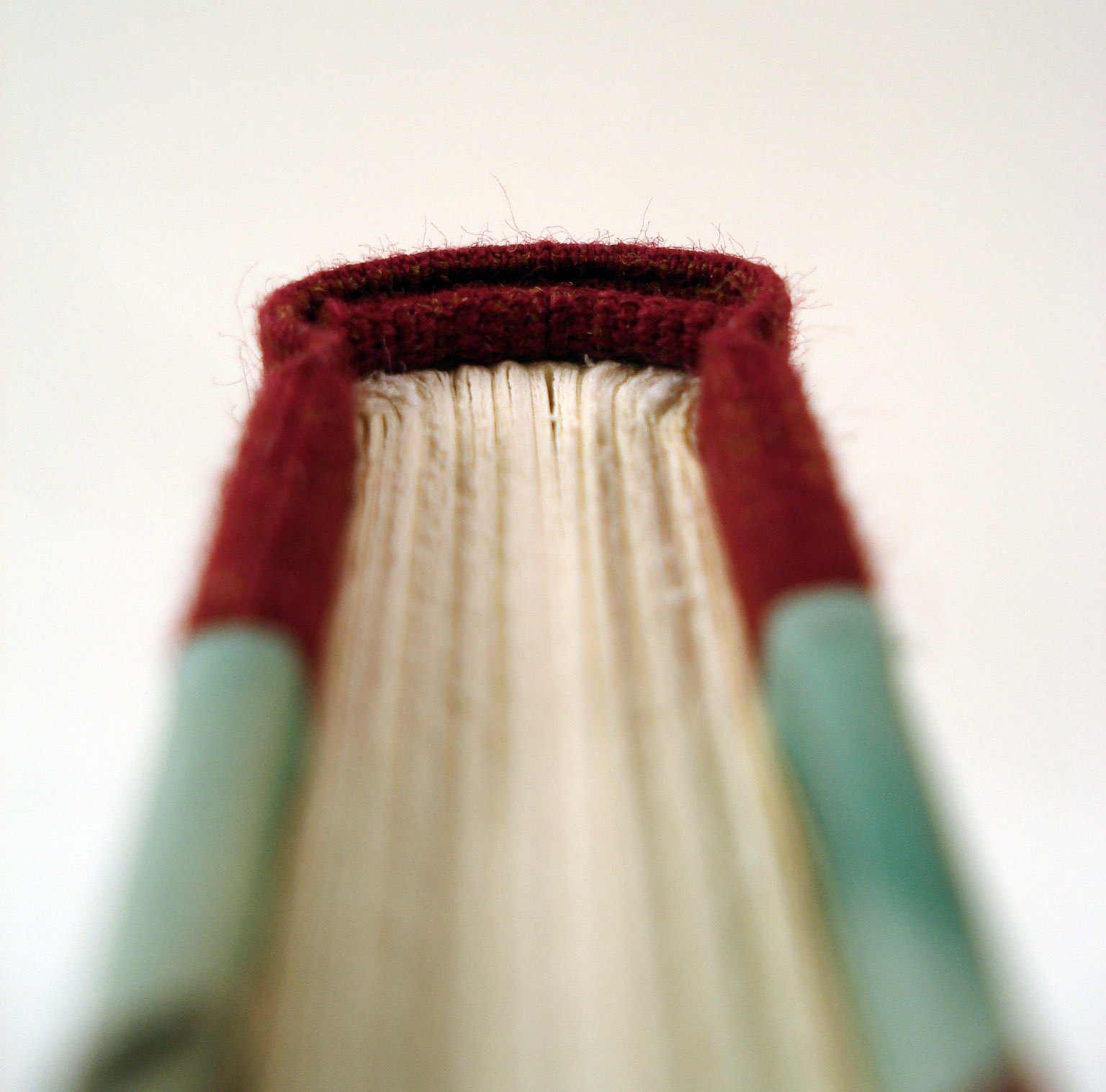
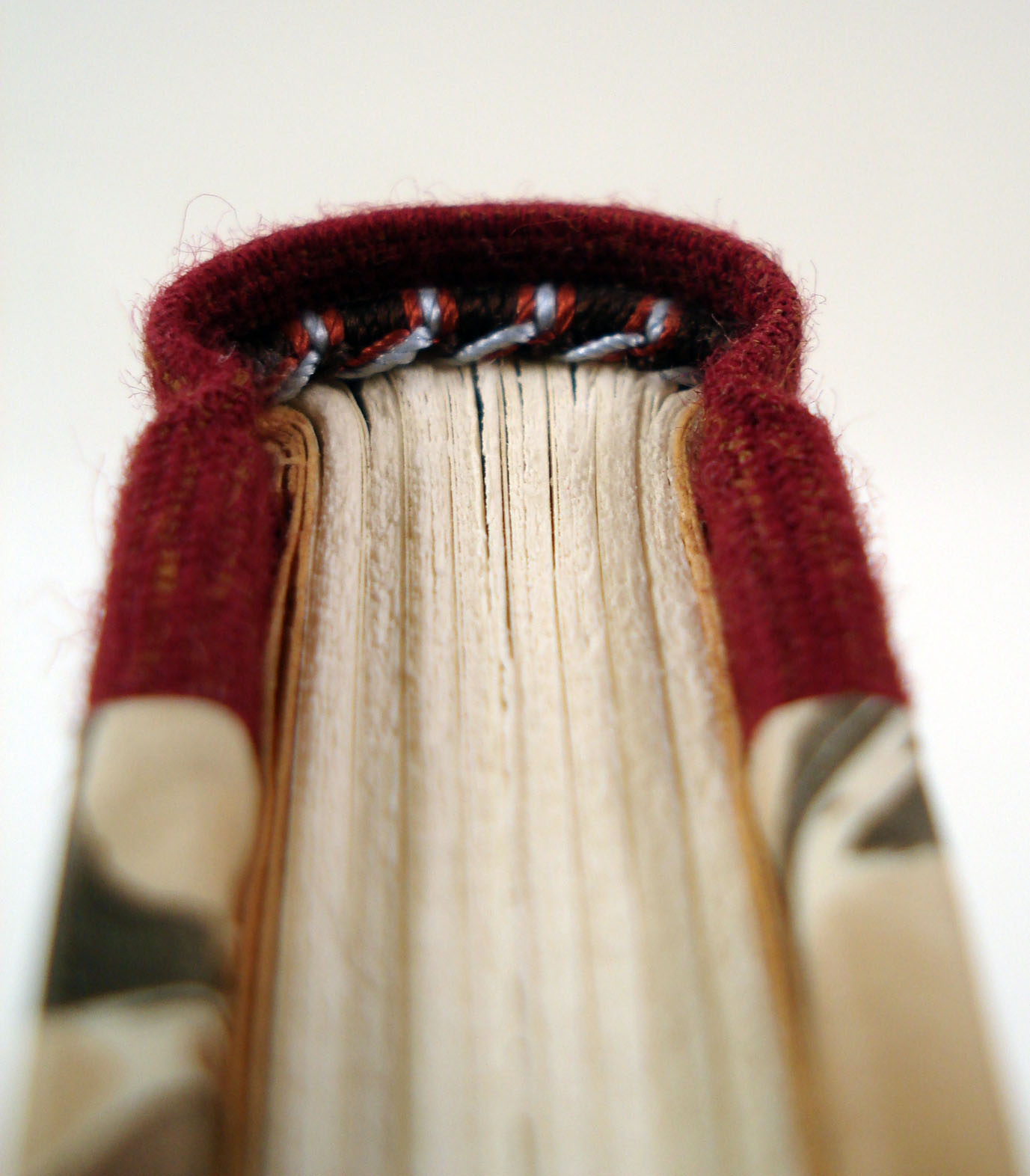
As these are case bindings, I thought it appropriate to do simple stuck-on endbands in different styles for a number of them. The first is bookcloth (the same used for covering) rolled around a hemp or linen core that is trimmed to size and stuck on the spine with PVA. This is about as unobtrusive as you can get.

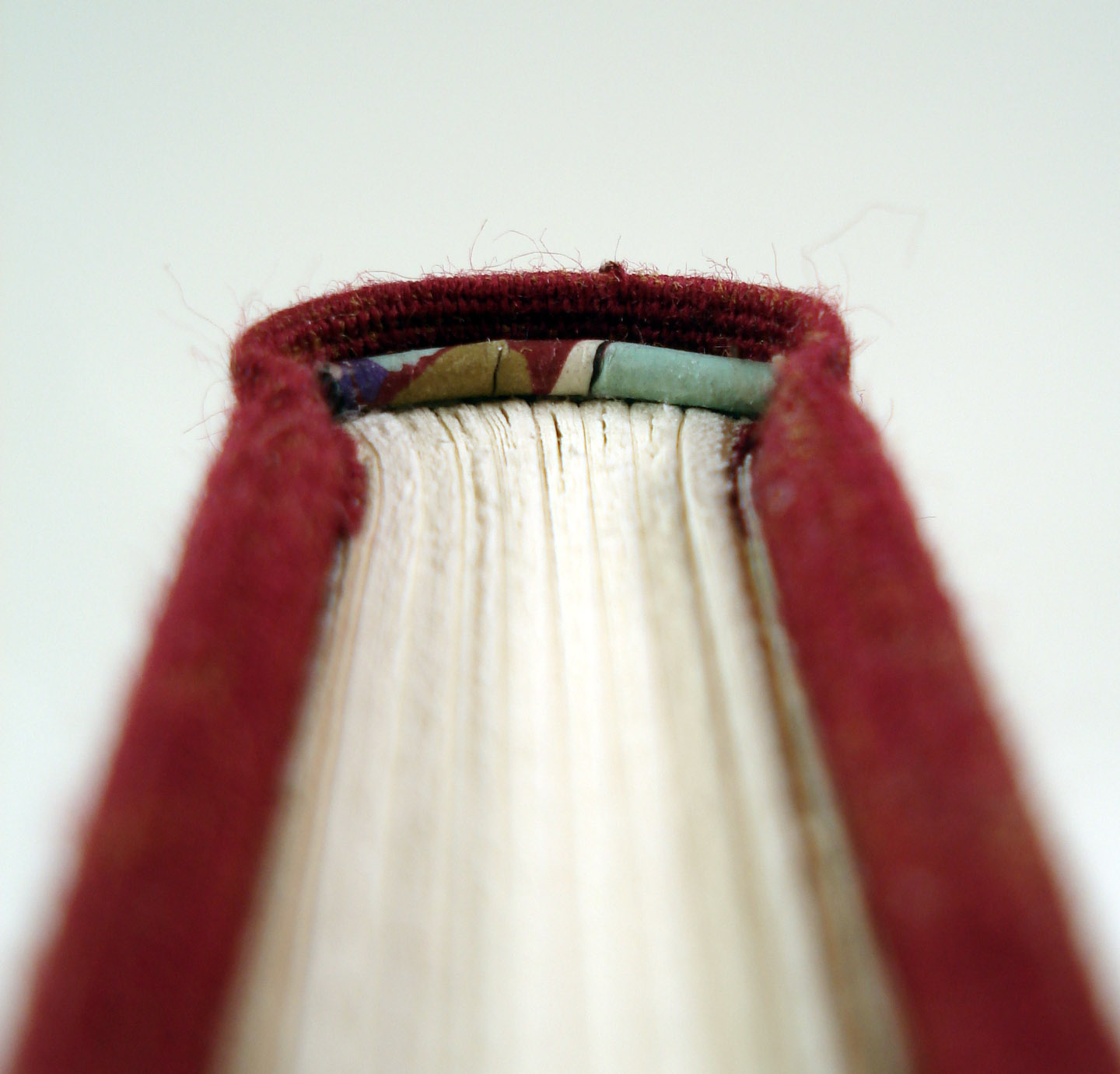
I also experimented with stuck on endbands made from marbled paper wrapped over a rolled paper core.

I’m still not sure how I feel about these – they are more a little more lively than the rolled bookcloth, but also look a bit strange and are very stiff.

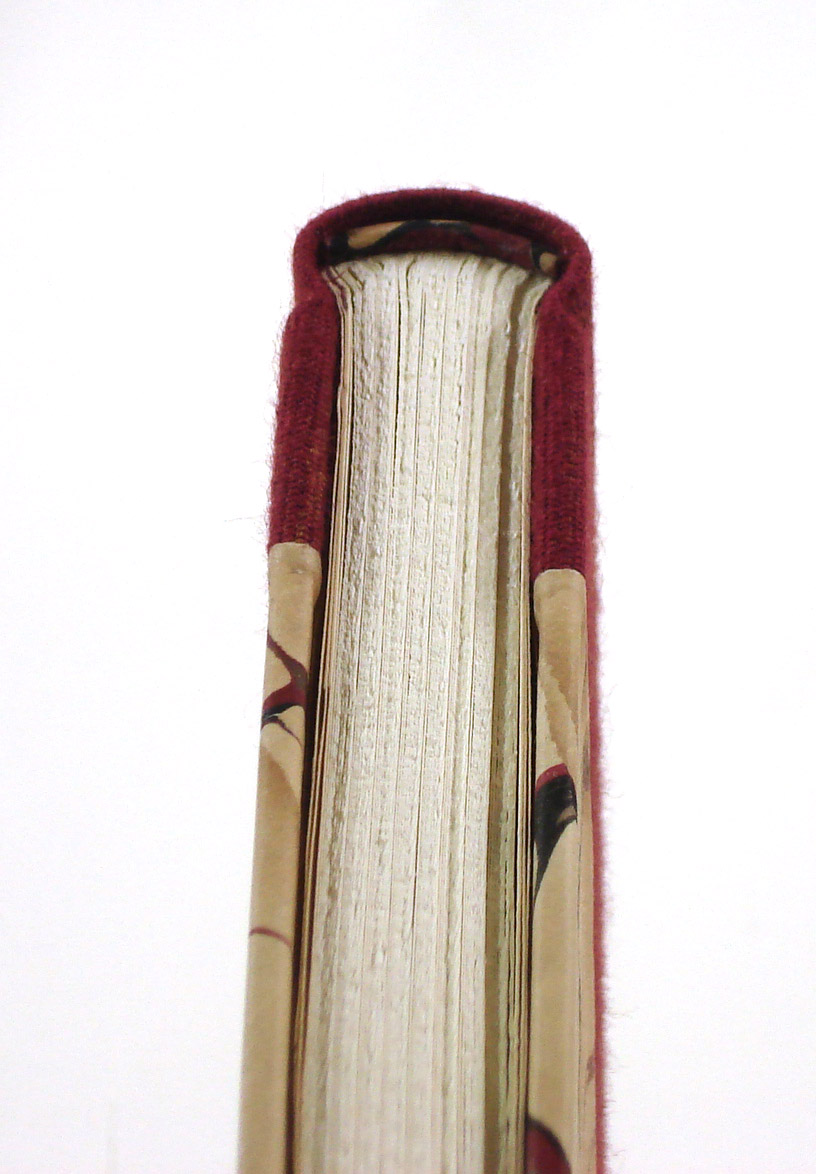
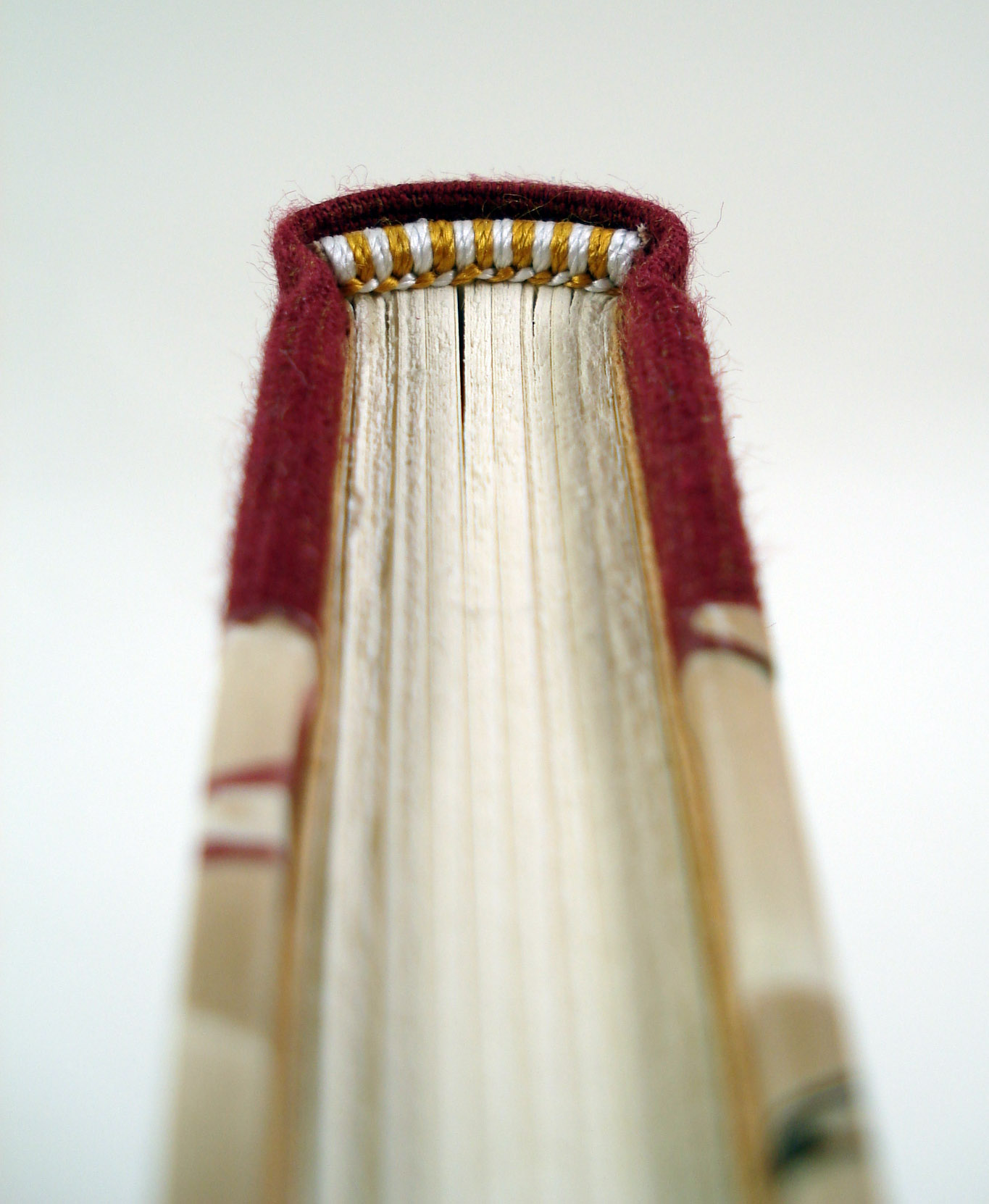
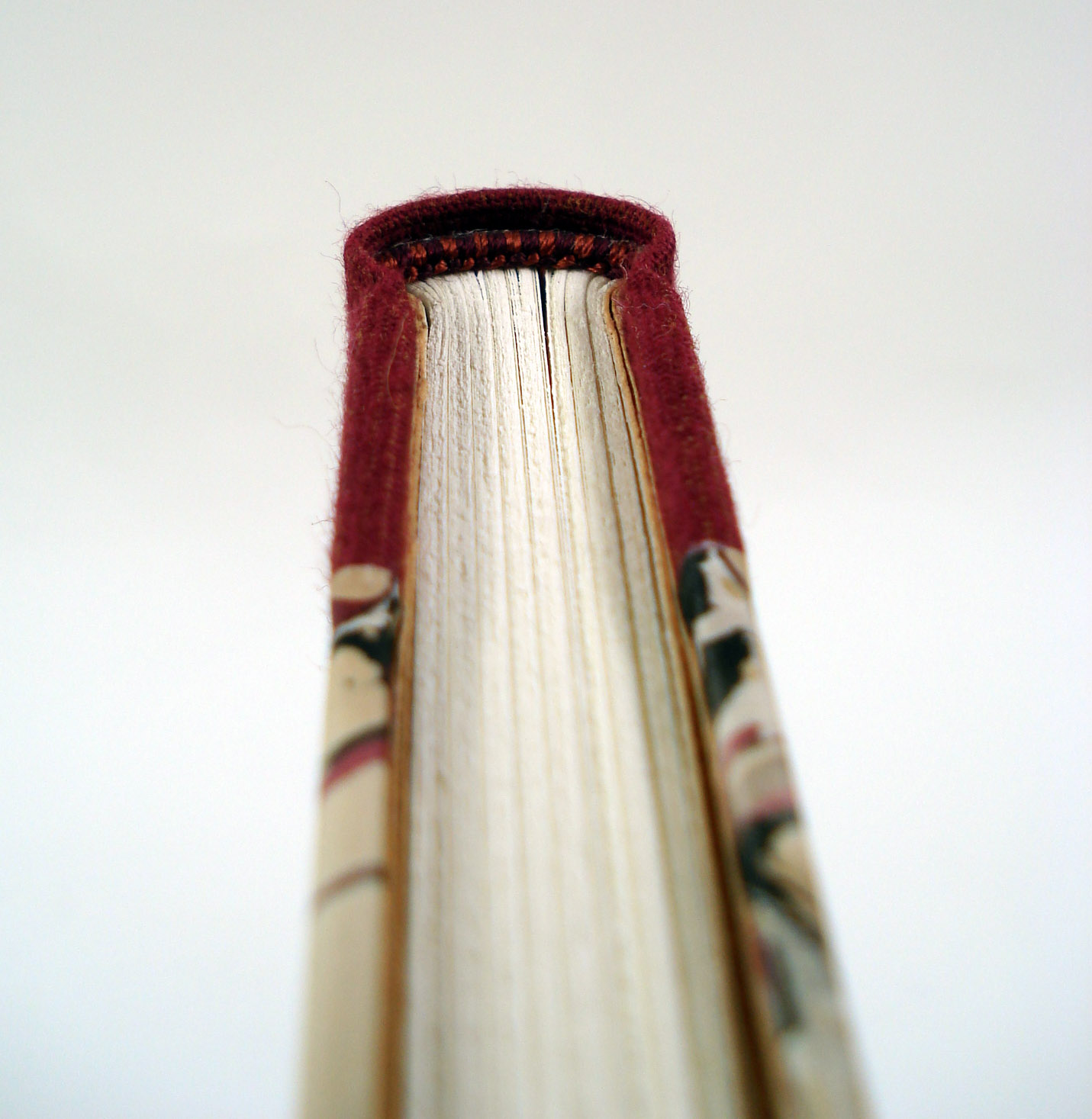
For the sewn endbands, I also tried to keep them as simple as possible. As I said in the last post, a complex endband on a case binding is a bit weird. All of these are two or thee color silk thread on a round leather core. You can find excellent instructions (with diagrams) for sewing these endbands in Jane Greenfield’s book (see bibliography below).


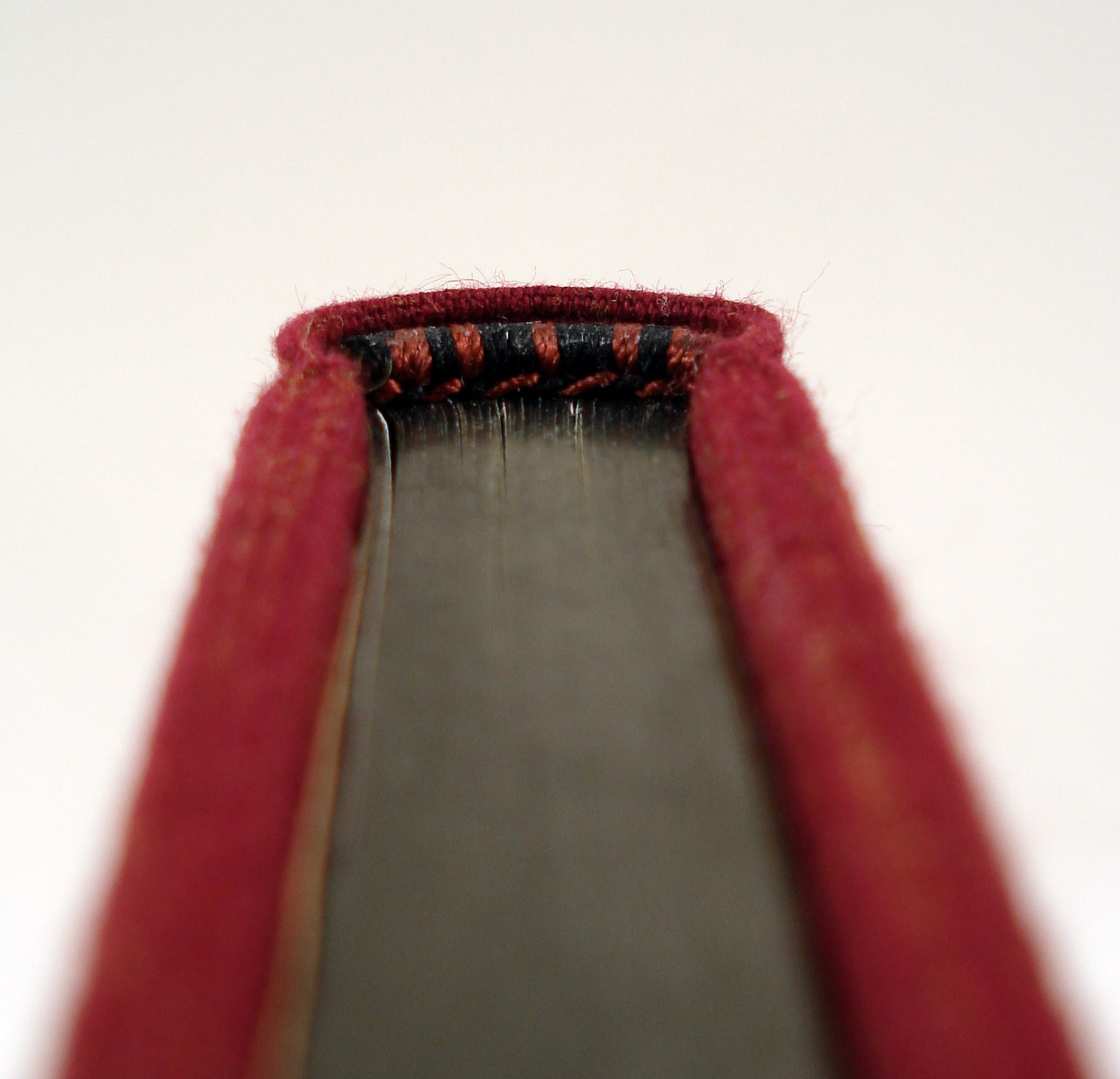
Back in December I shared the process for doing a graphite edge on a book. I only did this for two of my case bindings – mostly just to get a bit of practice.

In each case, I gave them a pretty dark headband.

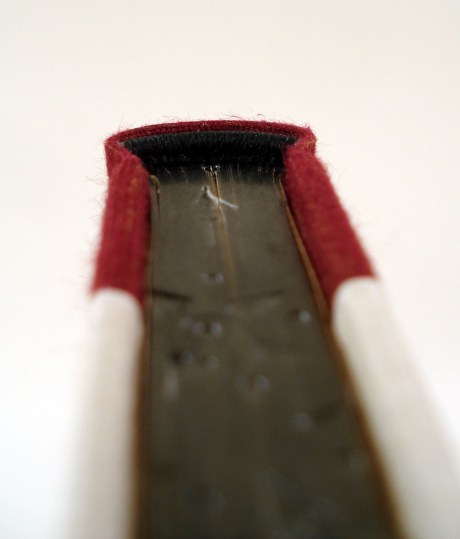
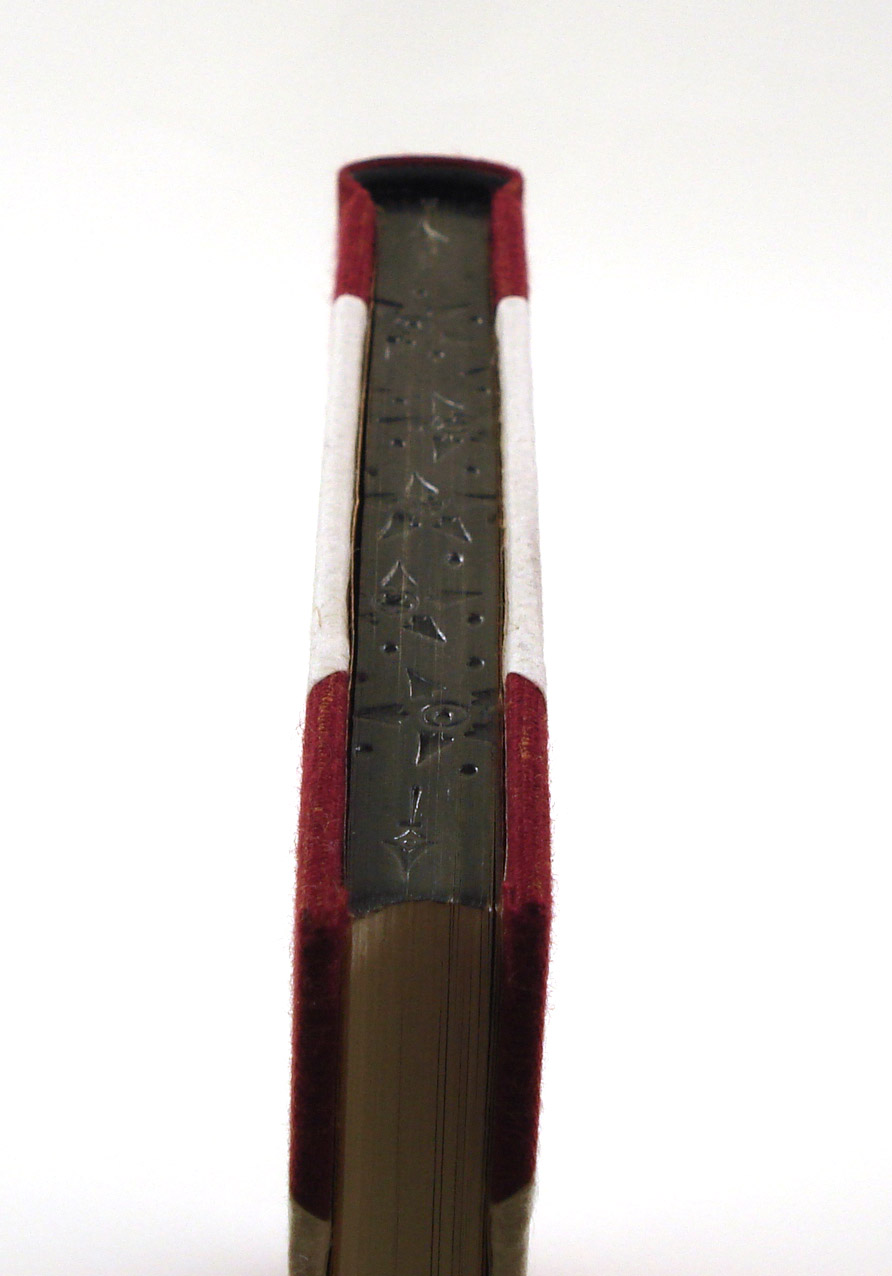
One of those edges is also gauffered or “impressed with finishing tools in repeating patterns” (Etherington & Roberts, 1981). The photo below is not the greatest, but it will illustrate the point.

Endsheet Structures

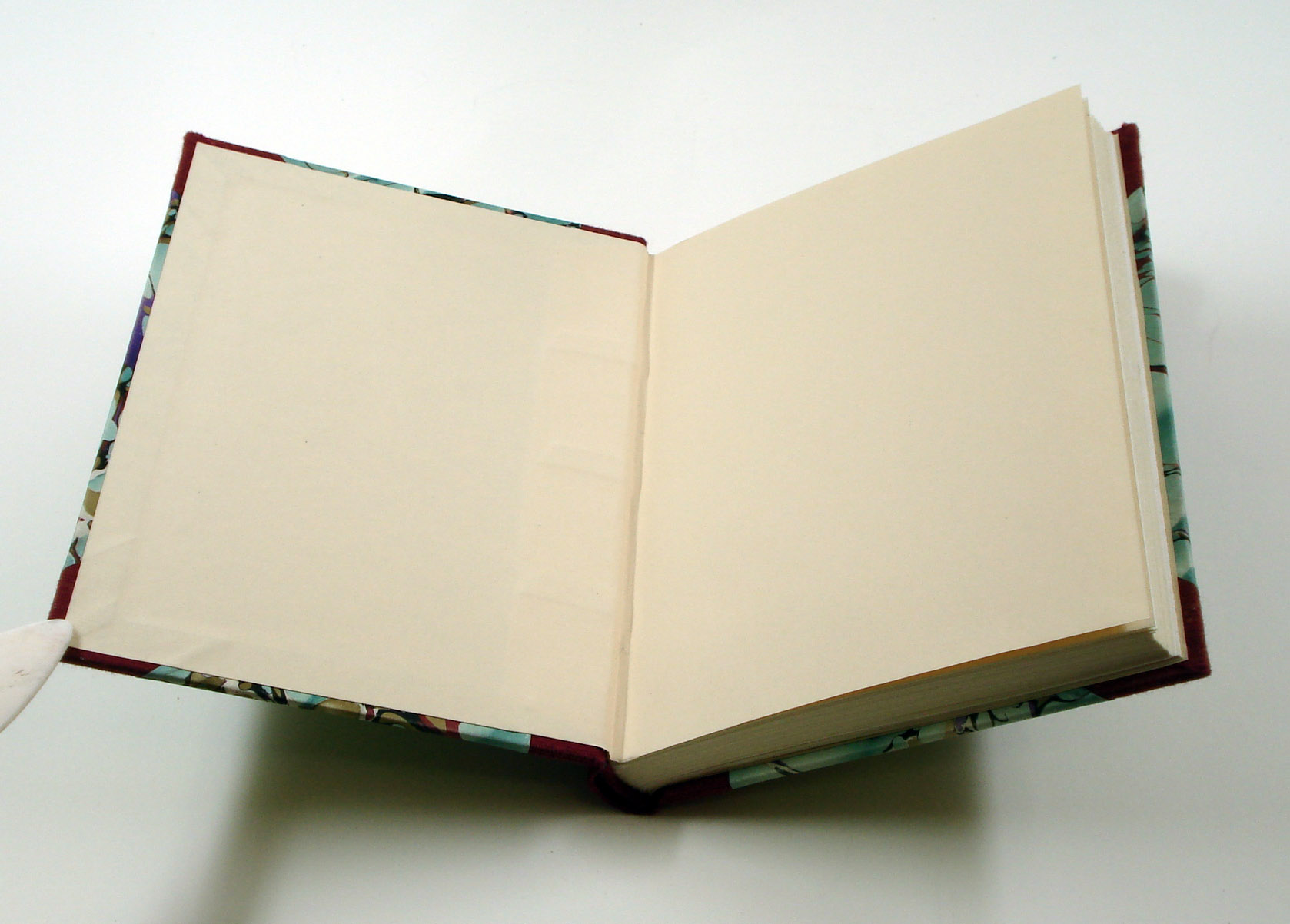
Several different endsheet materials and structures were used in this series of case bindings. Both Johnson (1978) and Middleton (1996) provide excellent diagrams of a variety of endpapers and discuss the relevant merits and shortcomings of each. Of the different papers used as endsheets in this series, the “vellum” shade of the Mohawk (pictured below) was the most plain.

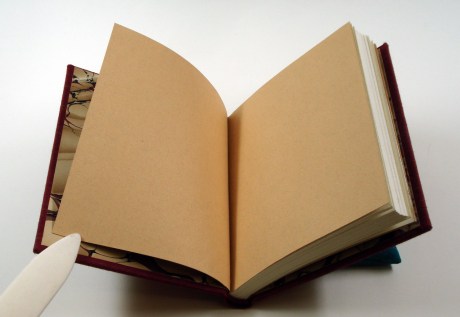
Ingres, a mould made paper with a laid finish manufactured by Canson and Hahnemühle, offered a nicer alternative.

On the full cloth bindings, I tended to go for a marbled endpaper to spruce them up a bit.

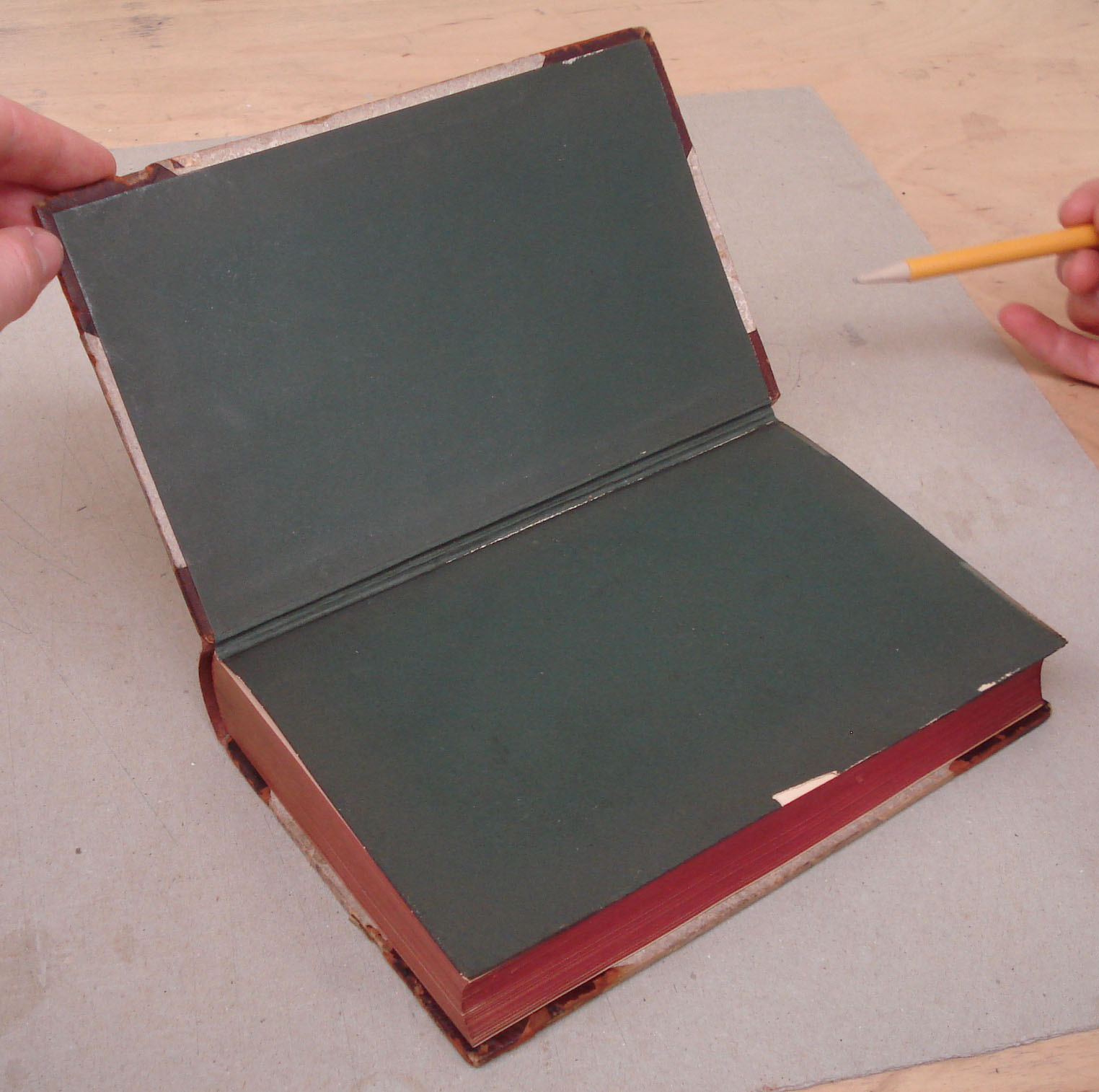
As marbled paper is often discolored on the back, I would use it in a made endpaper. In this form of endsheet, two fly leaves are laminated together to form a stiff leaf.  Here is an example with marbled and mohawk papers.

This one is made with marbled paper and Ingres.

A few of these case bindings incorporate an exposed cloth hinge (of the same cloth as the spine covering) that is incorporated into the endsheet structure. In this case the outer leaf of the endpaper is not pasted down, but a separate paper is put down to counteract the pull of the covering material but does not cover the hinge. I’ve seen this referred to as an “island paste-down” (Smith, 1998, p. 351) – I do not know if Keith Smith or Gary Frost coined the term.

Johnson (1978) includes two rather interesting variations on exposed-cloth jointed endpapers for account books that are “designed for extreme hard wear and durability” (p. 59). Even though these models are rather small and in no way require such a reinforced structure, I thought they were fun to do and looked nice.


Well, that is about all I have to share of interest in the case binding department. I just finished a few new projects and photographed them this weekend, so stay tuned. Up next will be either clamshell boxes or a structure we call onset boards… I haven’t yet decided


You may have noticed that I changed my blog theme to more prominently display my blogroll. Do you have a book related blog or photostream? Comment with your link!


_____________________


Etherington, D. & Roberts, M. (1982). Bookbinding and the conservation of books : A dictionary of descriptive terminology. Washington, D.C.: Library of Congress.

Greenfield, J. & Hille, J. (1986). Headbands : How to Work Them. New Haven, Conn.: Edgewood Publishers.

Johnson, A. W. (1978). Manual of Bookbinding. New York: Scribner.

Middleton, B. C. & Nixon, H. M. (1996). A History of English Craft Bookbinding Technique. New Catle, Del.: Oak Knoll Press.

Smith, K. A. & Jordan, F. A. (1998). Sewn and Pasted Cloth or Leather Bookbinding for Book Artists Requiring No Special Tools or Equipment. Rochester, NY: Keith Smith Books.

Case Bindings, Pt. I

Bookbinding

After spending a good deal of time exploring medieval book structures, the first years fast-forwarded a couple hundred years in bookbinding history to work on case bindings. Case binding is a general term referring to book structure in which the case (covered boards and spine) and book (textblock and endsheets) are prepared separately and later adhered together (Etherington & Roberts, 1981). Both Frost (1982) and Cloonan (1991) indicate that paper case bindings in form or another were popular in Italy and Germany as early as the 17th century; however, the cloth-covered variety that we are producing is very much a 19th century form (Frost). Case binding offers a distinct manufacturing advantage over in-boards structure in terms of mechanized processes, because the covers can be decorated (stamped) flat when they are off the book.

These book structures introduced a few new concepts and techniques to us, including rounding and backing, spine lining, sewn endbands, and hot-stamping. Practice is an important aspect of learning any hand skill, and, because case bindings are quickly produced, we churned out as many variations as possible over two or three weeks. In this first post, I’ll go over the three general types of case binding that we covered, as well as share a model of each that I produced.

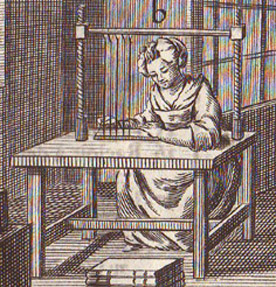
All of our cases did have a few structural aspects in common, in order for us to speed up the sewing by batching textblocks on a sewing frame, as well as to actually feel how different endsheet structures and spine linings affected the way the book opened. These commonalities included using Mohawk Superfine for the text, trimming to the same model size (155mm x 115mm), and sewing all-along on Dutch-style linen tapes. Doing this allowed us to speed up the sewing by batching textblocks on a sewing frame. It also allowed us to actually feel how different endsheet structures and spine linings affected the way the book opened. Sheets of mohawk are rough-cut, folded into sections, pressed, and sewing stations pierced as I described in my post on Sewn Board Bindings. After rigging up a wooden sewing frame with tapes, we sewed six or so textblocks at a time – making sure to dress in traditional 18th century bindery-girl garb as we were doing it.

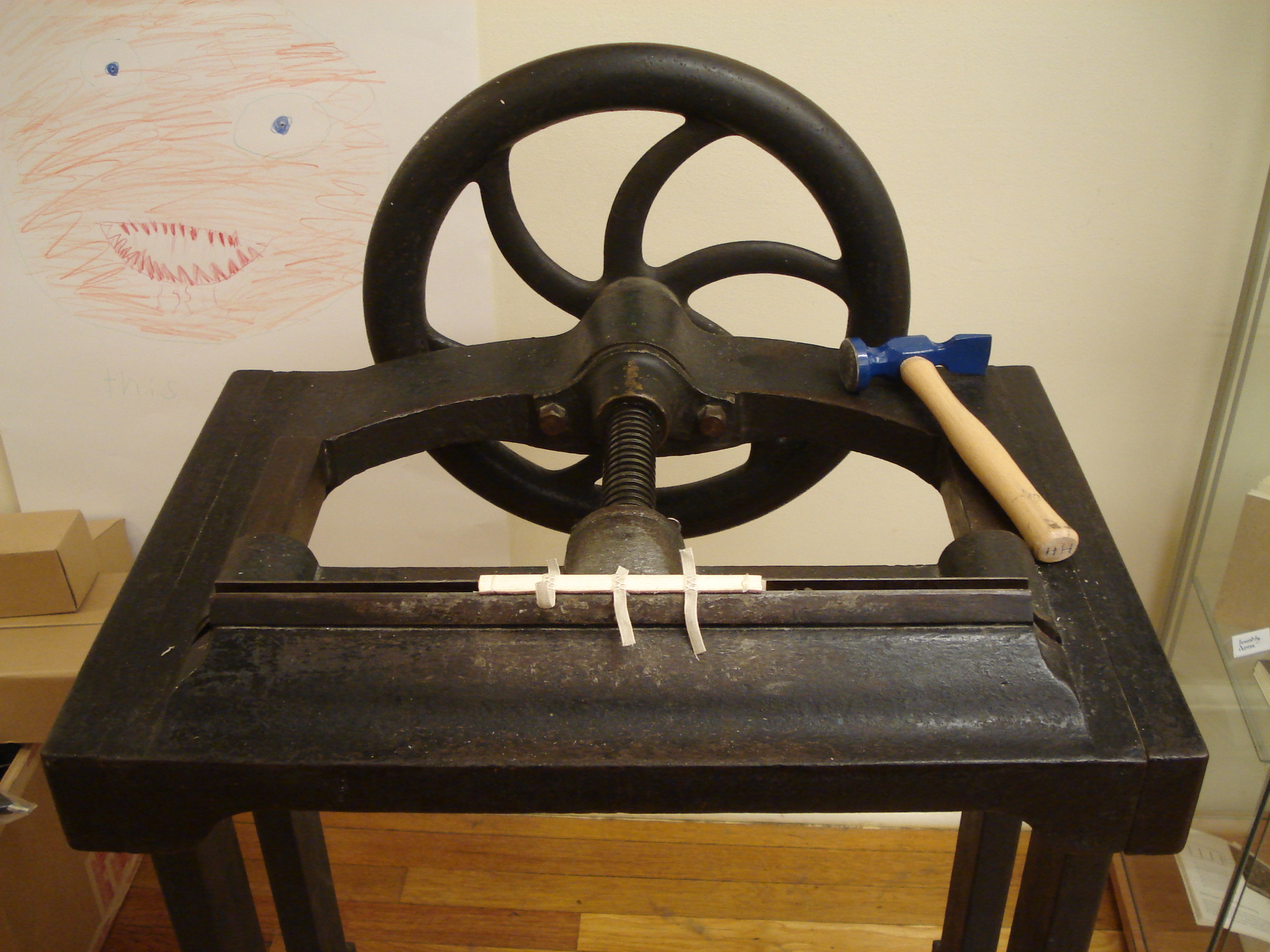
The textblocks are then squared up flat on a table with the spine overhanging the edge and a small weight to hold the book block in place. Hot animal hide glue (a rather pungent, water-soluble protein adhesive) is then applied to the spine. The adhesive is worked into the little “valleys” between sections and any excess glue is wiped off of the spine with a cloth. When the hide glue is dry enough to firm up, the textblock is gently rounded with a hammer. Rounding the spine of a book allows for the even distribution of the swell from the sewing thread and keeps it from eventually going into a concave round (Young, 1995). The rounded textblock is then placed in the job backer for backing, being careful to align it properly and evenly. The picture below shows off the department’s rather handsome cast-iron job backer, and features a portrait gracefully donated to the bindery by Jeff’s son.

Young (1995) rather concisely describes the purpose of backing as to “set the rounding and to distribute the remainder of the swell, and at the same providing shoulders to accommodate the thickness of the boards to be used in making the cover” (p. 102).

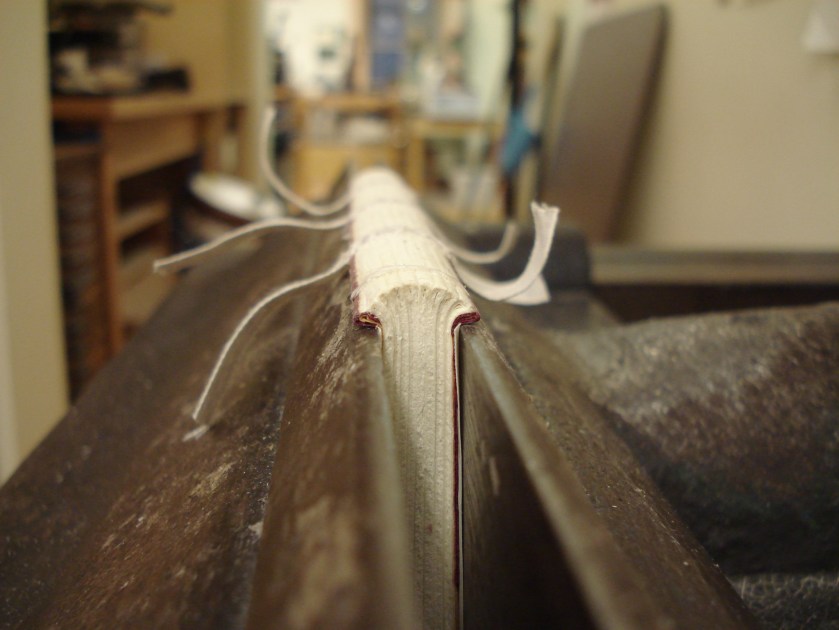
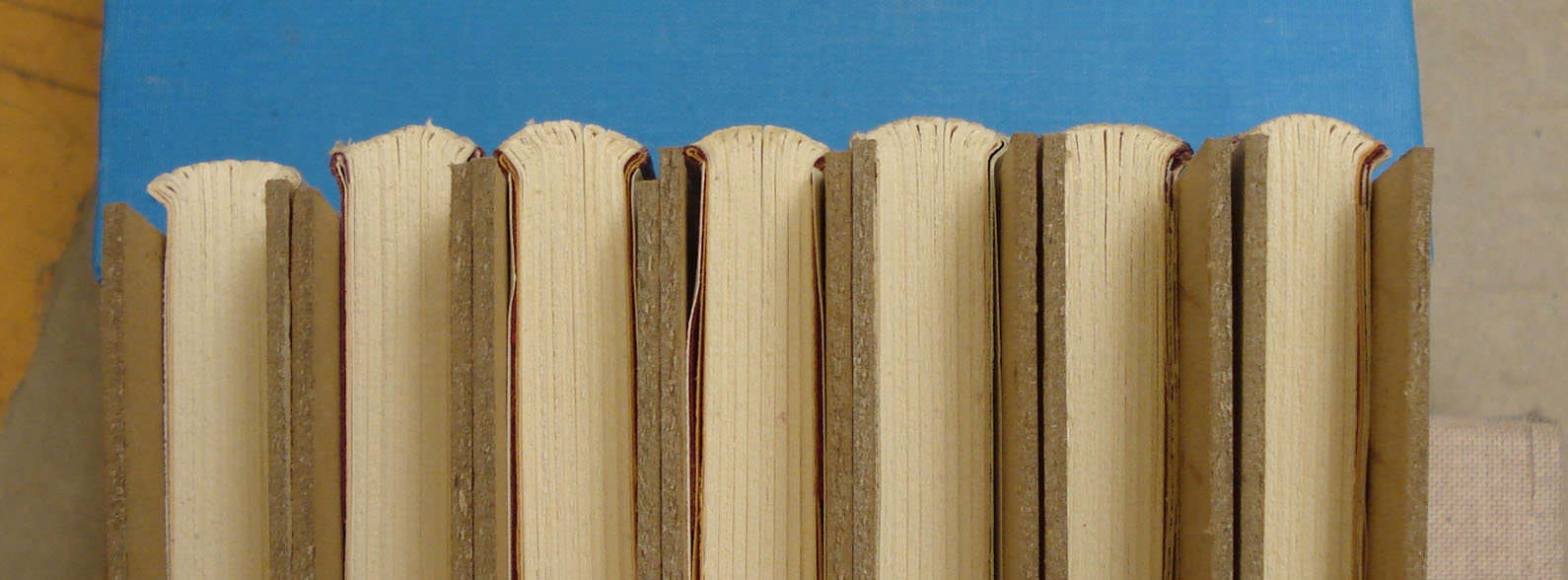
The backing job required depends upon the type of binding desired. There is plenty of excellent literature out there that describes how to successfully back a book for its intended function – so I will leave the subject well alone here. Besides, I’m not one to talk about quality rounding and backing; for every 10 backing jobs I do, only one or two look halfway decent. Just look at the set of seven below.

When the book is backed and dry, the endbands are put on and the spine is lined with various combinations of textile and paper. Spine lining is also a rather complex subject that I will not try to tackle in this post – but if you’d like to read more about it, I really enjoyed Tom Conroy’s 1987 paper on the movement of the book spine from the Book and Paper Group Annual (found here).

We focused on three styles of case binding: the built-in groove, the flat-back, and the pressed-in groove.

Built-in Groove

The built-in groove case is composed of two boards and a thin spine stiffening strip that are joined by strong paper before the case is covered. Peter Verheyen (2002) also calls this structure a Bradel binding and indicates that this method of case construction is particularly suited for amateur binders because it easily allows for a precise fit to the textblock. You can read the revised version of his paper describing the structure (including some very nice illustrations) here. For the first few models that I made, I tried to make use of scrap book cloth and siding up material – that way, in the event of an irreparable mistake, I could just toss it without feeling like I was wasting materials. This resulted in a rather strange combination of materials – one of those being the amusingly gaudy number pictured below.

This one has 2-color sewn silk endbands (bead on the front) on a kind of tall, square leather core. I admit, these are a bit too much on a lot of levels. Sewn endbands on a case binding are kind of like putting spinning rims on a $500 minivan: they might look nice, but why go to all the trouble.

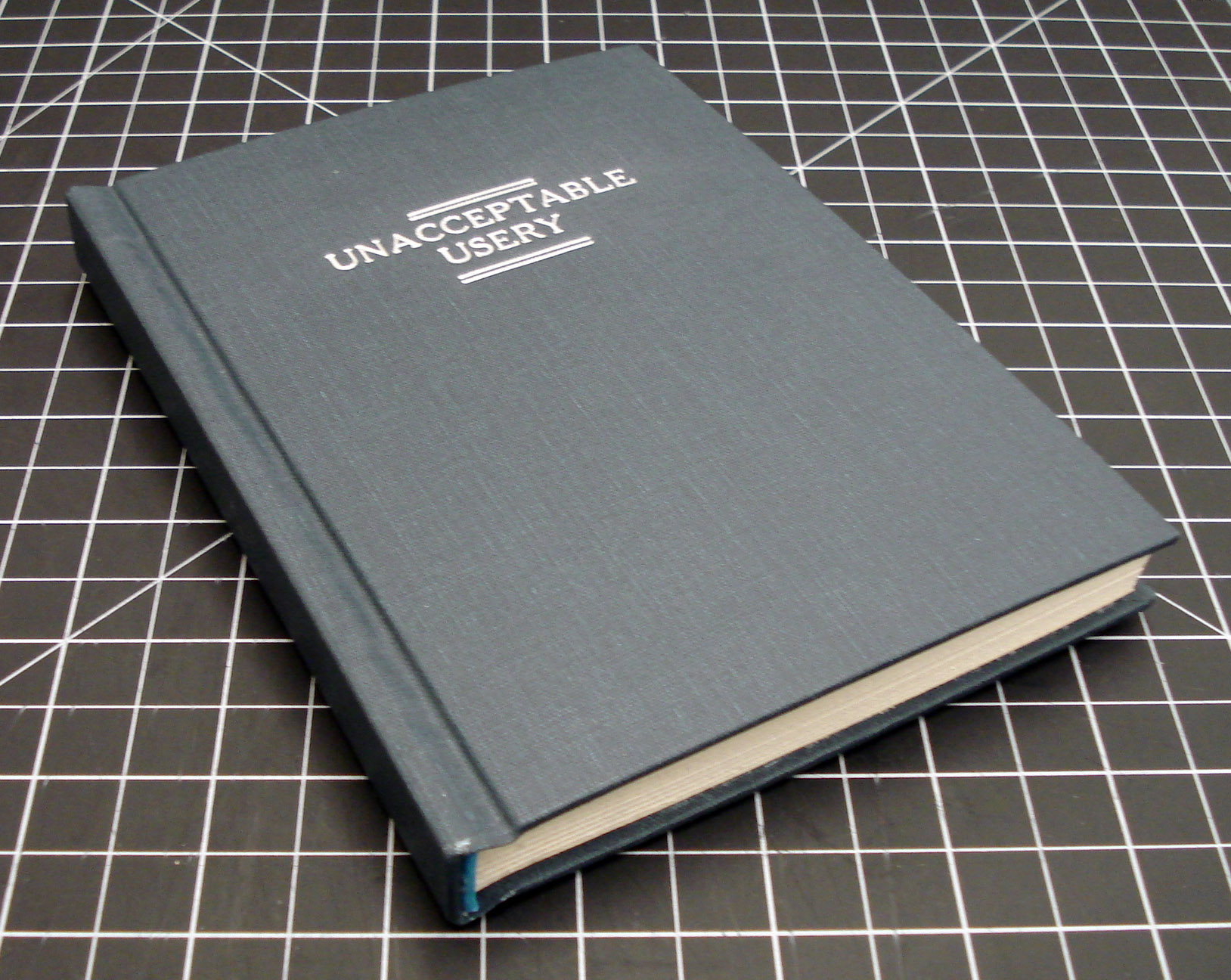
For this book, I also made my first attempts at foil hot stamping with the Kwikprint. I made sure to choose an italic sans-serif typeface to build upon the terrible “wow-factor” of the endbands. Getting a clear impression that is actually straight down the spine turned out to have a pretty high learning curve. And as you can see, I didn’t quite pull it off on this one.

But as monstrous as this book turned out to be, someone must have liked it, because it ended up selling at one of our fundraisers. Hopefully it will age well.

Flat-Back

The second style of case that we made was the flat back. For this structure, the spine is glued and lined without rounding so that it remains flat and the case is constructed with a piece of board as the spine piece. Unlike the pressed-in groove binding, the boards and spine piece are assembled as the case is covered. The groove is then pressed in with brass-edged boards. The example below has stuck-on endbands of rolled bookcloth and silver stamping on the front cover.

I should say that I find it pretty difficult to come up with anything witty or interesting to stamp on these blank models. The only way I am going to learn is to stamp as much as possible, however. So instead of wasting my time trying to be creative, I realized that I can rely on the ancient art of bibliomancy to “divine” my titling. The process goes like this: grab the largest dictionary, encyclopedia, or sacred text you have at your disposal. We have an absolutely massive unabridged Webster’s in the bindery that worked out rather well for this. Lay the volume, unopened, on a table. After performing an invocation/sacrifice or pouring a libation to the deity of your choice, close your eyes and, as the “spirit” moves you, open the book and place your index finger on a page. I would either pick the closest adjective/noun combination to the spot on the page or perform the operation twice to get a suitable adjective and noun.  I had a pretty expansive list of titles after about 10 minutes of using this method.

Pressed-in Groove

The last version of the case binding that we made was the pressed-in groove. This structure combines a couple different aspects of the methods of assembly for the other two. In this case binding, the textblock is rounded and backed and the case makes use of a thin, flexible spine stiffening strip like the Bradel; however, the case is constructed as it is covered like the flat back. Brass edged boards are used in the press after casing the textblock in to give it that nice French groove. The most exciting model that I made was the one I like to call “The Bulletproof Book”.

This one is covered in a paper-backed ballistic nylon bookcloth called Techno. Unfortunately, Techno has been discontinued by the manufacturer, but you can still get small quantities through Talas. This stuff is pretty crazy – it’s tough to cut and impossible to stamp. Techno does fray out very easily, so after covering the corners at the fore-edge, I had to burn the exposed edges of the cloth with a lighter to seal them up. This cloth has a very pronounced texture that, after casing in, gets pressed straight through the pastedown. But it is shiny and feels rather nice in the hands.

I’m pretty sure this would stop a small handgun – but of course I’ll have to wait for the field test results before I start marketing books as body armor.

That’s all for my general overview. Next time I’ll share photos of a series of more “polished” case bindings.

_____

Cloonan, M. V. (1991). Early bindings in paper : A brief history of European hand-made paper-covered books with a multilingual glossary. Boston, MA: G.K. Hall.

Frost, G. (1982). Historical paper case binding and conservation rebinding. The New Bookbinder, 2, 64-67.

Roberts, M. & Etherington, D. (1982). Bookbinding and the conservation of books : A dictionary of descriptive terminology. Washington, D.C.: Library of Congress.

Verheyen, P. D. (2006). German case (Bradel) binding. Skin Deep, 22, 2-7.

Young, L. S. (1995). Bookbinding & conservation by hand : A working guide. New Castle, Del.: Oak Knoll Press.