Return of the ‘Kettenstichheftung’

Bookbinding

As Boston is currently being pummeled by snow, I figured it best to stay inside and catch up a bit on my bloggin’. Ever since we first tried out some variations on limp medieval structures back in October, I’ve been meaning to revisit them using materials that are a little more refined than paper covers and laminated skin spine plates. I went back through the chapter on limp structures in Szirmai’s (2000) Archaeology of Medieval Bookbinding as well as Pam Spitzmueller’s article on long and link stitch structures (GBW Journal, 2000)  for some inspiration from historical examples. It seems in any of the literature on this type of structure, one inevitably finds images of two particularly fine examples from the Herzog August Bibliothek in Wolfenbüttel (pictured left and center below).
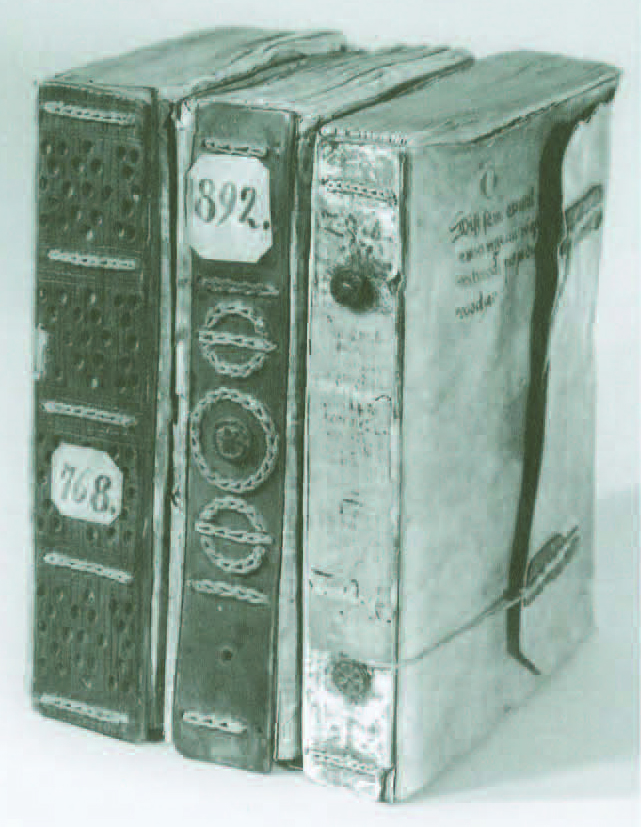
Loubier (1926, p. 9)  describes these structures as “Kettenstichheftung”, and Szirmai (2000) indicates that they amount to about 40% the total number of medieval volumes with rigid back plates dating from 1375 to 1500 surveyed in the literature (p. 299). These volumes are nearly all literary manuscripts on paper, covered in course parchment that is cut flush with the textblock. Some uncommon attributes include covers lined with paper, limp leather coverings, or leather edging.  Analysis of these structures has determined that the “equal number of chain links at each sewing station could be obtained by alternately omitting linking at the intermediate stations” (Adam, 1910). This sewing pattern is exactly as Larsson demonstrated in his 2004 presentation at Standards.  Szirmai states that “some chains are not functional but are solely decorative: the circular and two of the perpendicular chains on HAB Cod.Guelf.892 Helmst. (see Figure 10.12 [centre]), are chain stitches ’embroidered’ onto the back plate before sewing” (p. 299).

There is something quite satisfying about the sewing pattern in the center binding above (no. 892) and it has inspired a number of contemporary variations – including this one by Dominic Riley.
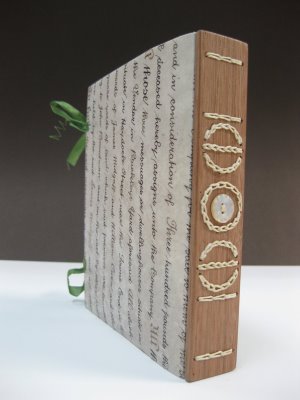
The fact that the circular sewing is not part of the structure makes the whole operation quite a bit easier; however there is still some planning that must go into mapping out the stations. While the original is done with a horn spine plate, I made a variation on this structure with a maple spine plate and goatskin parchment covers. As the width of my piece of maple was somewhat narrower than the horn used in the original, I decided to use the dimensions of my original spine piece as the basis for my final model size, rather than attempt to make an exact duplicate. There are quite a few holes to drill for this sewing pattern, and to ensure that I got it right, I first worked the pattern out to scale on paper.

As you can see, I’ve shifted the alignment of the 2nd and 5th sewing stations in order to make a more even spacing in the pattern for my model – with the kind of long and skinny dimensions of this book, it just looked better to me.   Next I went ahead and made a model of the spine plate with binder board covered in paper to check that the pattern looked alright with the rather thick size of thread (18/5) that I intended to use.
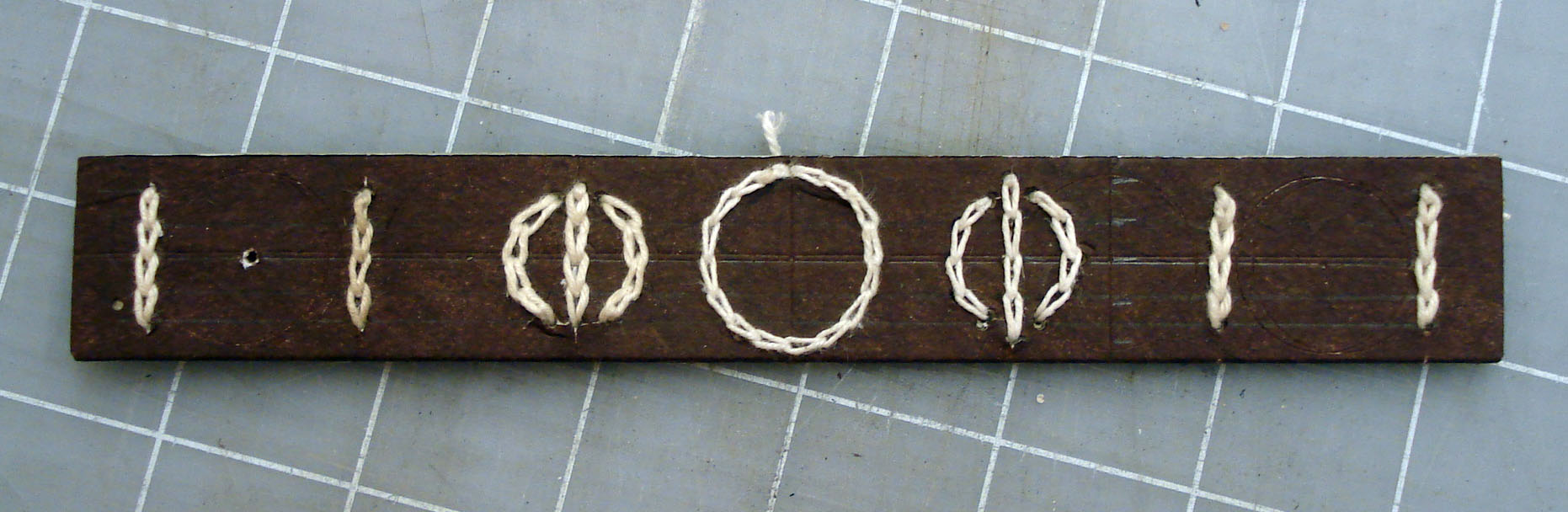
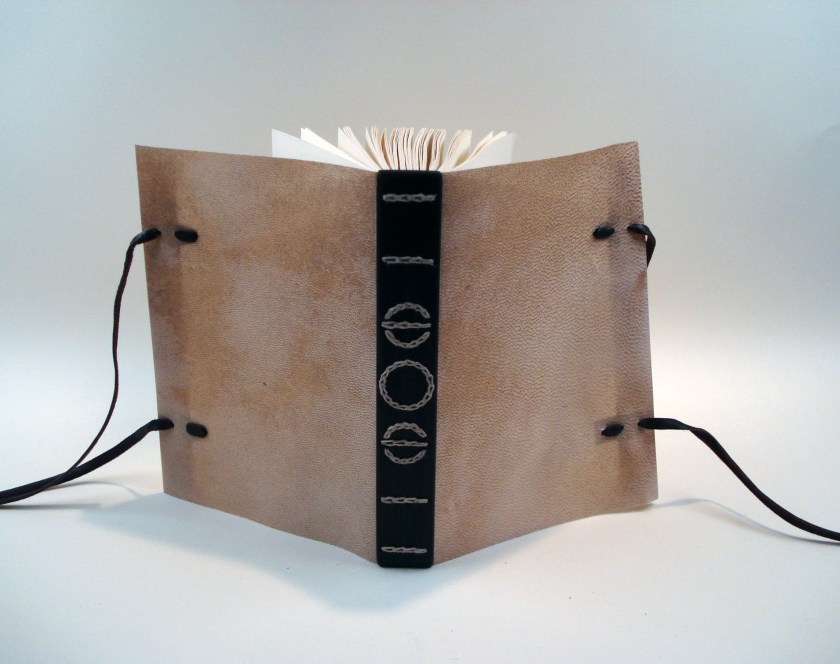
Taking the time to make this ‘dummy spine’ actually worked to my advantage, because once I had checked the layout, I just used it as a jig to punch the parchment cover and mark the wooden spine plate for drilling. When the spine plate and cover were ready, I stitched them together along the circular parts of the pattern. Paper sections were then folded, trimmed to the height of the spine piece, pierced with 6 stations, and attached to the cover via the straight chain sewing of the pattern using Larsson’s method. The final product looks like this:
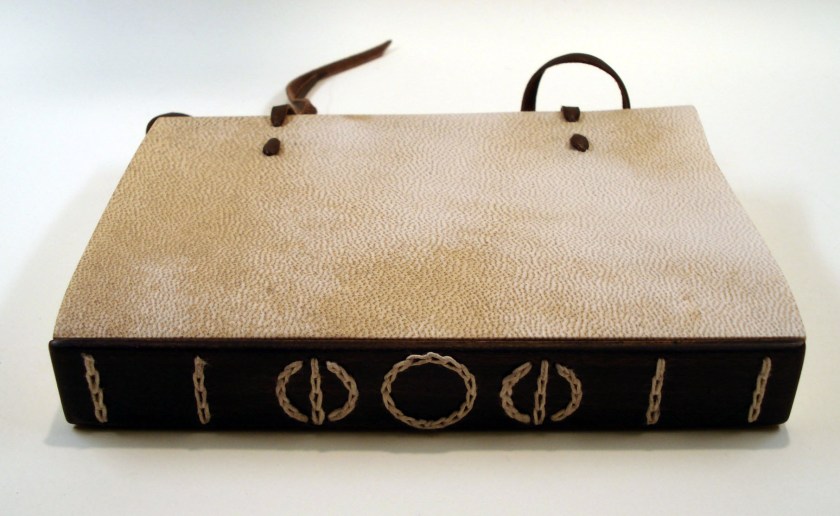
The small sheet size and relative thickness of the paper, coupled with the rigid spine plate, make the opening of this book is kind of stiff but quite strong.

As for the fore-edge treatment: in the photographs of the original, it looks like there were, at one time, buttons attached to the spine plate. I can only assume that there is/was a fore edge flap with ties that once attached to the buttons to hold the volume closed, however I could not find a decent photo of what is actually going on there. Szirmai includes diagrams of a few variations on leather ties for limp structures, and I decided to go with a three-hole structure (listed as 3a in the diagram below) that offers a simple outward appearance.
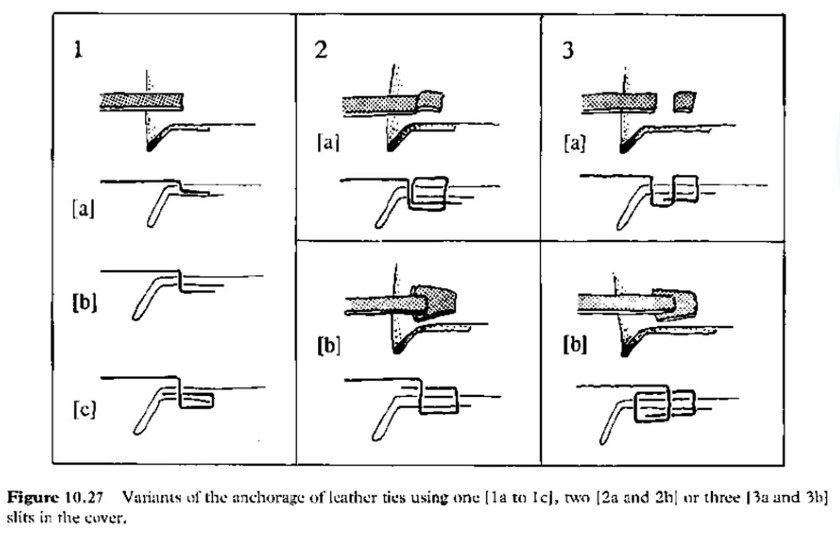
The diagrams appear to illustrate the leather tie lacing through slots in the covers, but I found that after mechanically softening the leather, the lacing looks a bit neater when done through rounded holes. This also keeps the parchment from splitting or tearing at the edges of the slot.

The structure of the tie also holds the simple turn-ins of the stiff parchment together.

References:

Adam, P. (1910). Die altesten heftweisen und ihr Kirfluss auf die jetzt ubliche Heftweise, Archiv fur Buchbinderei, 10, 73-6.

Loubier, H. (1926). Der bucheinband von seinen anfangen bis zum ende des 18. jahrhunderts zweite, umgearbeitete und vermehrte auflage. Leipzig: Klinkhardtand Biermann.

Spitzmueller, P. (2000). Long and link stitch bindings, Guild of Book Workers Journal, 35 (2A) 86-112.

Szirmai, J. A. (2000).  The archaeology of medieval bookbinding. Aldershot, Hants. ;: Ashgate.
Points of Interest

Bookbinding, Fieldtrips

First off, I’d just like to apologize for being such a negligent blogger. The last month has been rather packed with projects, and although a lot has been happening, I have been too preoccupied to share any of it. Therefore I’ll try to give you, the gentle reader, all the highlights in one post. I’ve been listening to way too much This American Life recently, so this installment is organized into three acts.


ACT 1: MARKING TIME

In early November, we took our first field trip up to Dartmouth College. Deborah Howe, the collections conservator, invited the bookbinding department up to Hanover to tour the library’s conservation lab and to assist in the unpacking and installation of the Guild of Book Workers Marking Time Exhibit.

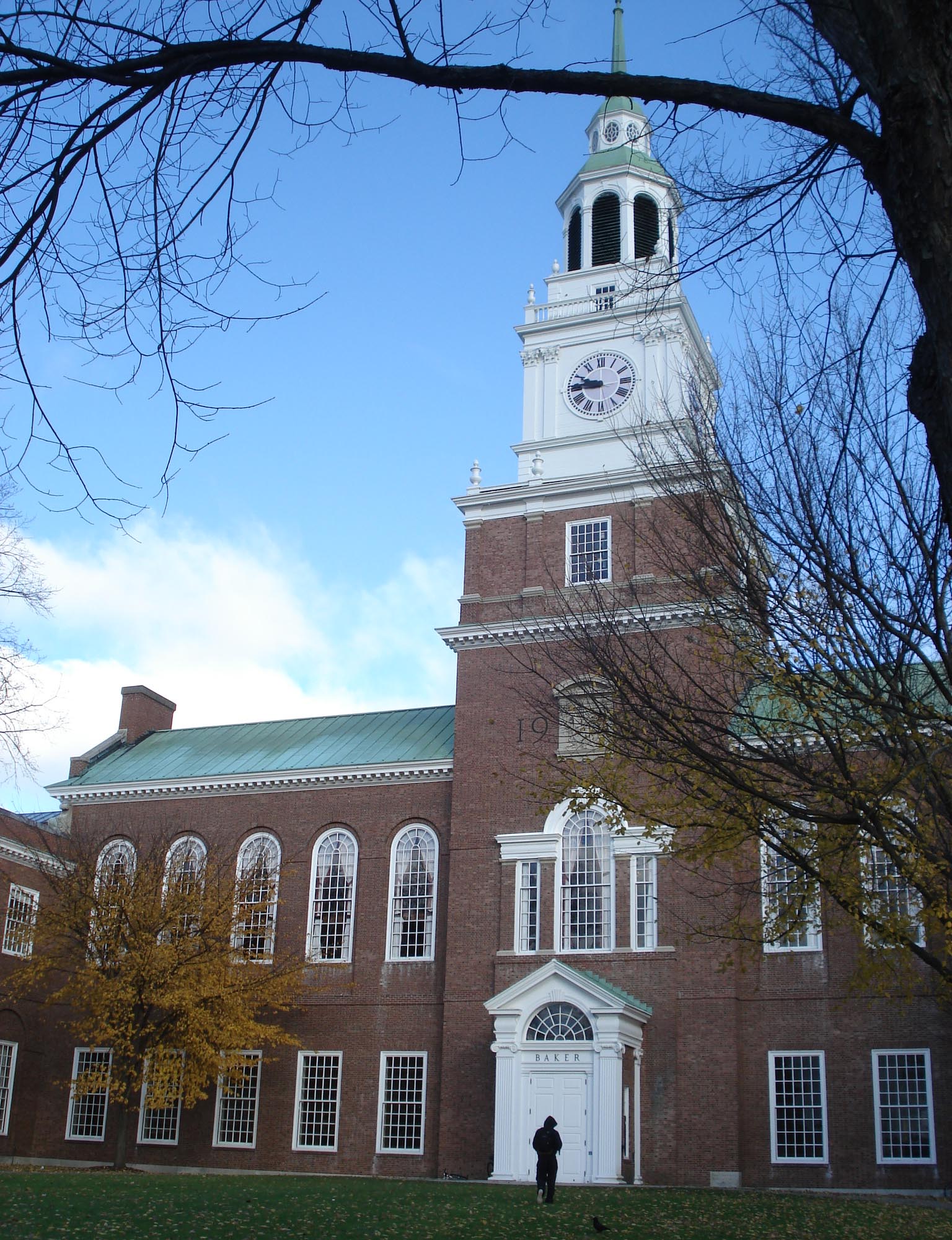
Dartmouth’s campus is stunning and we arrived just in time  to see the changing leaves at the height of their transformation. As a southern boy, it is somewhat surreal to be encircled by such intense New England “Autumn-ness”; The old brick buildings and foliage are just so picturesque that they seem fake sometimes. Regardless, the Baker-Berry library building itself is as excellent inside as out; in addition to the well-placed exhibit spaces, the reserve corridor of the library houses Jose Clemente Orozco’s mind-blowing mural The Epic of American Civilization. We were also quite impressed with the size and adaptability of the lab space in Preservation Services.

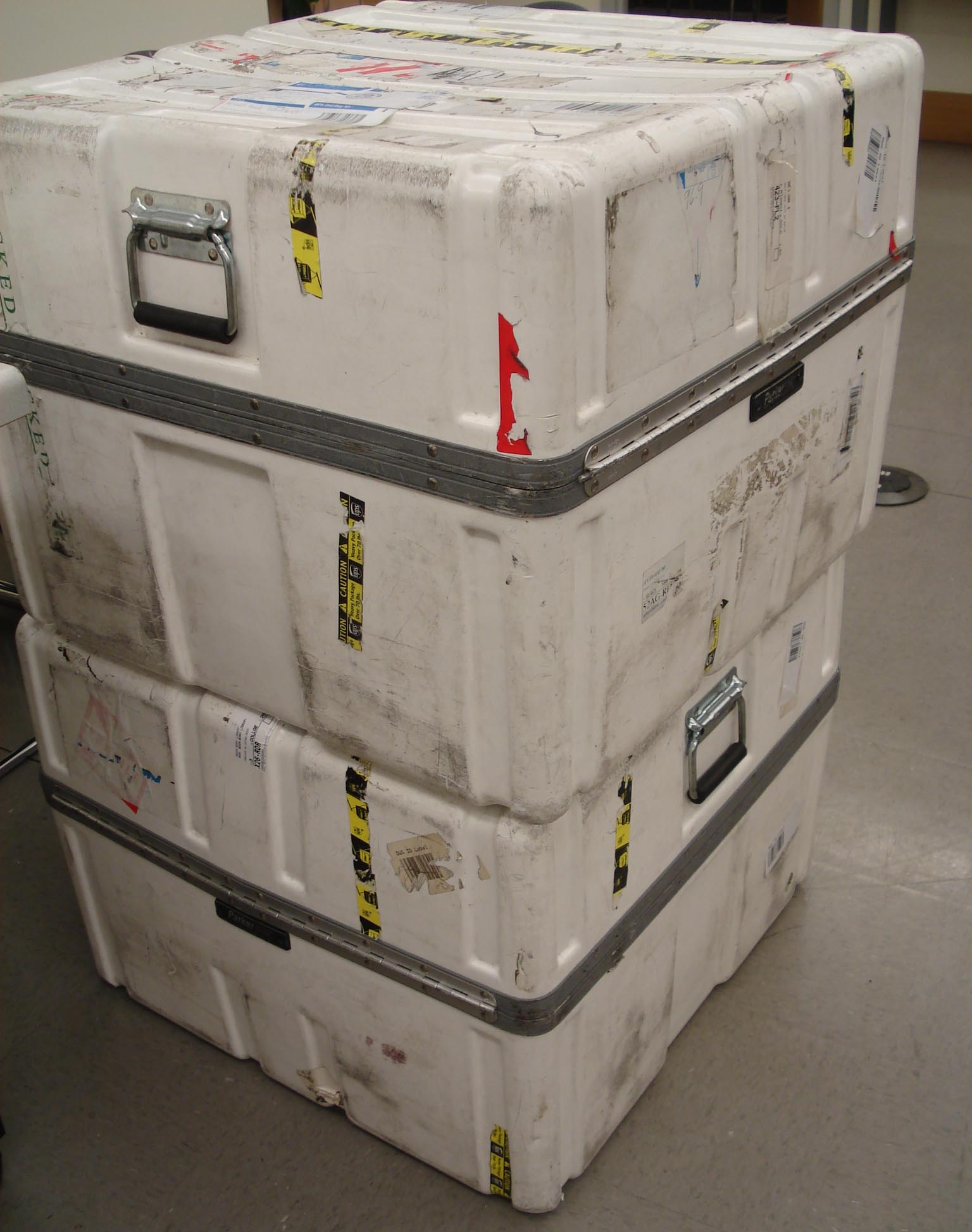
Shortly after our arrival that morning, the exhibit was delivered in three large crates.

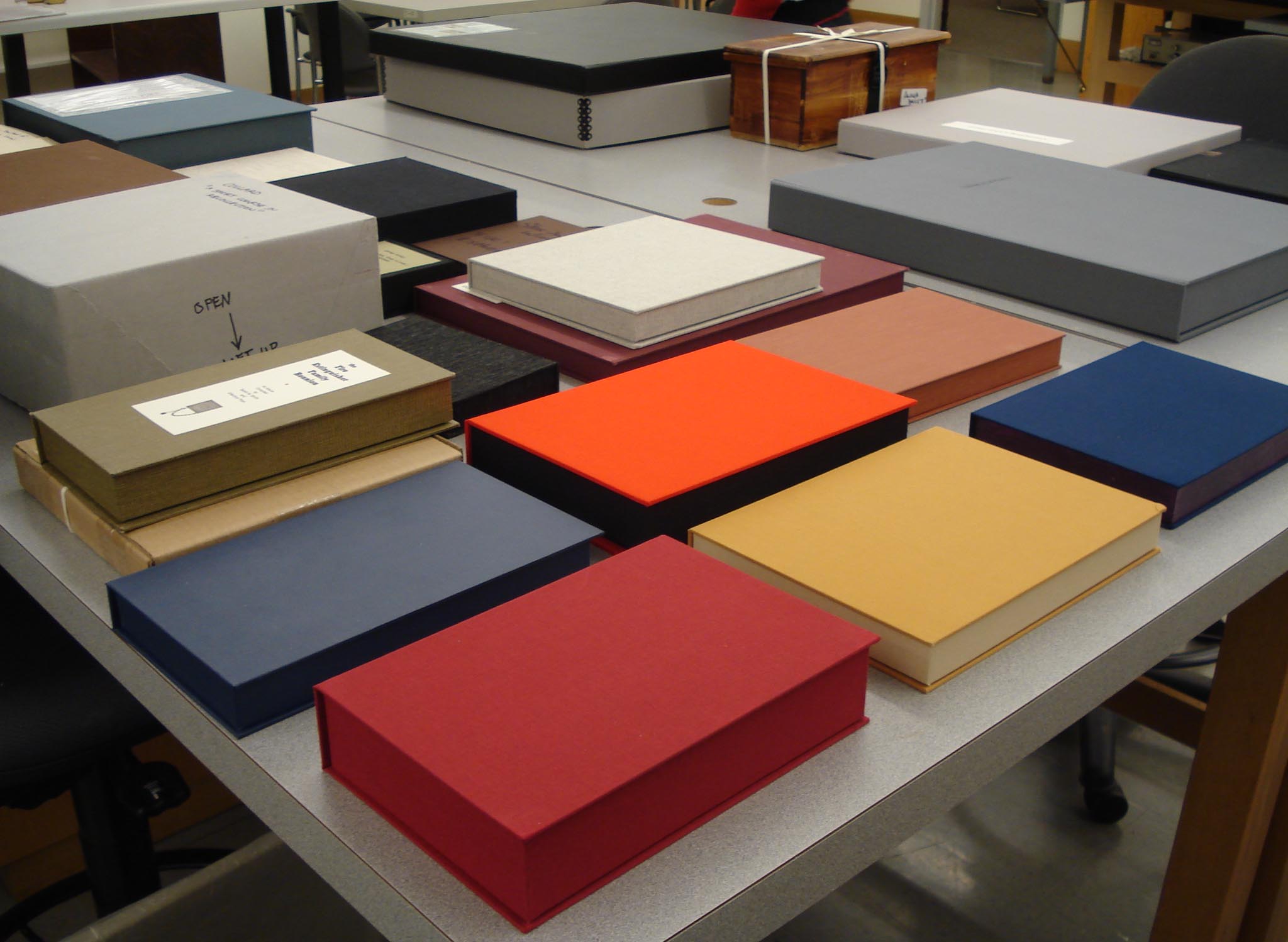
After unpacking the contents of the crates, we arranged them alphabetically by artist on several large tables in the lab. Each exhibit book comes in its own custom enclosure with a condition report and detailed instructions for its display. We broke up into teams and documented the condition of each exhibit item before transferring them to the secure exhibit cases. There are around 50 items, of various shapes and sizes, in this traveling exhibit. To give you an idea, here is about half (in their individual enclosures) spread out on two tables. For excellent photographs and descriptions of the books themselves, please visit the exhibit website.

I really enjoyed the opportunity to experience the behind-the-scenes aspects of a traveling book exhibit. There are so many logistical challenges involved in unpacking and repacking a large group of delicate and valuable items, and it was fascinating to see the solutions employed by the organizers of the show. For example, after determining the best way to pack 50 oddly sized boxes securely in three crates, how does one ensure that they are repacked the same way as the exhibit travels through the eight locations on the exhibit schedule? In this case, each crate included a detailed packing list as well as printed photographs of each layer of boxes and packing materials as they should be placed in the crate.  Taken with the packing instructions by each book artist, every step in the packing process is well documented.

In addition to working on the exhibit, our field trip included a brief tour of the Book Arts Program facilities and the opportunity to handle some high spots from the rare book collection. The special collections at Dartmouth are stored in an amazing climate-controlled glass cube!

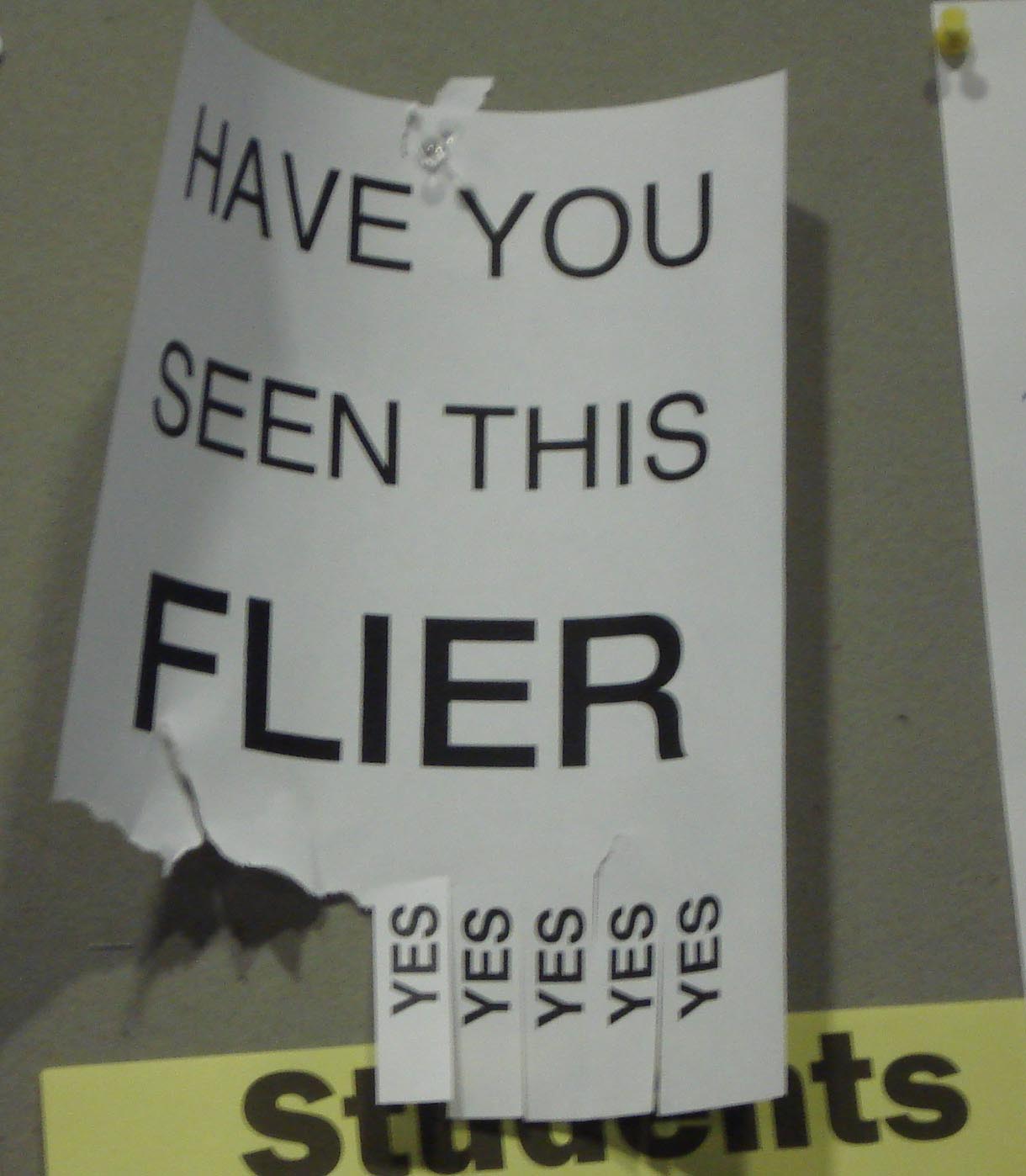
But aside from book things, as we wandered through the campus I managed to snap some photos of two particularly amusing examples of Dartmouth student humor. The first is an re-imagining of the Dartmouth shield by an anonymous artist on the white board of an empty classroom.

The other is a flyer posted on a bulletin board in the cafe area of the library.

All in all, our outing was an amusing and edifying experience. Special thanks to Deborah Howe and Jay Satterfield for taking the time to make our trip so enjoyable!


ACT 2: GRAPHITE EDGES

As I may have mentioned before, one of the current projects in the first year is an “edition” of 12 case bindings that exhibit common materials but very in case style, endpaper structures, headbands, stamping, and edge decoration. I should be finishing this set this week, and will post pictures soon. In the meantime, I wanted to share some edge decoration that I think is very cool.

With a bit of nagging, we got Jeff to demo the proper operation of the plow and edge treatment with graphite. The plow is a device used for trimming a very smooth edge on the textblock. Etherington and Roberts describe the plow as such:

“It consists of two parallel blocks of wood about 4 inches wide and 8 inches long connected by two guide rods and one threaded rod, with a cutting blade attached to the lower edge of one of the blocks. The left hand part of the plow fits into a runner on the left cheek of the lying press, while the other block is fitted with the adjustable knife. The knife is generally moved inward by the turn of a screw, cutting into the leaves as the plow is moved back and forth.” (under “Plow“)

At NBSS, we have a very nice plow and lying press made by Timothy Moore, much like this one:

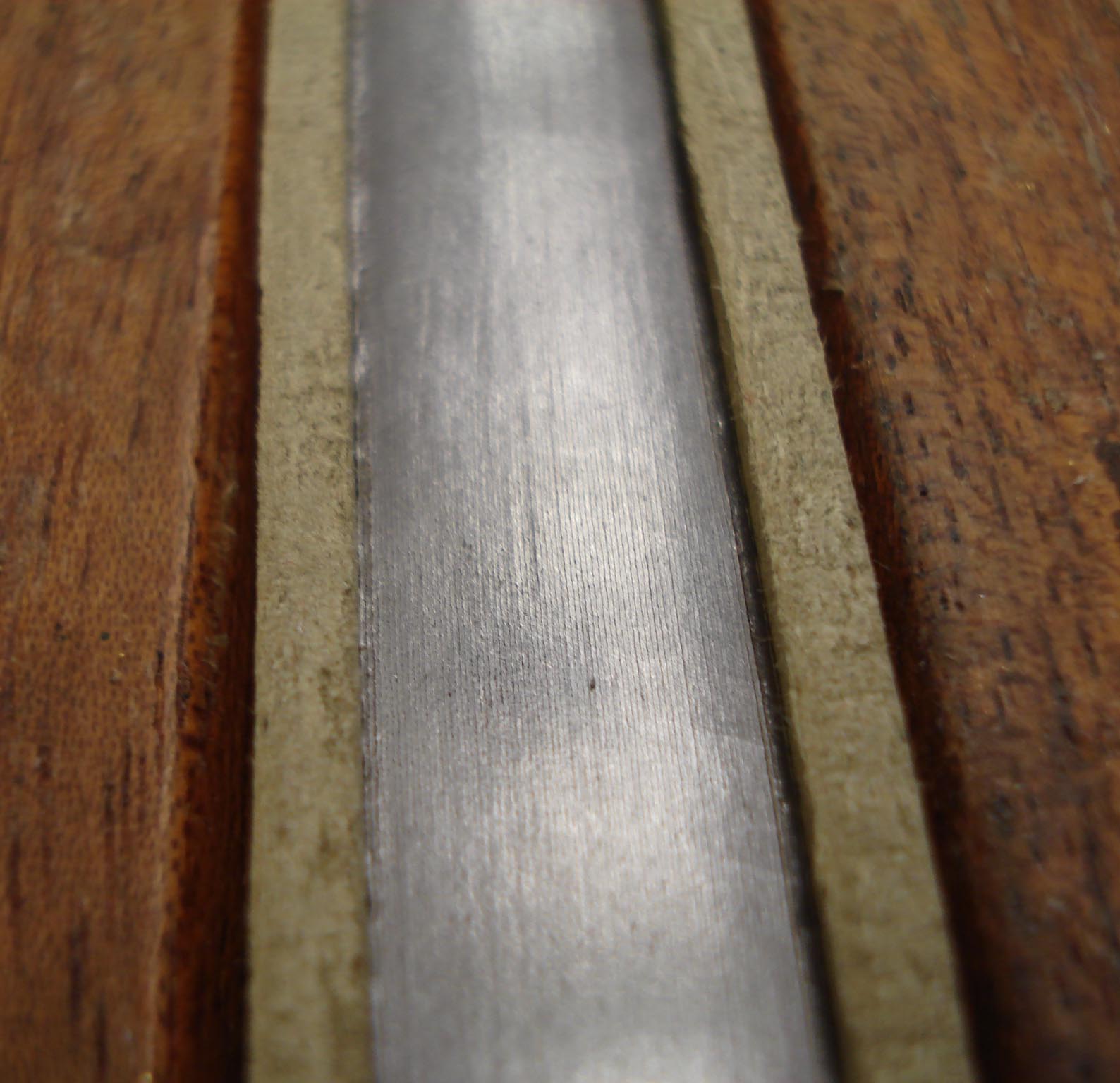
After plowing the edges of a couple of my textblocks, I decided to attempt to decorate the top edges of two with graphite. The process involves sanding the plowed edge to get it very flat and smooth. A mixture of graphite powder and paste is applied and rubbed in with one’s thumb. The edge is then scraped clean again with a metal scraper to really be sure that the edge is smooth and another coat of graphite and paste is rubbed in. After a light coating of bee’s wax, the edge is burnished with an agate burnisher. The result is a dark grey, polished edge.

Graphite definitely gives the edges a very refined look, but it can be quite difficult to achieve an even finish. It is much easier (and cheaper) than gilding, but also functions to create a kind of seal between the leaves and reduce the paper’s exposure to dust and pollutants. Here is a close up image of the finished edge.

After the textblock is removed from the press, one must smack it sharply against the lying press or table surface a couple of times to separate the leaves.


and finally,

ACT 3: BOOKBINDERS MAKE MORE THAN BOOKS, APPARENTLY.

I had never heard of this restaurant/food product before Daniel brought it in the bindery the other day. I think it’s hilarious. You can read more about good ol’ Samuel Bookbinder (complete with jazz sax soundtrack) here or here.


That’s all for this installment. Next up, the return of the medieval linkstitch, the Big 12, and more!