Points of Interest

Bookbinding, Fieldtrips

First off, I’d just like to apologize for being such a negligent blogger. The last month has been rather packed with projects, and although a lot has been happening, I have been too preoccupied to share any of it. Therefore I’ll try to give you, the gentle reader, all the highlights in one post. I’ve been listening to way too much This American Life recently, so this installment is organized into three acts.


ACT 1: MARKING TIME

In early November, we took our first field trip up to Dartmouth College. Deborah Howe, the collections conservator, invited the bookbinding department up to Hanover to tour the library’s conservation lab and to assist in the unpacking and installation of the Guild of Book Workers Marking Time Exhibit.
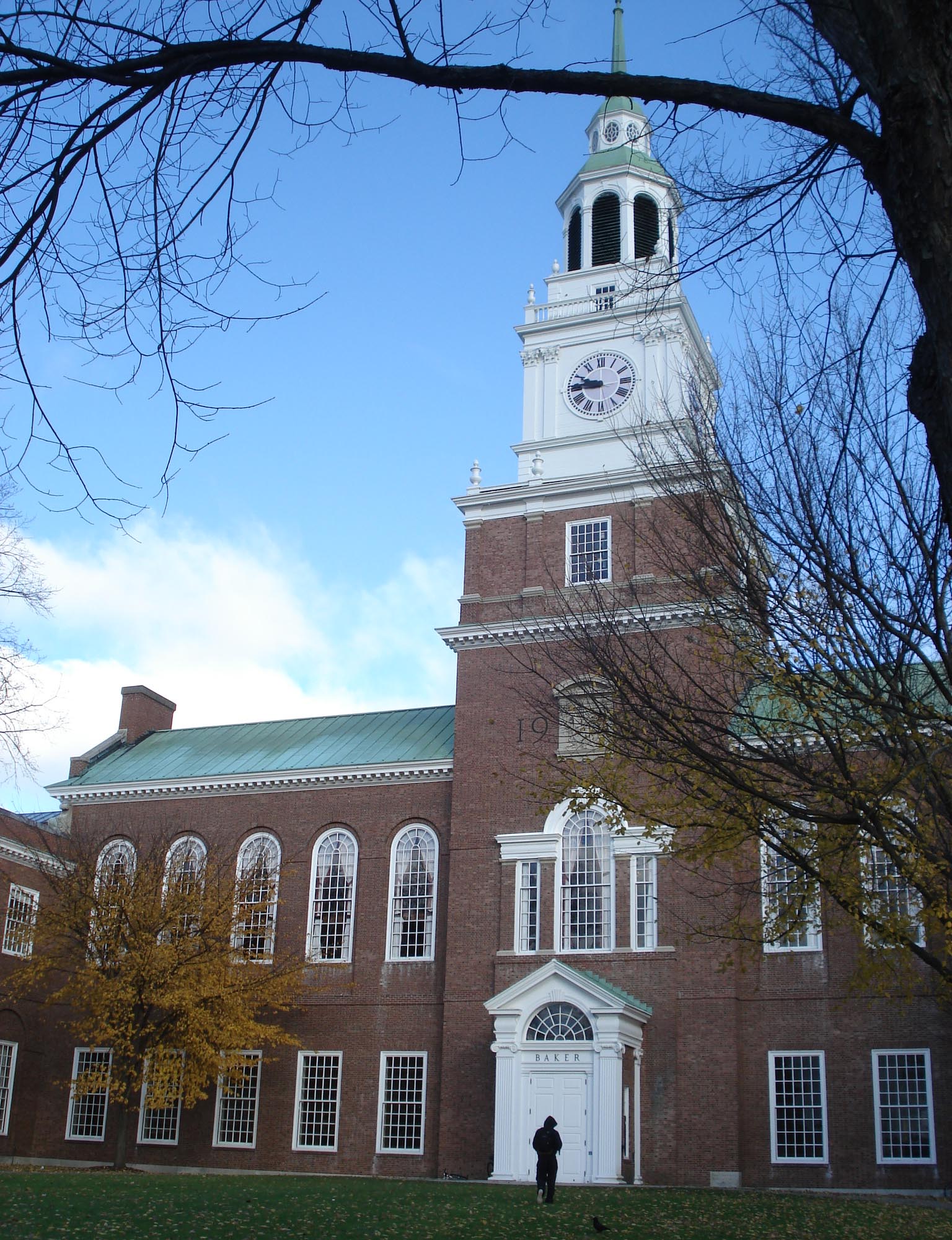
Dartmouth’s campus is stunning and we arrived just in time  to see the changing leaves at the height of their transformation. As a southern boy, it is somewhat surreal to be encircled by such intense New England “Autumn-ness”; The old brick buildings and foliage are just so picturesque that they seem fake sometimes. Regardless, the Baker-Berry library building itself is as excellent inside as out; in addition to the well-placed exhibit spaces, the reserve corridor of the library houses Jose Clemente Orozco’s mind-blowing mural The Epic of American Civilization. We were also quite impressed with the size and adaptability of the lab space in Preservation Services.

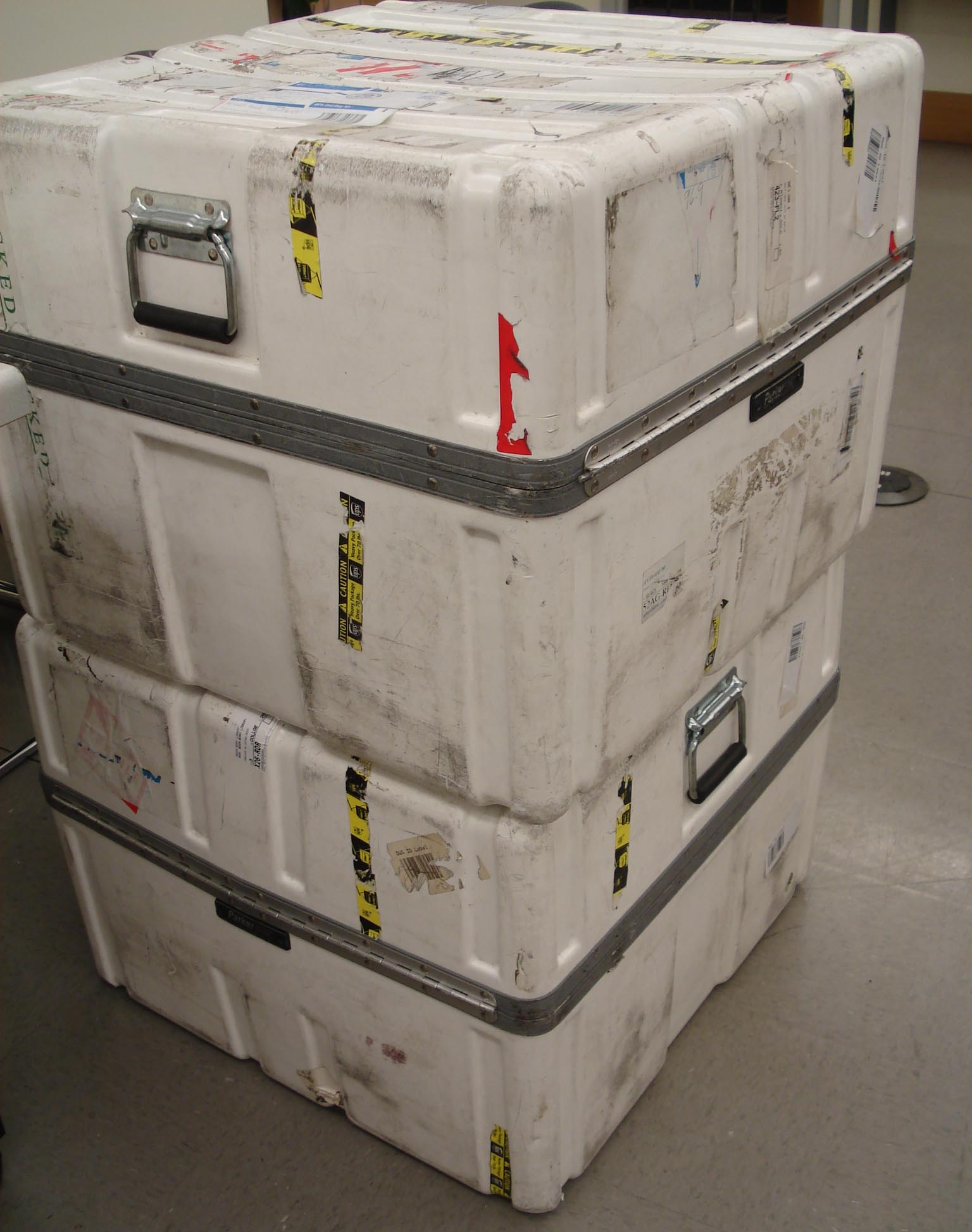
Shortly after our arrival that morning, the exhibit was delivered in three large crates.
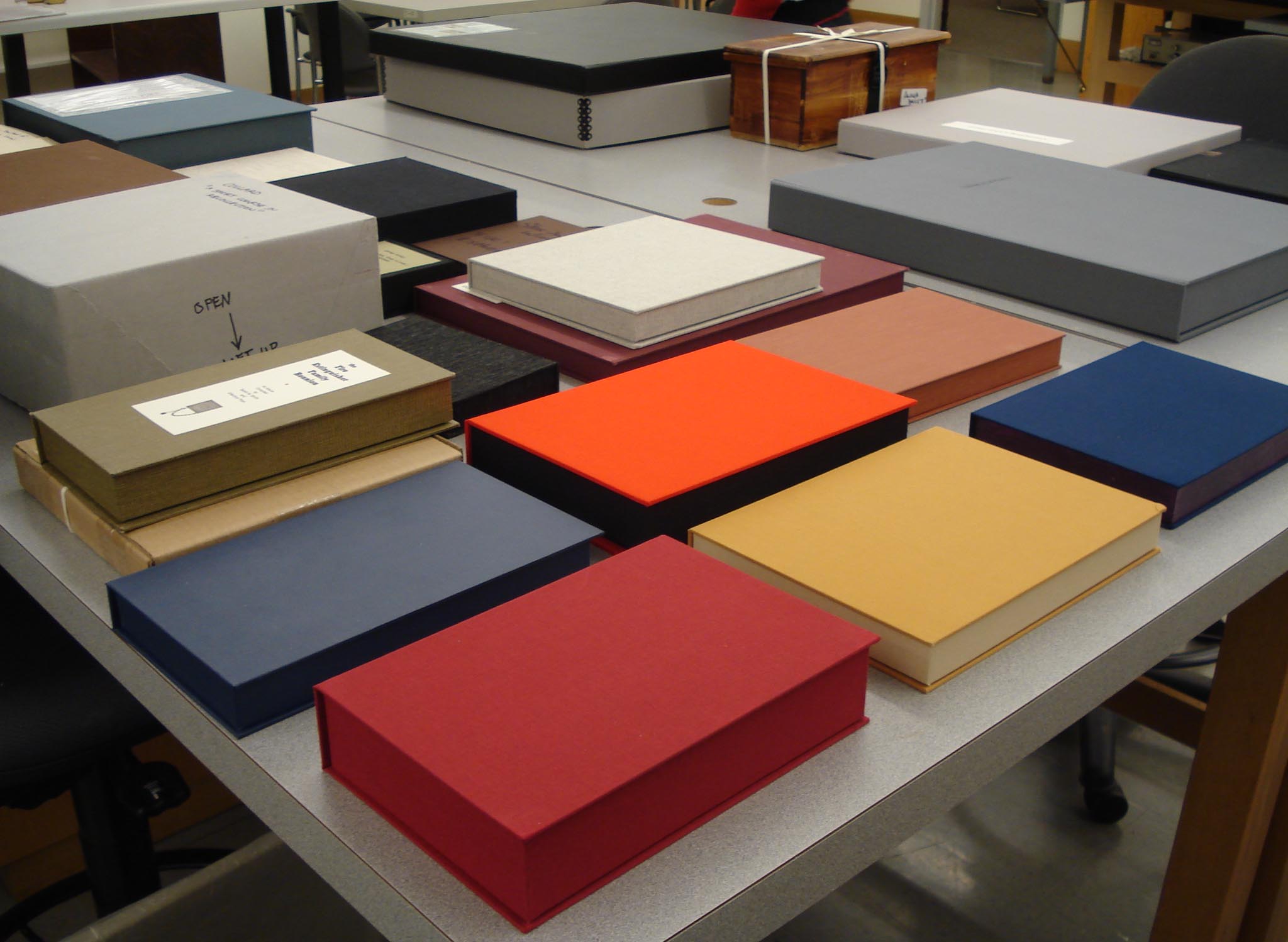
After unpacking the contents of the crates, we arranged them alphabetically by artist on several large tables in the lab. Each exhibit book comes in its own custom enclosure with a condition report and detailed instructions for its display. We broke up into teams and documented the condition of each exhibit item before transferring them to the secure exhibit cases. There are around 50 items, of various shapes and sizes, in this traveling exhibit. To give you an idea, here is about half (in their individual enclosures) spread out on two tables. For excellent photographs and descriptions of the books themselves, please visit the exhibit website.
I really enjoyed the opportunity to experience the behind-the-scenes aspects of a traveling book exhibit. There are so many logistical challenges involved in unpacking and repacking a large group of delicate and valuable items, and it was fascinating to see the solutions employed by the organizers of the show. For example, after determining the best way to pack 50 oddly sized boxes securely in three crates, how does one ensure that they are repacked the same way as the exhibit travels through the eight locations on the exhibit schedule? In this case, each crate included a detailed packing list as well as printed photographs of each layer of boxes and packing materials as they should be placed in the crate.  Taken with the packing instructions by each book artist, every step in the packing process is well documented.

In addition to working on the exhibit, our field trip included a brief tour of the Book Arts Program facilities and the opportunity to handle some high spots from the rare book collection. The special collections at Dartmouth are stored in an amazing climate-controlled glass cube!

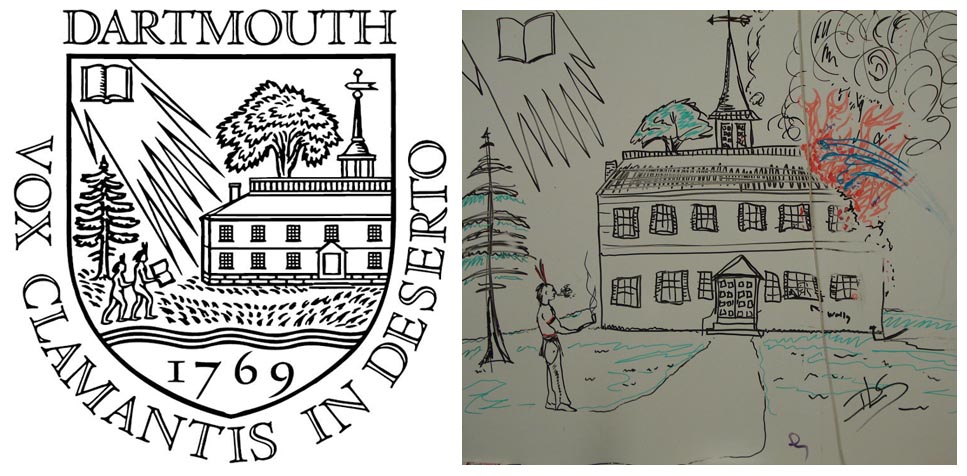
But aside from book things, as we wandered through the campus I managed to snap some photos of two particularly amusing examples of Dartmouth student humor. The first is an re-imagining of the Dartmouth shield by an anonymous artist on the white board of an empty classroom.
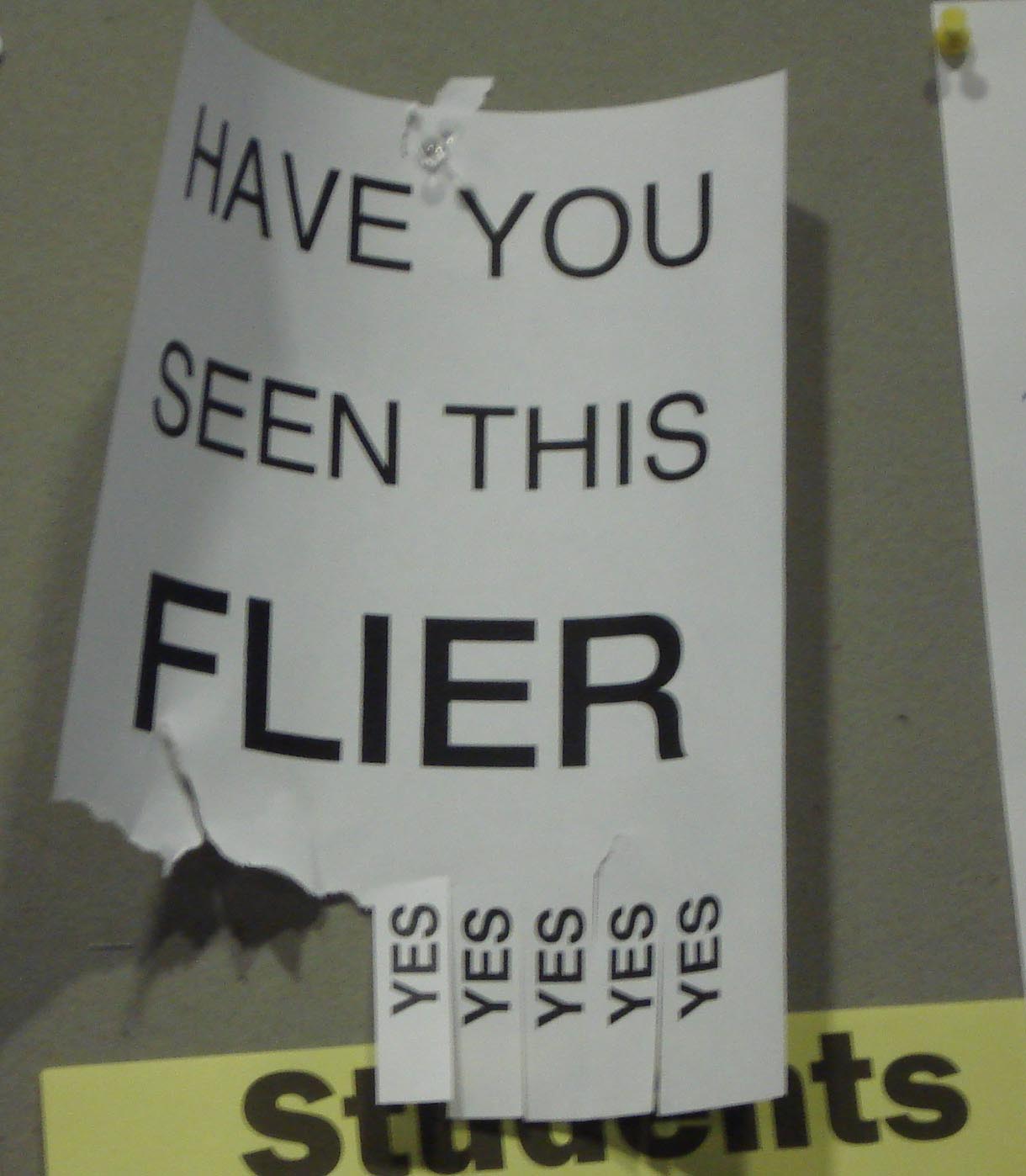
The other is a flyer posted on a bulletin board in the cafe area of the library.
All in all, our outing was an amusing and edifying experience. Special thanks to Deborah Howe and Jay Satterfield for taking the time to make our trip so enjoyable!


ACT 2: GRAPHITE EDGES

As I may have mentioned before, one of the current projects in the first year is an “edition” of 12 case bindings that exhibit common materials but very in case style, endpaper structures, headbands, stamping, and edge decoration. I should be finishing this set this week, and will post pictures soon. In the meantime, I wanted to share some edge decoration that I think is very cool.

With a bit of nagging, we got Jeff to demo the proper operation of the plow and edge treatment with graphite. The plow is a device used for trimming a very smooth edge on the textblock. Etherington and Roberts describe the plow as such:

“It consists of two parallel blocks of wood about 4 inches wide and 8 inches long connected by two guide rods and one threaded rod, with a cutting blade attached to the lower edge of one of the blocks. The left hand part of the plow fits into a runner on the left cheek of the lying press, while the other block is fitted with the adjustable knife. The knife is generally moved inward by the turn of a screw, cutting into the leaves as the plow is moved back and forth.” (under “Plow“)

At NBSS, we have a very nice plow and lying press made by Timothy Moore, much like this one:

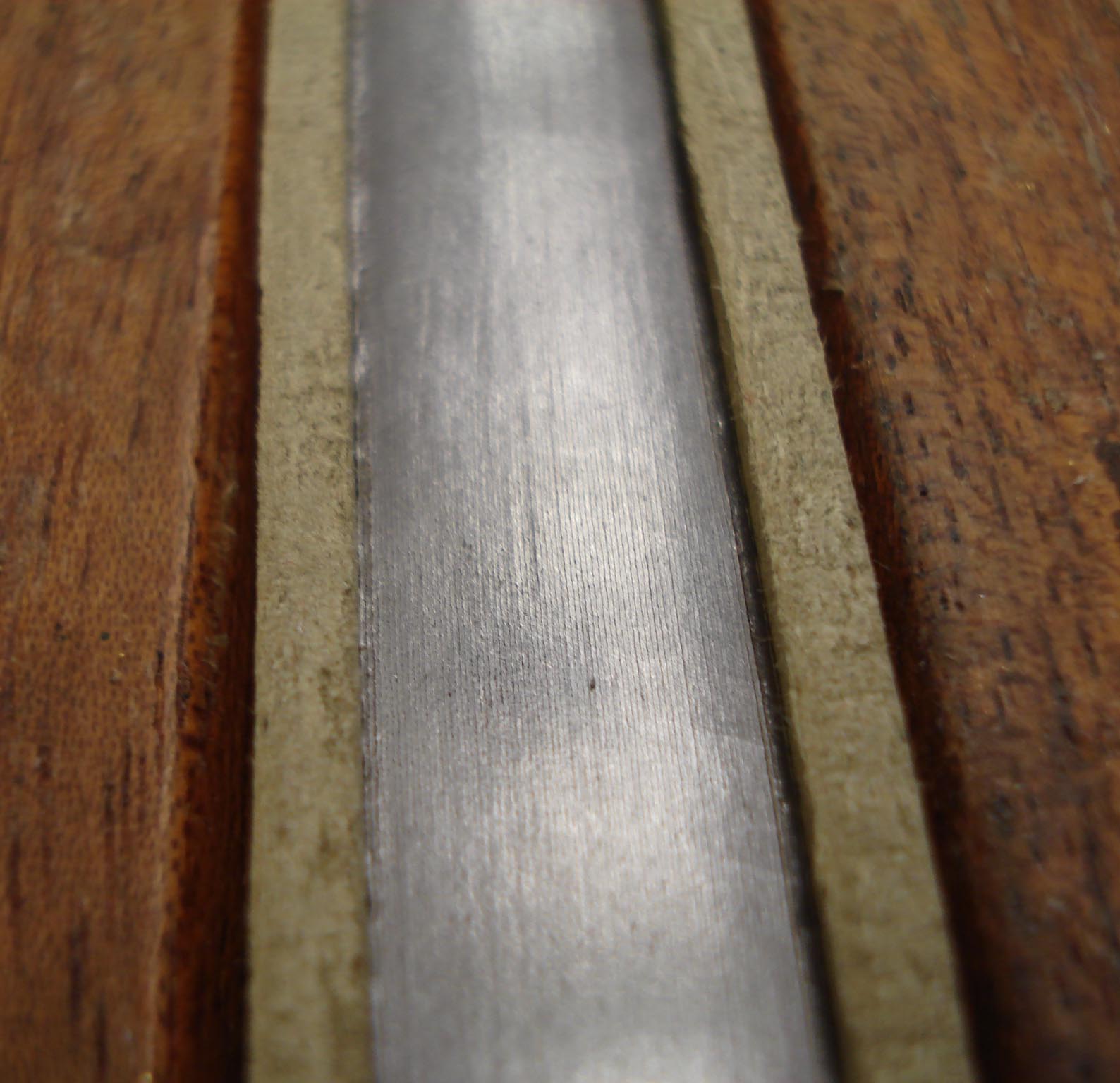
After plowing the edges of a couple of my textblocks, I decided to attempt to decorate the top edges of two with graphite. The process involves sanding the plowed edge to get it very flat and smooth. A mixture of graphite powder and paste is applied and rubbed in with one’s thumb. The edge is then scraped clean again with a metal scraper to really be sure that the edge is smooth and another coat of graphite and paste is rubbed in. After a light coating of bee’s wax, the edge is burnished with an agate burnisher. The result is a dark grey, polished edge.

Graphite definitely gives the edges a very refined look, but it can be quite difficult to achieve an even finish. It is much easier (and cheaper) than gilding, but also functions to create a kind of seal between the leaves and reduce the paper’s exposure to dust and pollutants. Here is a close up image of the finished edge.
After the textblock is removed from the press, one must smack it sharply against the lying press or table surface a couple of times to separate the leaves.


and finally,

ACT 3: BOOKBINDERS MAKE MORE THAN BOOKS, APPARENTLY.
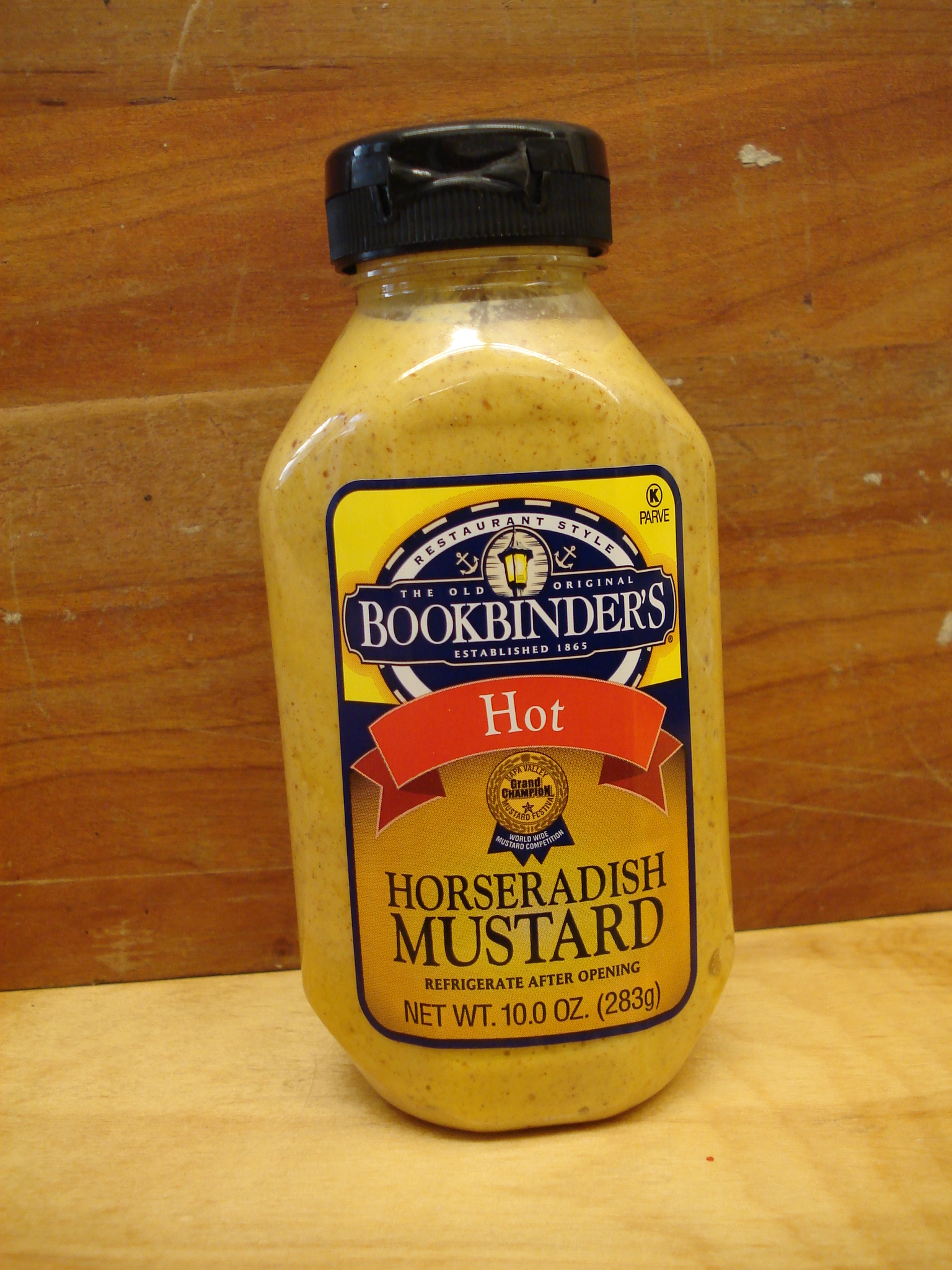
I had never heard of this restaurant/food product before Daniel brought it in the bindery the other day. I think it’s hilarious. You can read more about good ol’ Samuel Bookbinder (complete with jazz sax soundtrack) here or here.


That’s all for this installment. Next up, the return of the medieval linkstitch, the Big 12, and more!

Sewn Board Bindings

Bookbinding

In the coming spring, the bookbinding department plans to take a trip to England to visit notable libraries, conservation labs, binderies, and equipment suppliers. As this educational trip is outside the normal curriculum and we are responsible for our own travel costs, we have begun fundraising by doing what we do best: making books. This is also an excellent opportunity for us to get some experience in a more production style of working – rather than the single-item focus that our projects usually take.

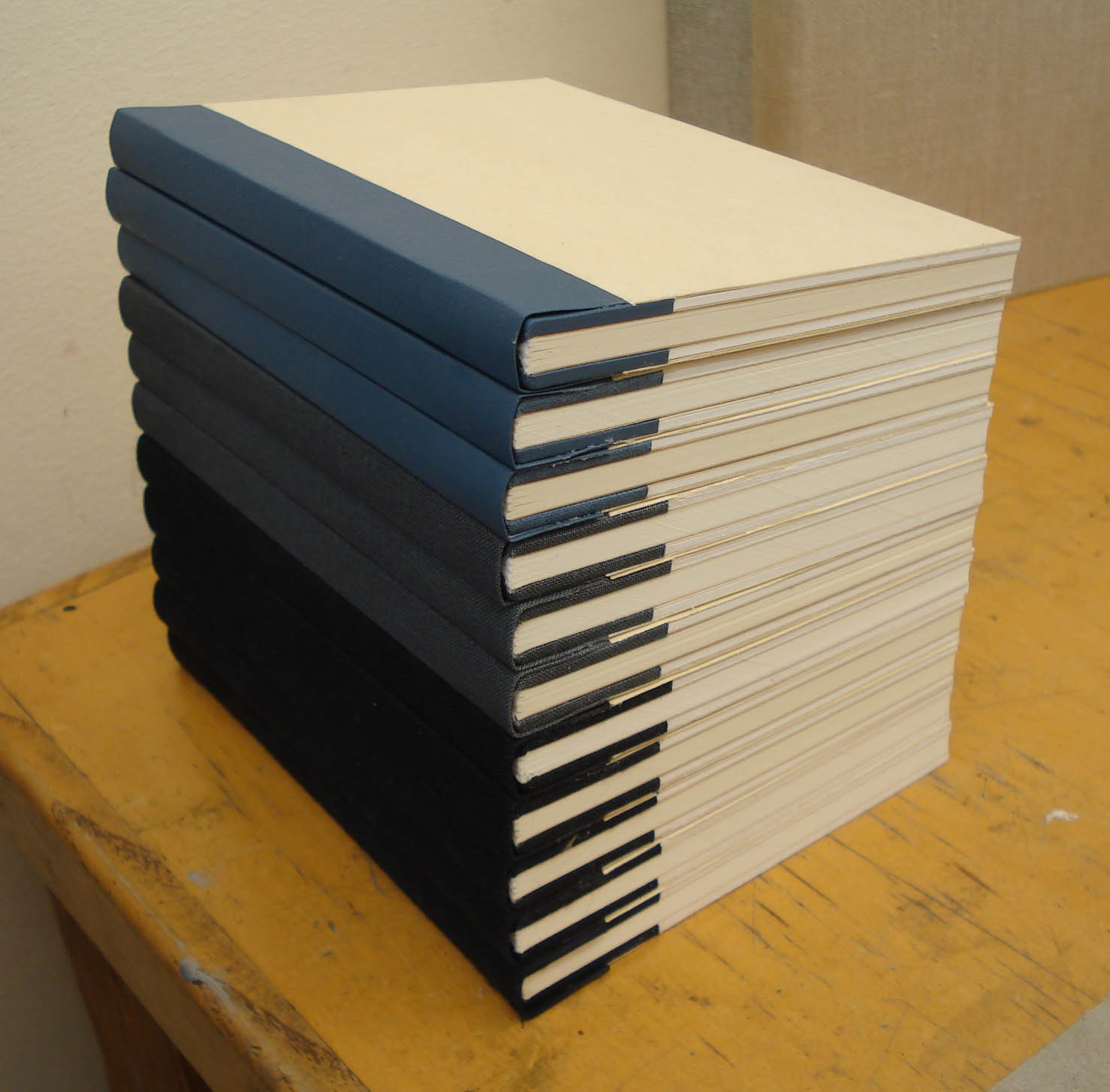
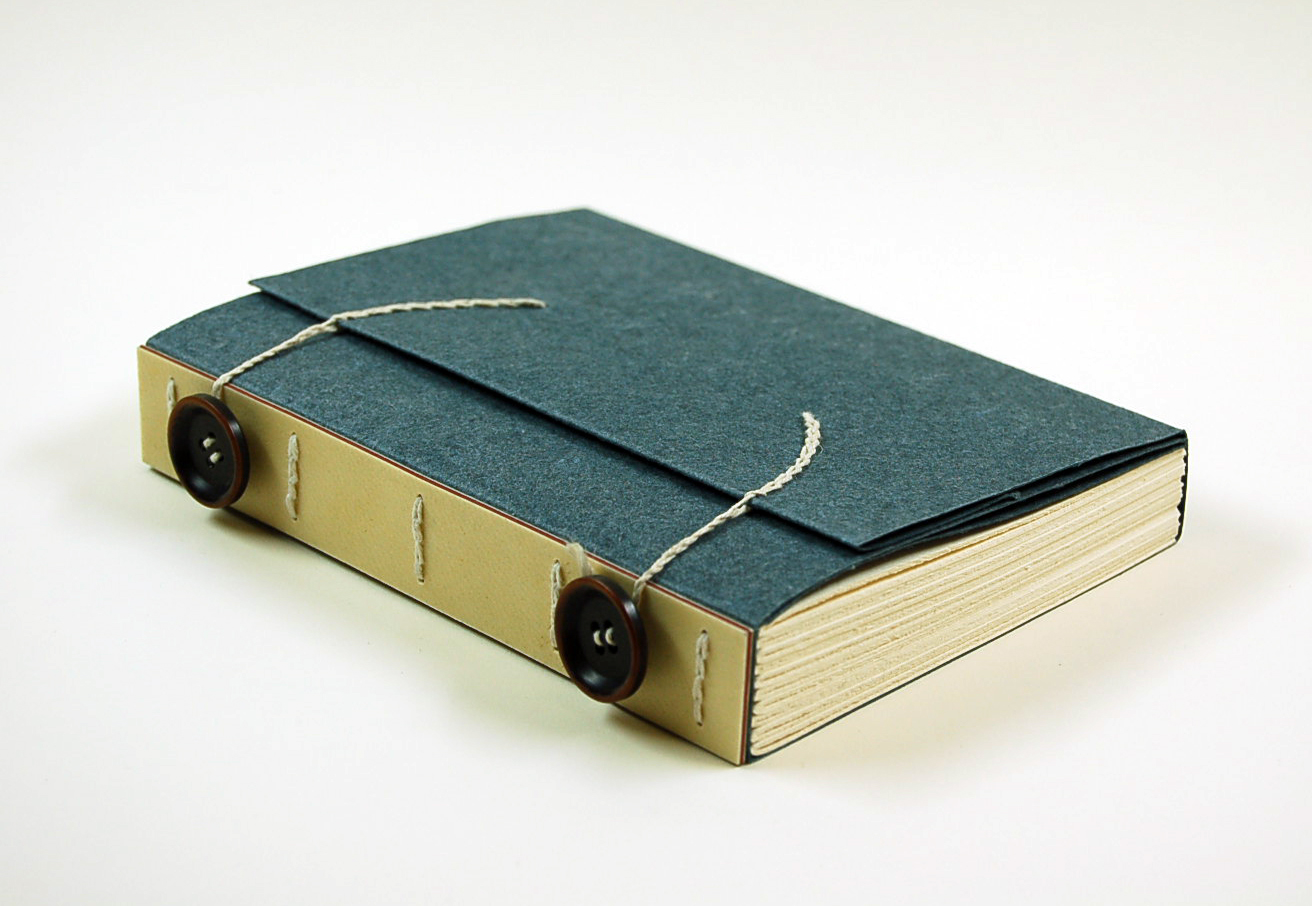
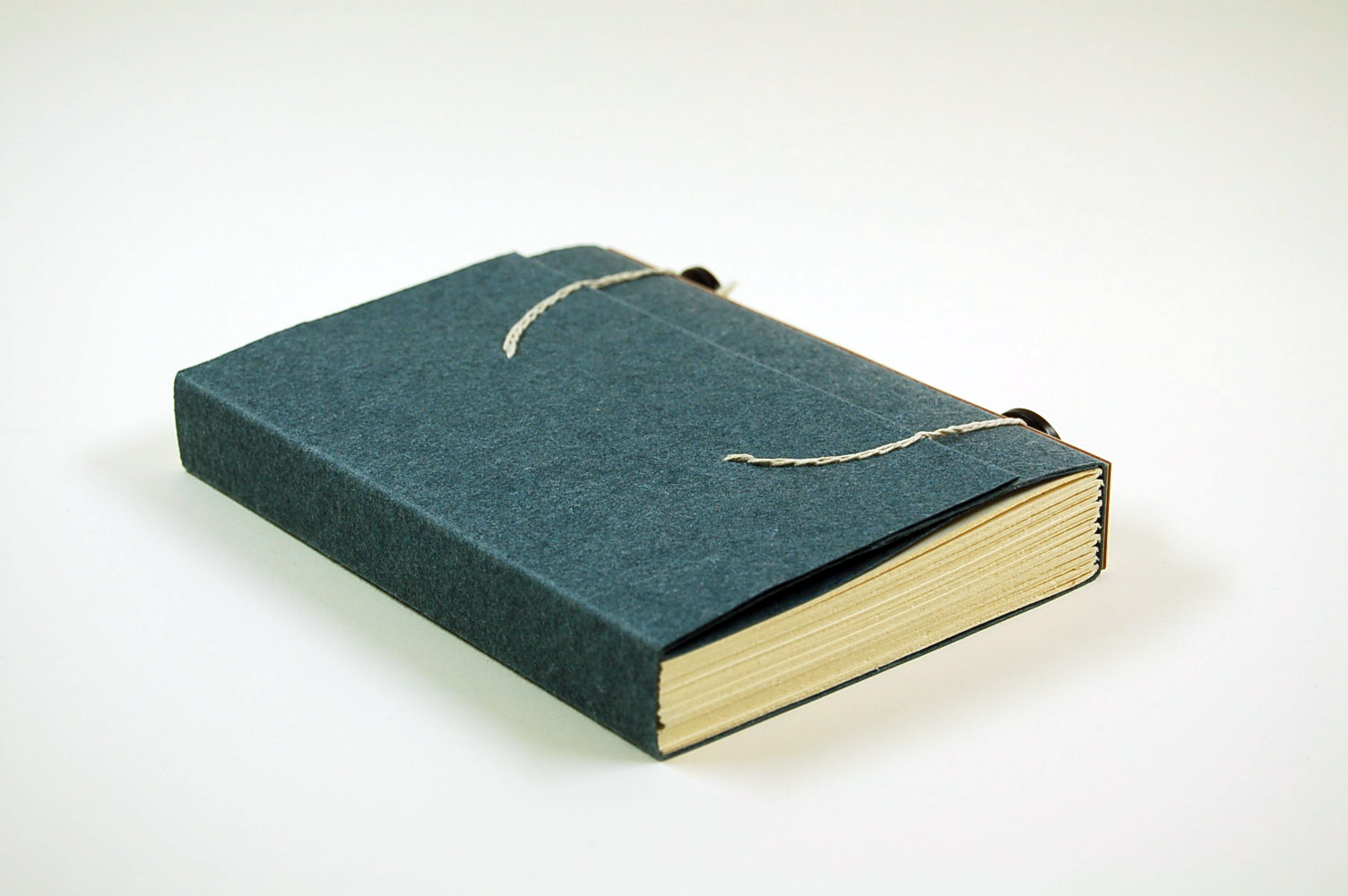
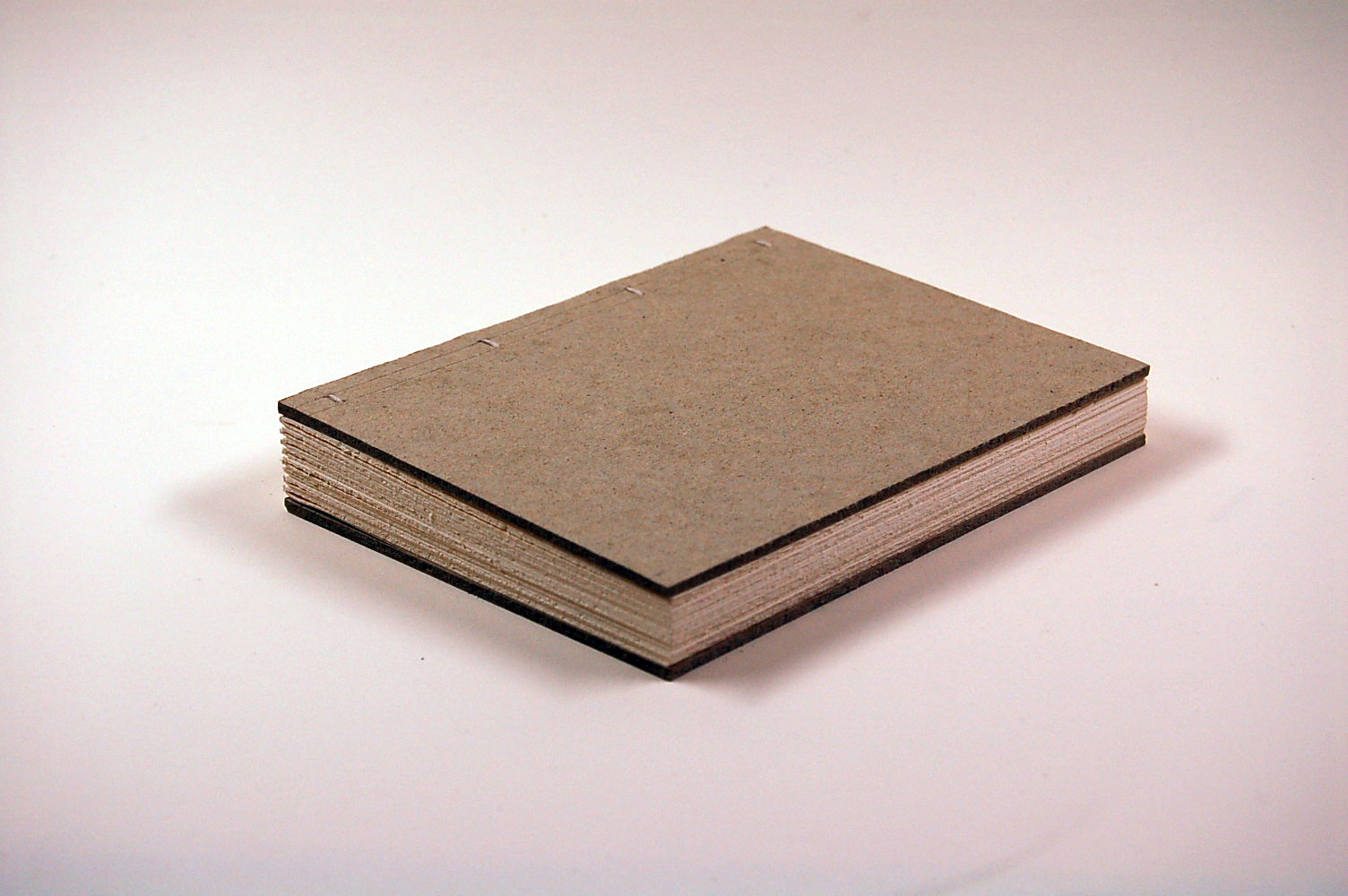
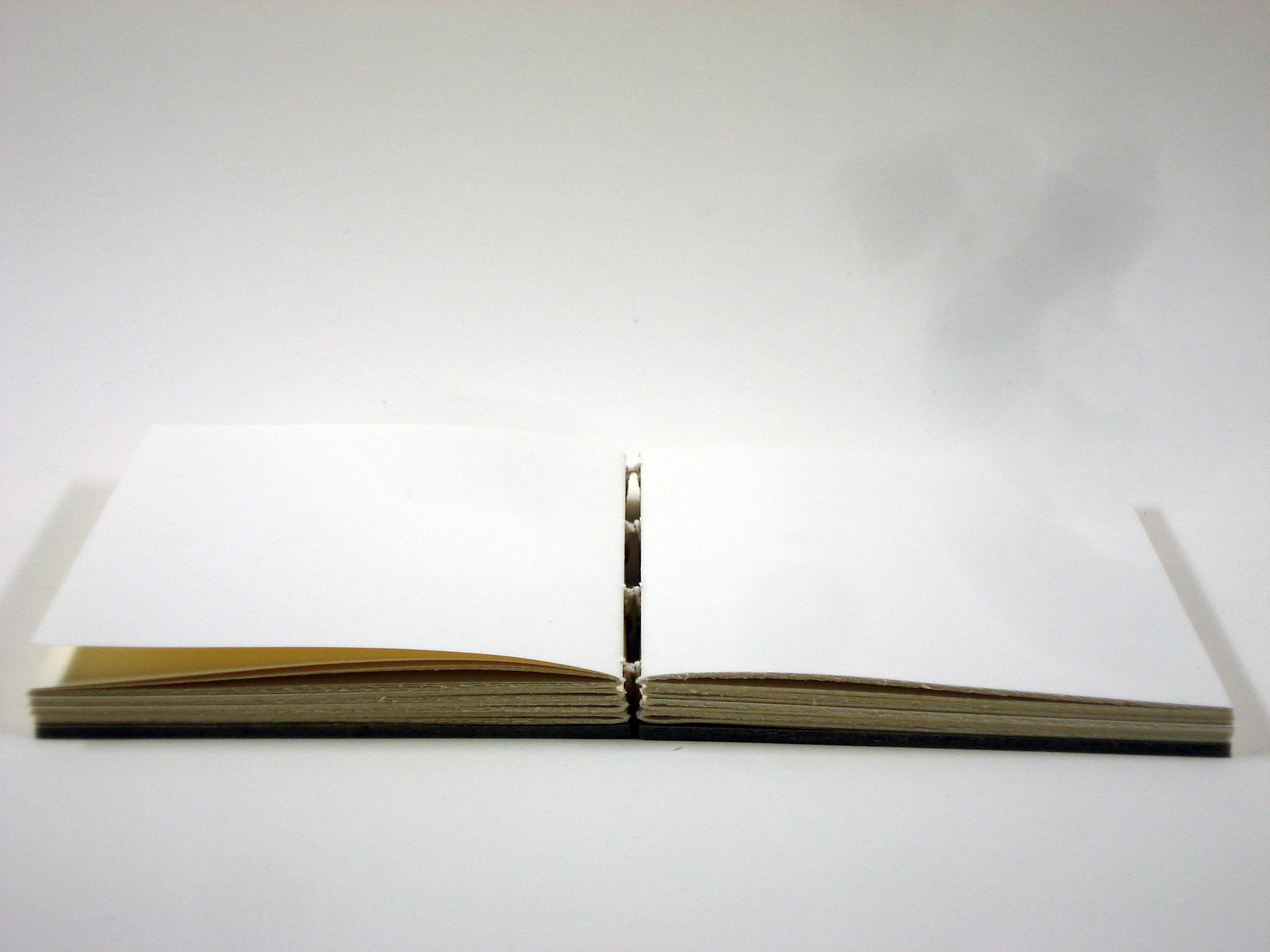
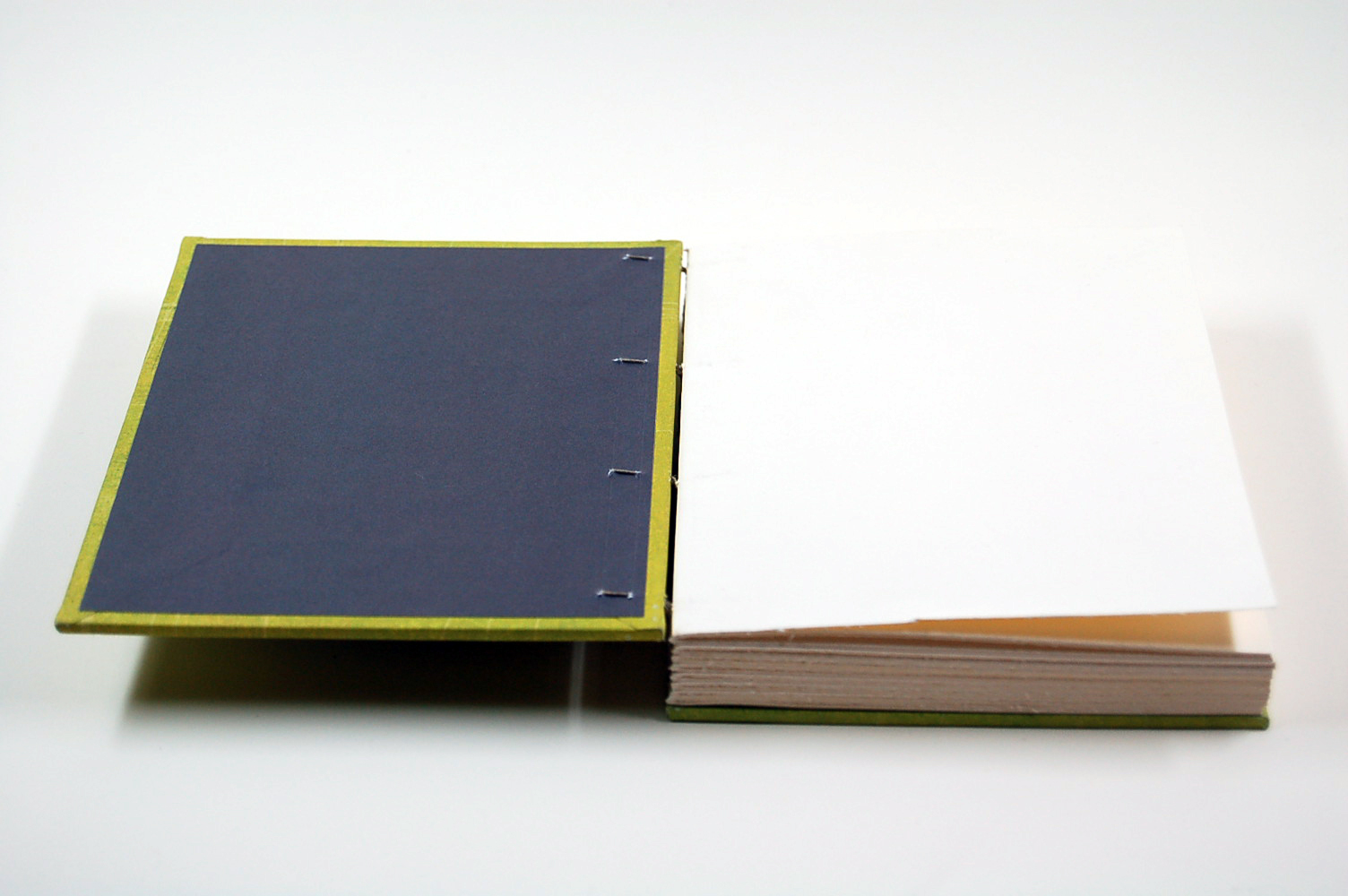
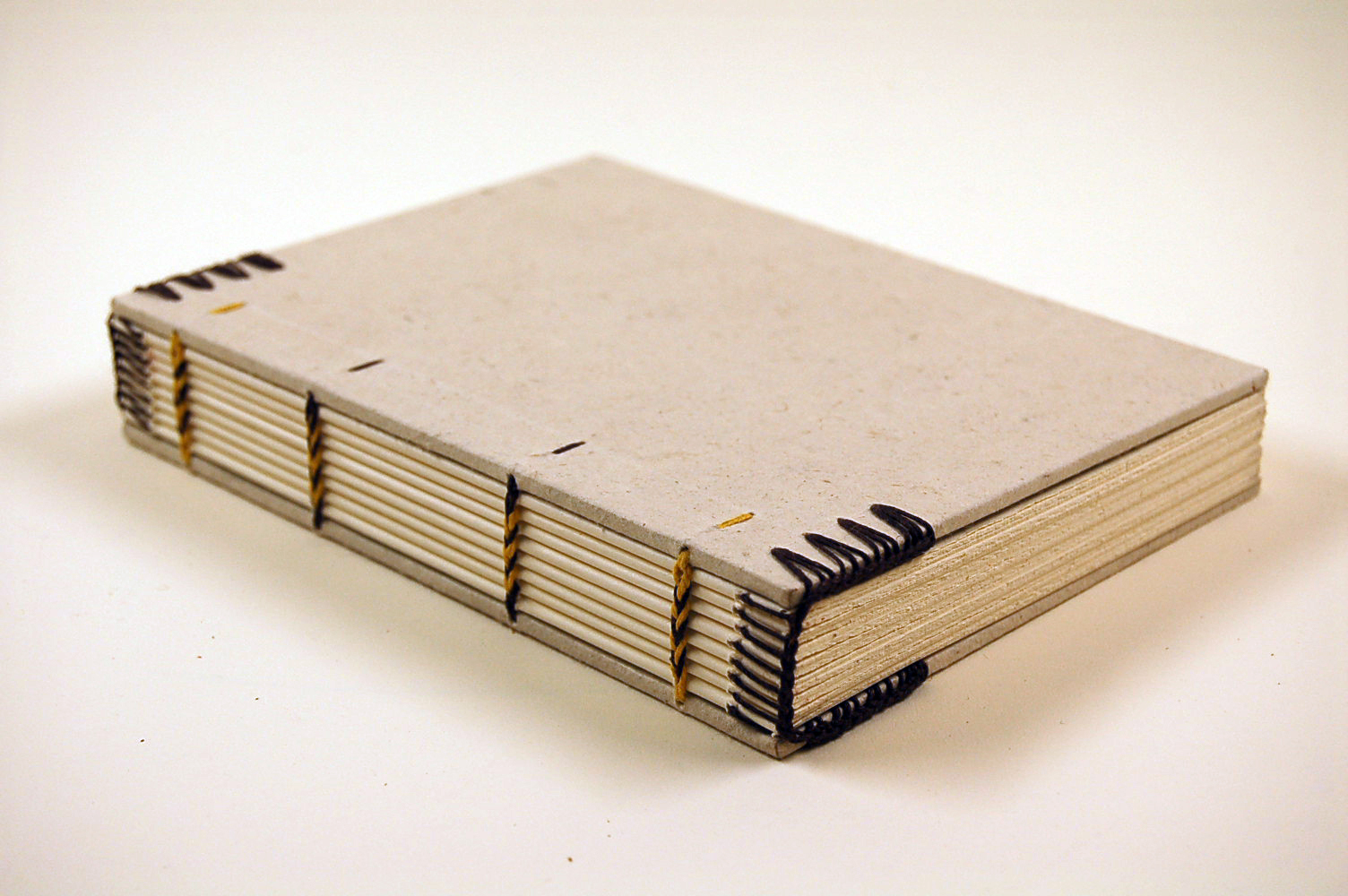
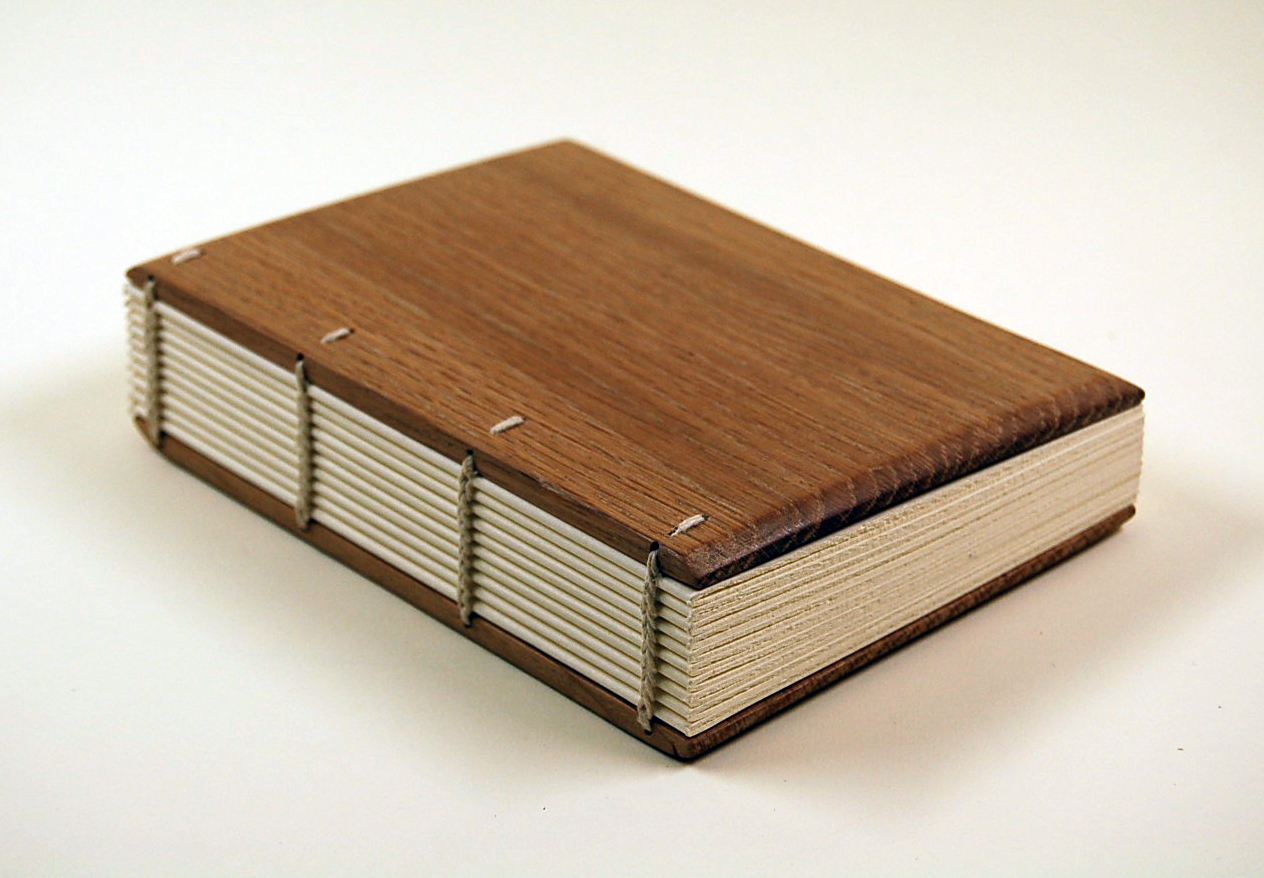
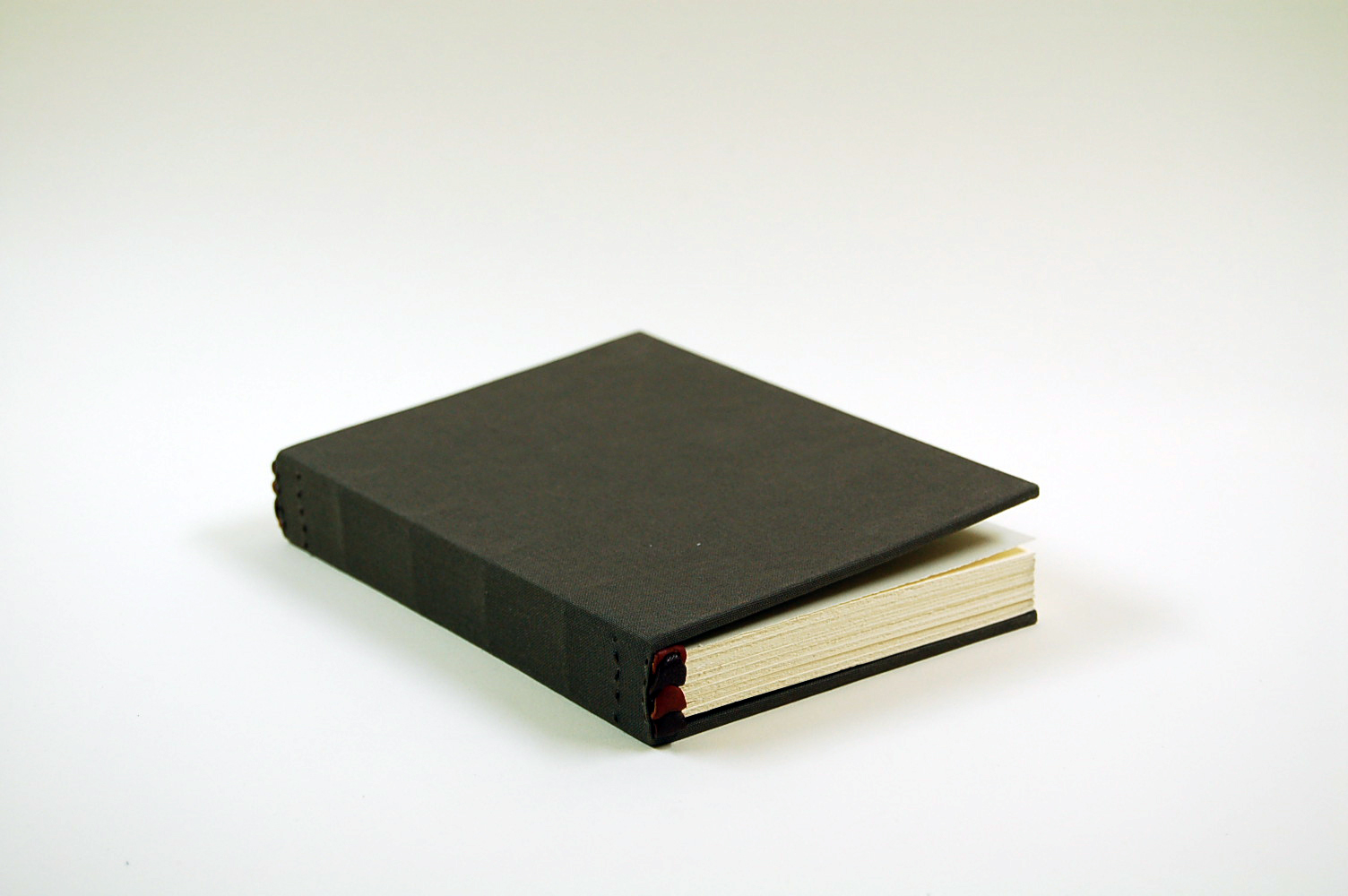
This year, we created a small “edition” of sewn board bindings to sell at the school’s annual open house and the Boston International Antiquarian Book Fair . This particular structure, designed by Gary Frost, takes advantage of the sewing and board attachment features of the earliest form of the codex but has a final form that is more in-line with a modern case binding. Like the Ethiopian and Coptic bindings that I shared some time ago, the sewn board binding exhibits unsupported sewing, a squareless cover ( i.e. cut flush to the text), and boards sewn directly to the sections. In the Ethiopian binding, the sewing passes through a lacing path drilled through the board, while in the sewn board structure, the covers are composed of folios of thin card that are “sewn to the text as if they were outermost sections of the book”  (Booklab Booknote 8, p. 2). Frost (2004) describes the “particular attribute of the through the fold sewing pattern across the entire bound book” as a “secure cover to text attachment”, providing “exemplary docile, flat opening”. This helpful feature provides a “full gutter reveal” so that books with text are more easily scanned or copied, while blank books are more easily inscribed. The textblock of the sewn board structure has little or no shoulder, requiring “no damaging or distorting backing of the outermost gatherings” (Frost, 2004). In addition, the squareless cover prevents the textblock from sagging when shelved upright.

A description of the benefits of the sewn board structure is all well and good – but a description of the production may be more useful to the reader. We began the project by outlining the materials required and individual steps of the project. Each person would make 12 books, and each book required 4 sections of text paper, 2 folios of endsheet paper, and 2 folios of 20 pt board for the covers, as well as filler board, book cloth, and decorative paper covering. Jobs were distributed among the first years: a person was assigned to each board sheer, cutting specific dimensions of paper and board, while another group of students gathered around a large table, dividing up the stacks of paper and folding sections.

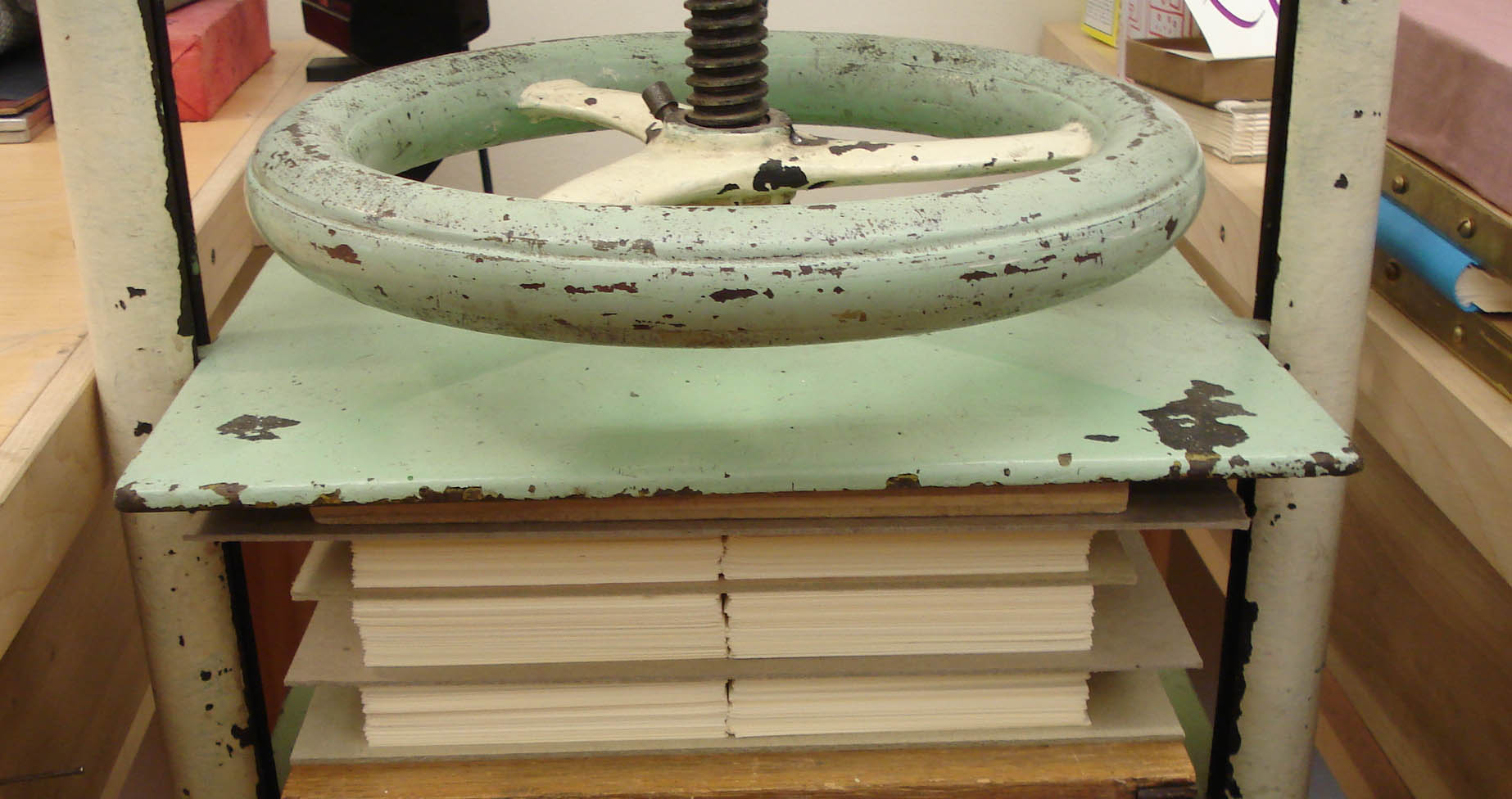
Next the folded sections were distributed into even piles, placed between boards, and pressed overnight.

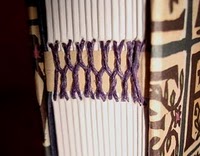
The next day, endsheet folios were tipped on to the outer sections with PVA (polyvinyl acetate) and the sections and boards of each volume were pre-pierced for sewing using a guide. The sewing pattern of 6 sewing stations is the same used for link stitching across linen tapes. The two outermost stations are used for the conventional kettle stitch, while the other pairs of stations provide another link. When the thread exits the section at one station pair, it is linked through the sewing of the lower section, creating a support. The picture below (found at random through the interwebs because I failed to take a decent picture of my own) illustrates the pattern.

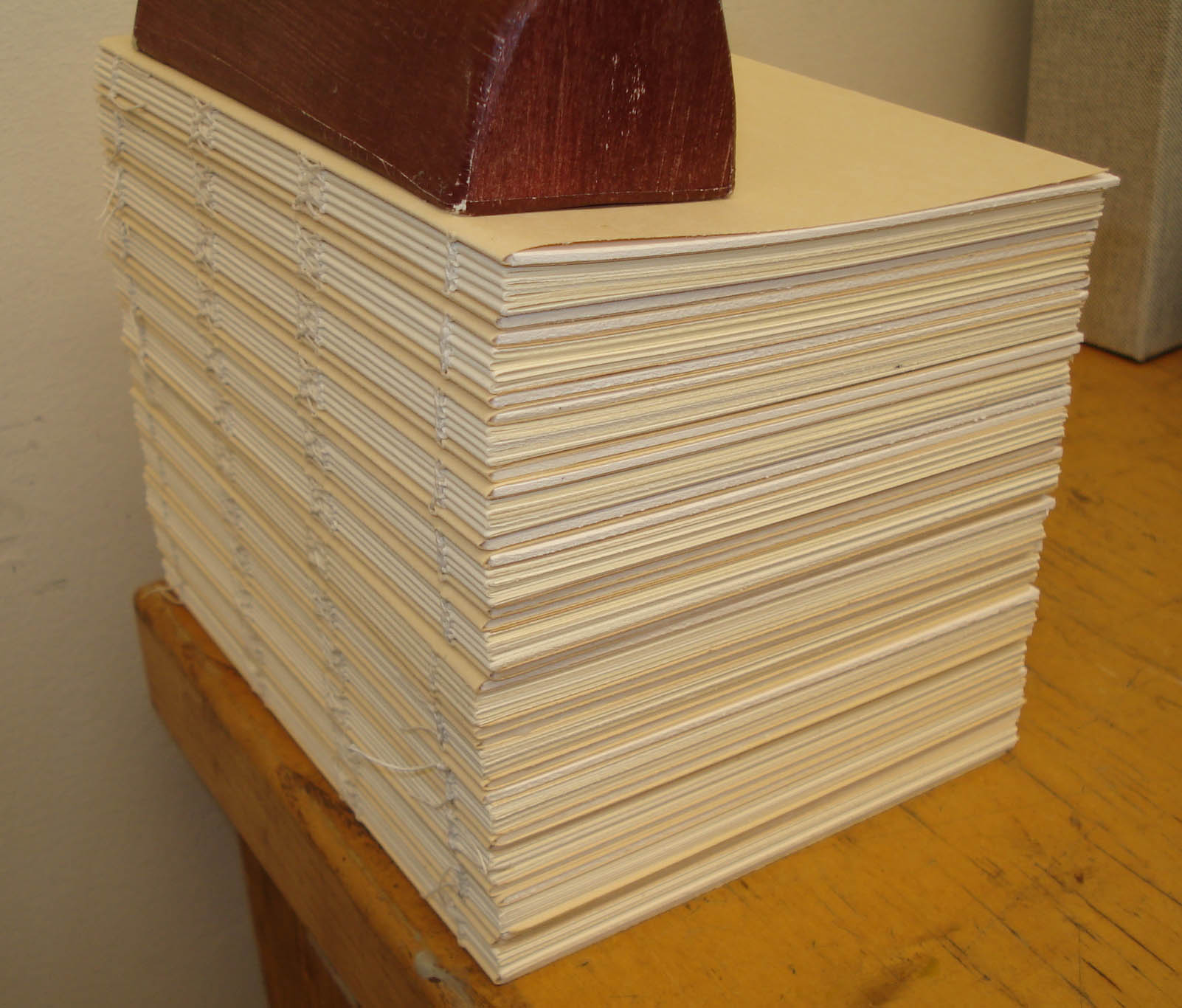
At this stage, the cover folio was also filled by tipping in a 4ply museum board at the fold with PVA. This will make a much thicker (and more pleasing looking) board later in the process. When sewn, my own stack of books looked like this:

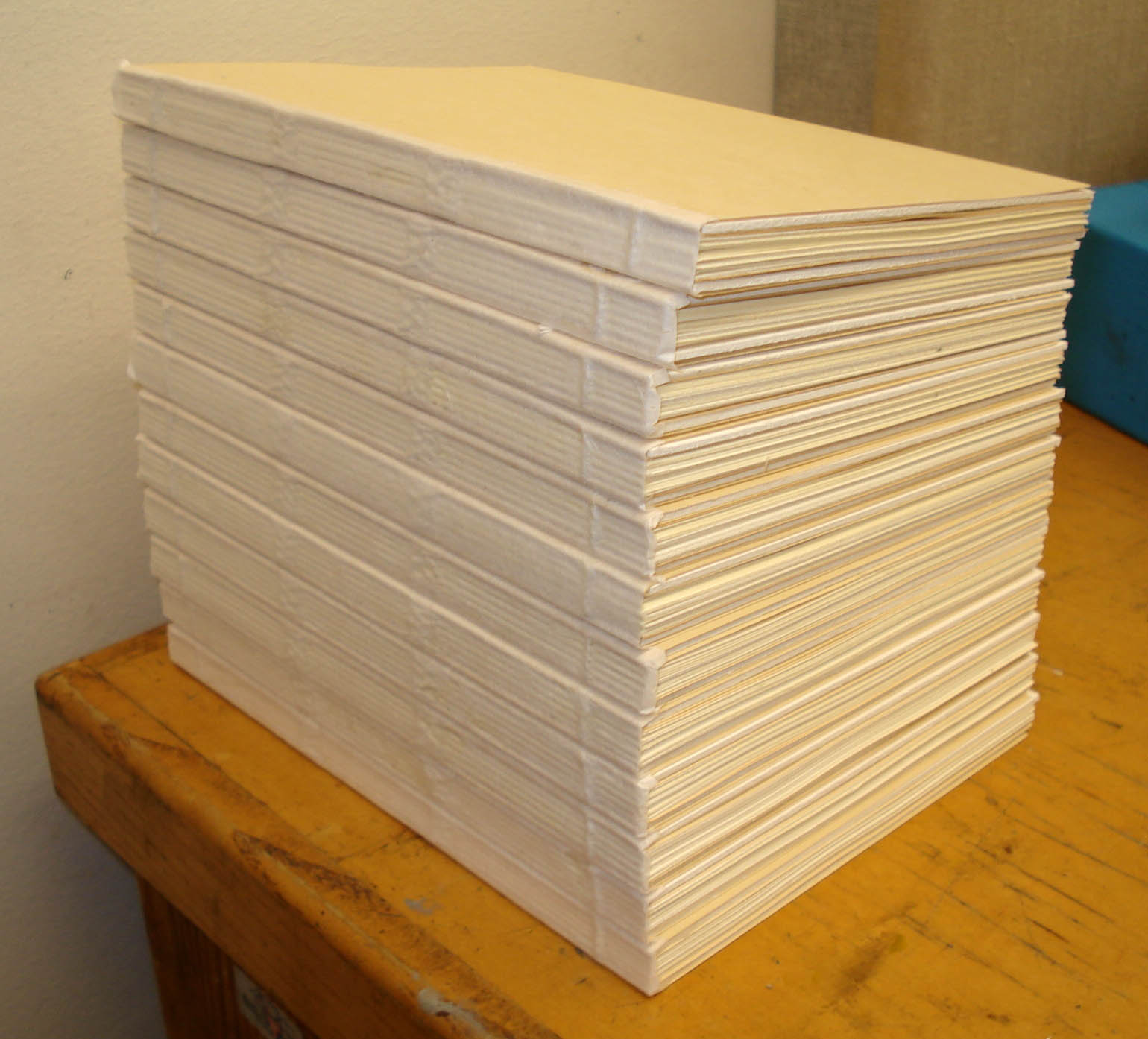
The next stage of the process involved lining the spines. Each book was pasted up with Aytex-P wheat starch paste and lined with a piece of Kizukishi Japanese tissue that extended on to each board about 1/8″. Etherington and Roberts (1982) indicate that the purpose of the spine lining is “to support it and to impart a certain degree of rigidity while still maintaining the necessary flexibility for proper opening” and that the “weight and stiffness of the spine lining material is of considerable importance.” In this case, we wanted to maintain the significant flexibility of the structure, so no subsequent paper or textile linings were applied. After lining, the spines look like this:


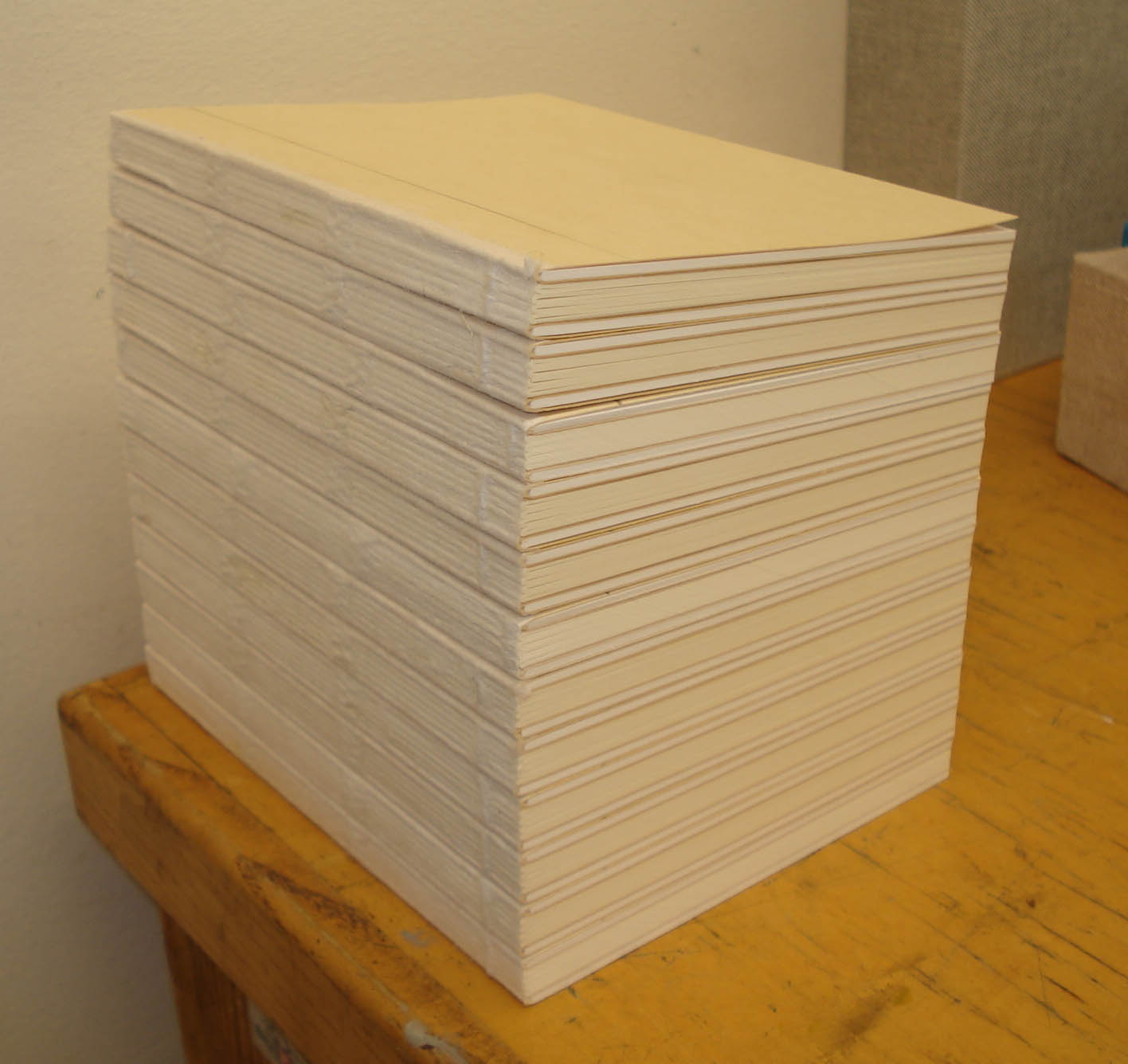
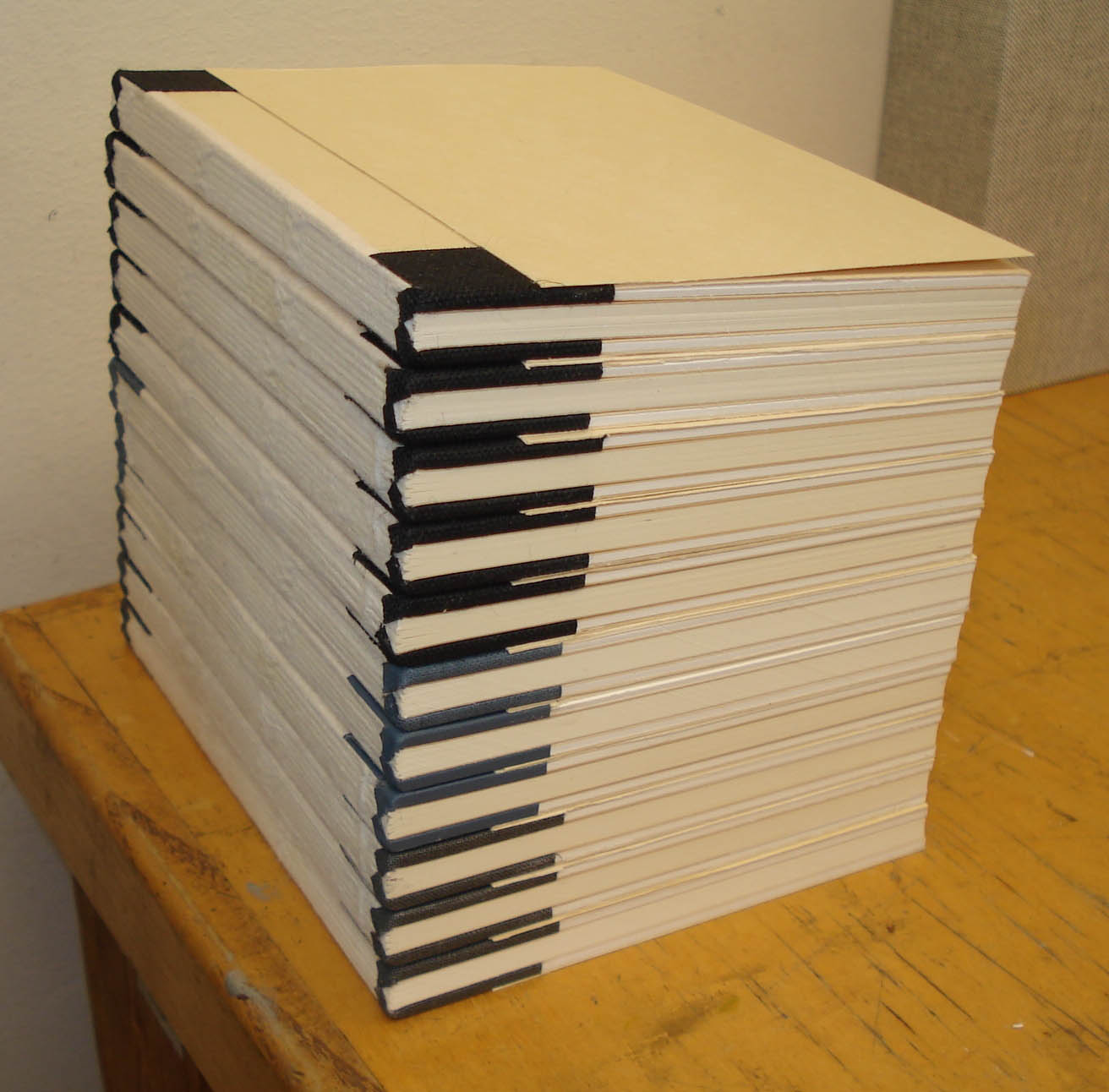
Up to this point, all of the book structures in the first year curriculum have been methodically trimmed, section by section, before sewing using the board shear. This process takes a considerable amount of time, so for our production project (and in accordance with Frost’s instructions found in the Iowa Book Works Kit) we trimmed the edges after sewing in a guillotine (or “hand lever cutter” – kind of like these). This gives the edges a very even, almost machined look. (When all stacked up, I kind of think they look like a layer cake.)

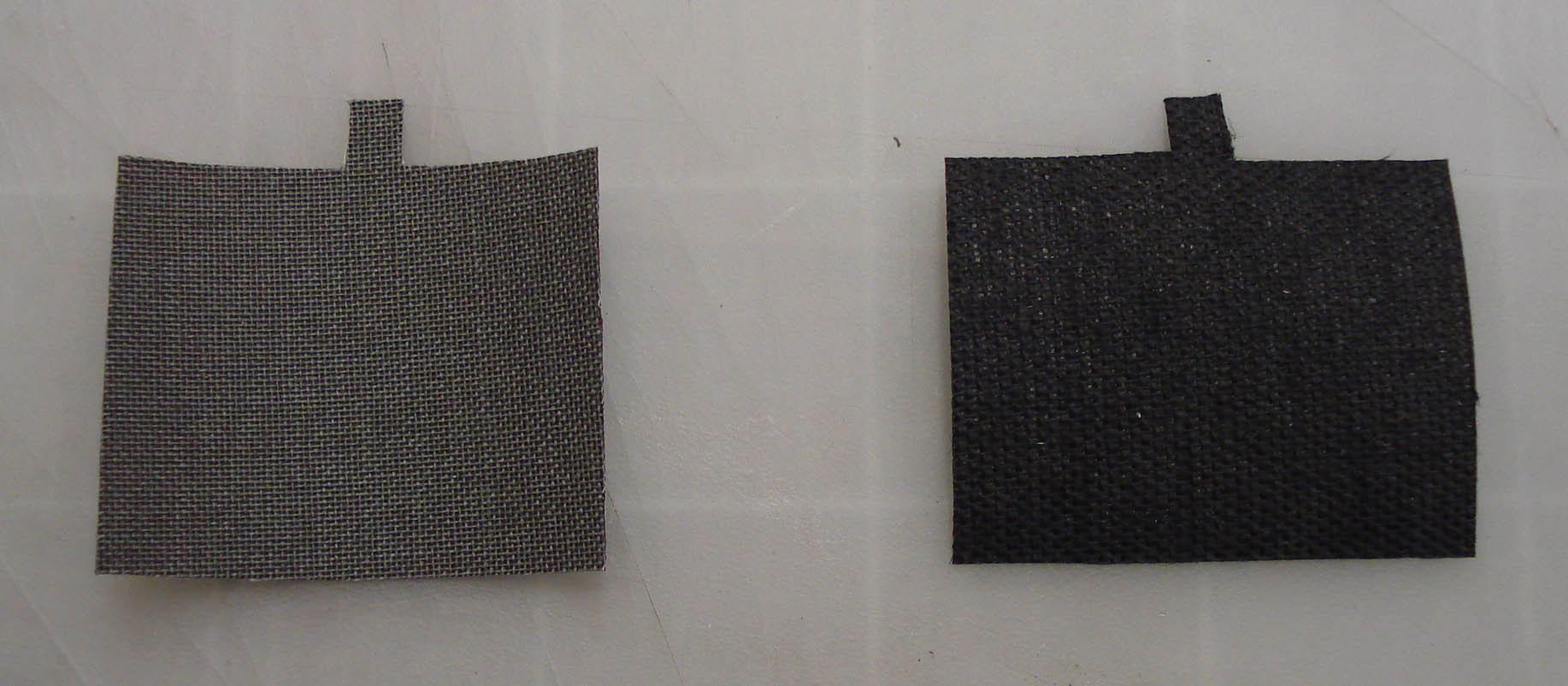
In the next step, little corners of book cloth were adhered with PVA to cover the areas of exposed board at the spine edges of the head and tail.

These add a little refinement to the finished product (as you will see shortly). In this stage, a filler card of 10 pt board was attached to the outside of the cover folios in order to even out the added thickness of the spine covering (that will be added in a later step).

The layers of the covers were then adhered together with 3M #414 Polyester Double sided tape. This allows the layers of board to be laminated together quickly, without the risk of warping from moisture in the adhesive or the requisite long pressing time.

With the boards now solid, book cloth spine strips were adhered with PVA. The spine covering is not adhered completely to the spine, but on the boards about a 1/4″ from the spine edge. This allows for a firm attachment of the material, but without restricting the opening of the book.

Finally, the books were covered with decorative paper. In many cases, we used paste papers that we had made in class a few weeks before.

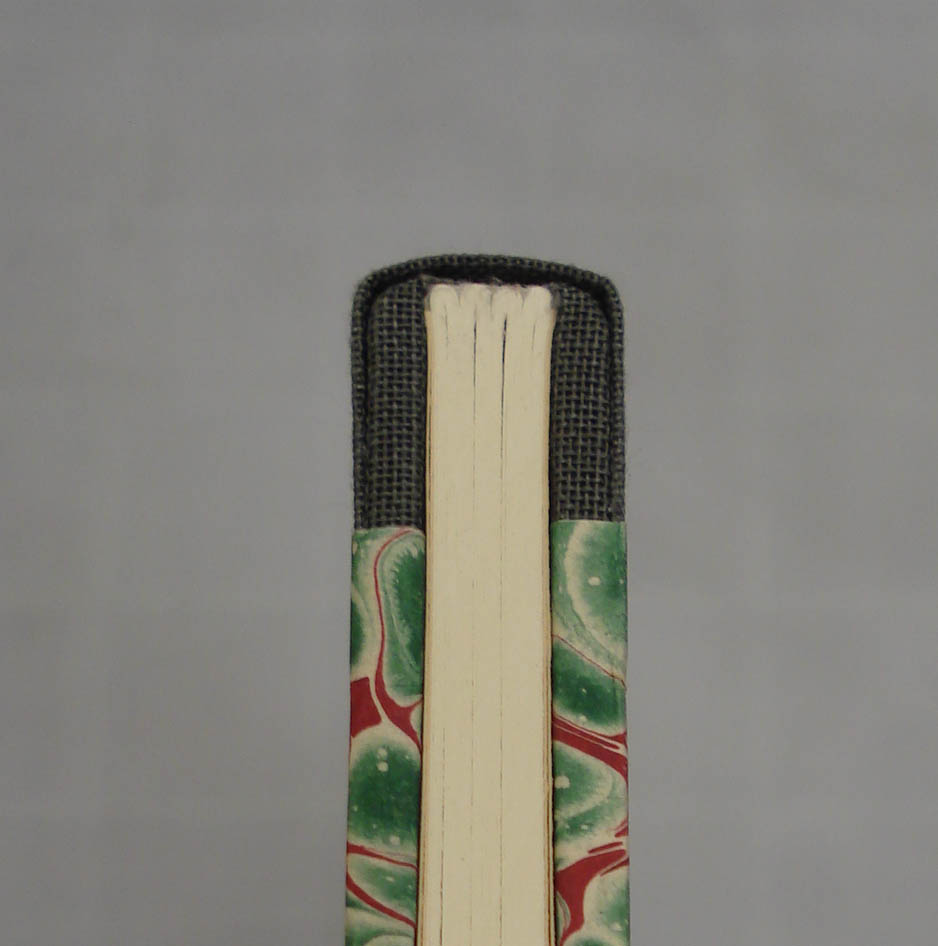
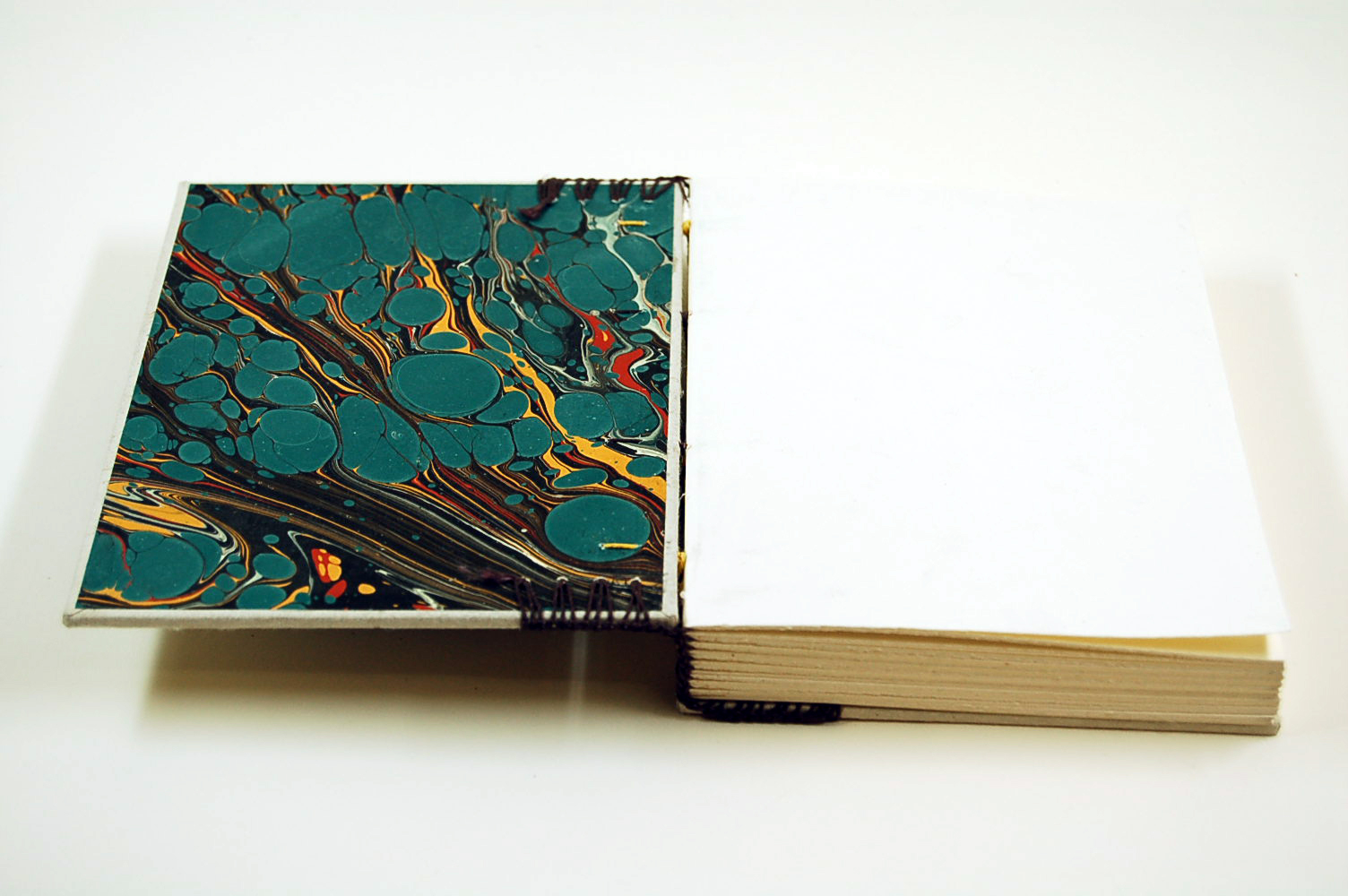
Instead of gluing out the entire sheet of paper, the final board covering is “drummed” on. In other words, the edges of the sheet are brushed out with adhesive and the sheet is applied tightly across the board. Much like the method of board lamination, the drummed on paper allows the boards to be quickly covered while remaining flat. The endsheets are similarly treated; adhesive is applied to only the edges of the pastedown. The result is a thin book with thick boards and a flat spine. Here is an example I made with Italian marbled paper (by Atelier Flavio Aquilina) .

As you can see, the spine tabs and flush-cut boards give the book a very finished appearance while not sacrificing the flexibility of the opening.

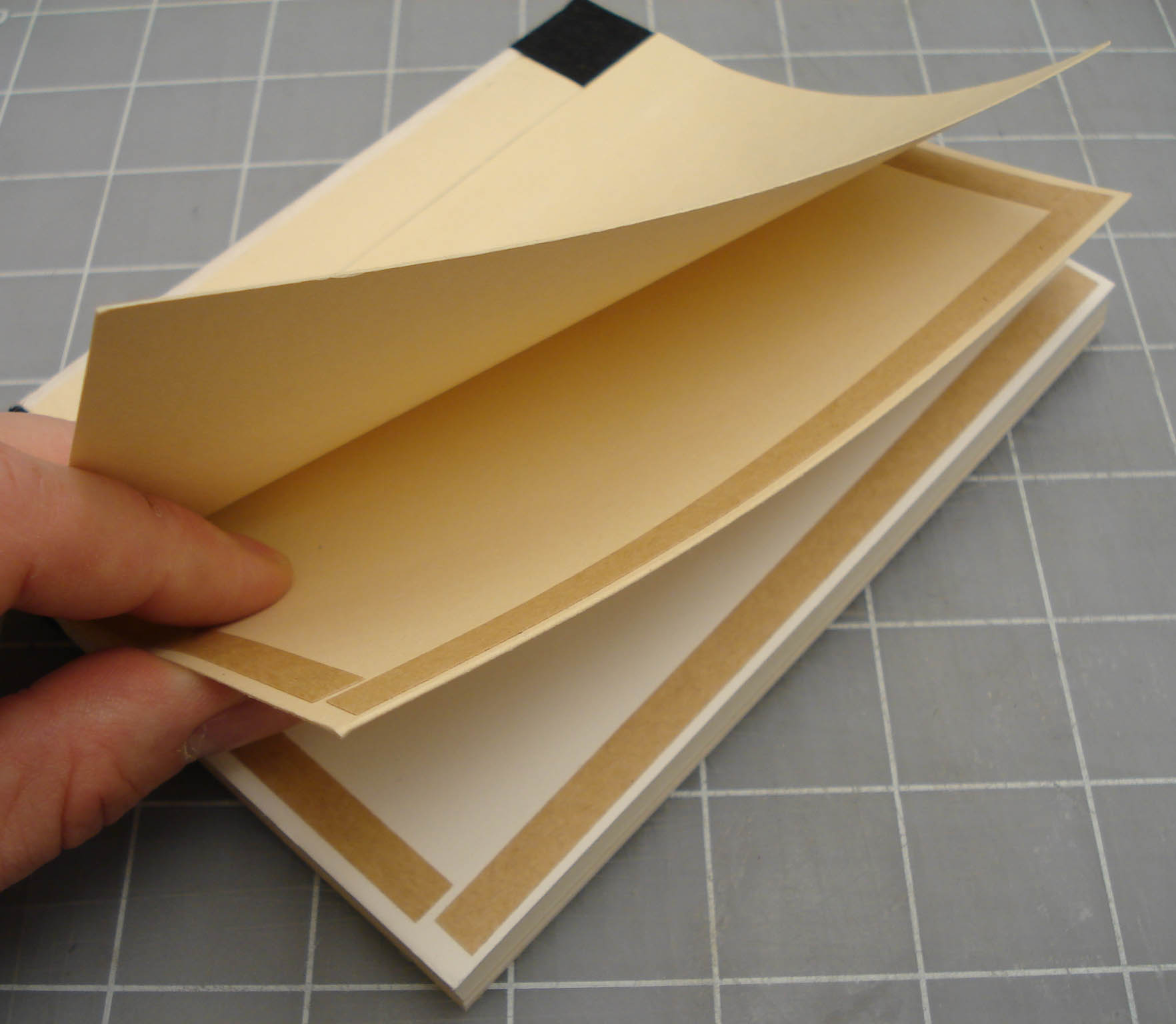
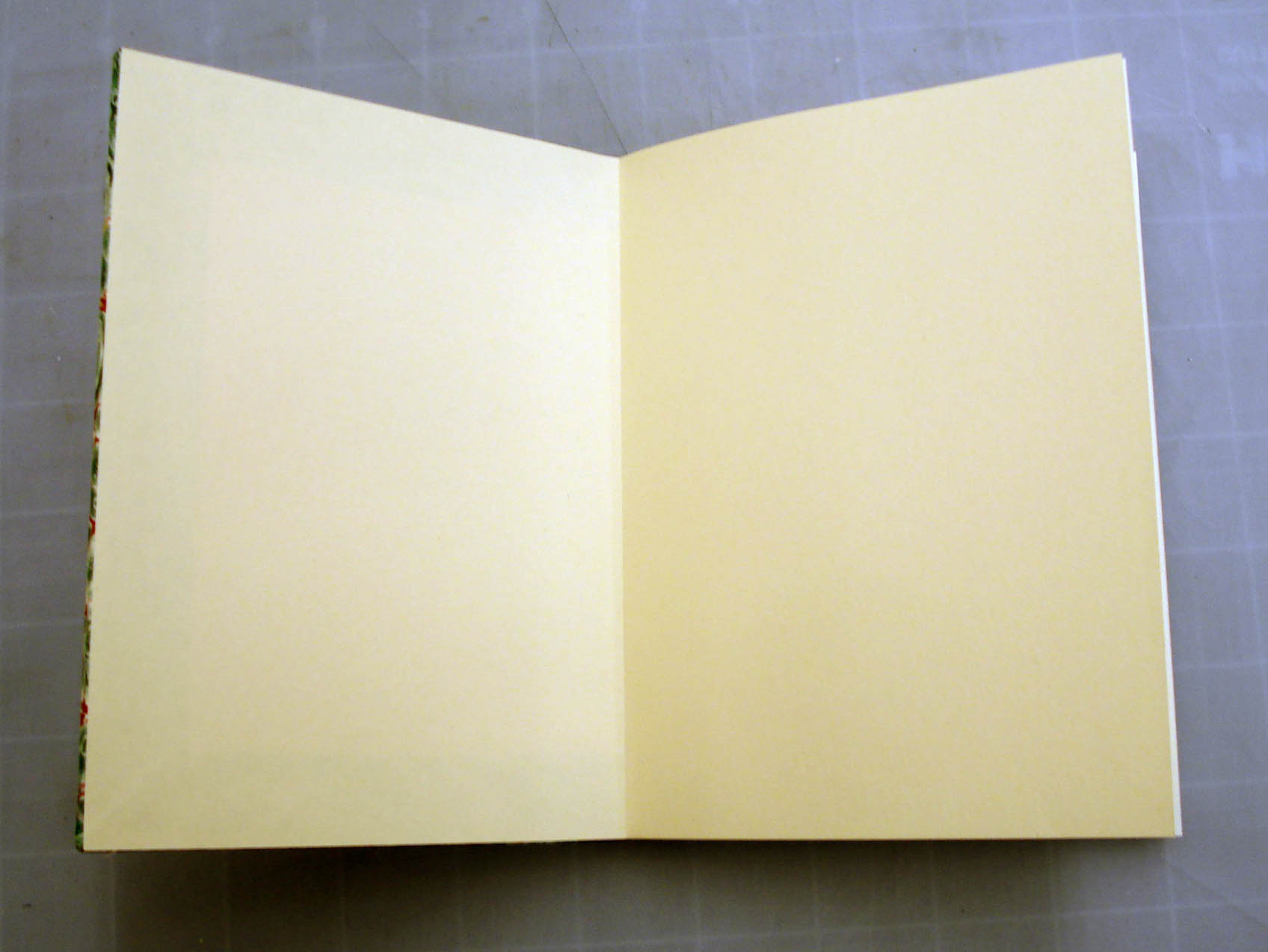
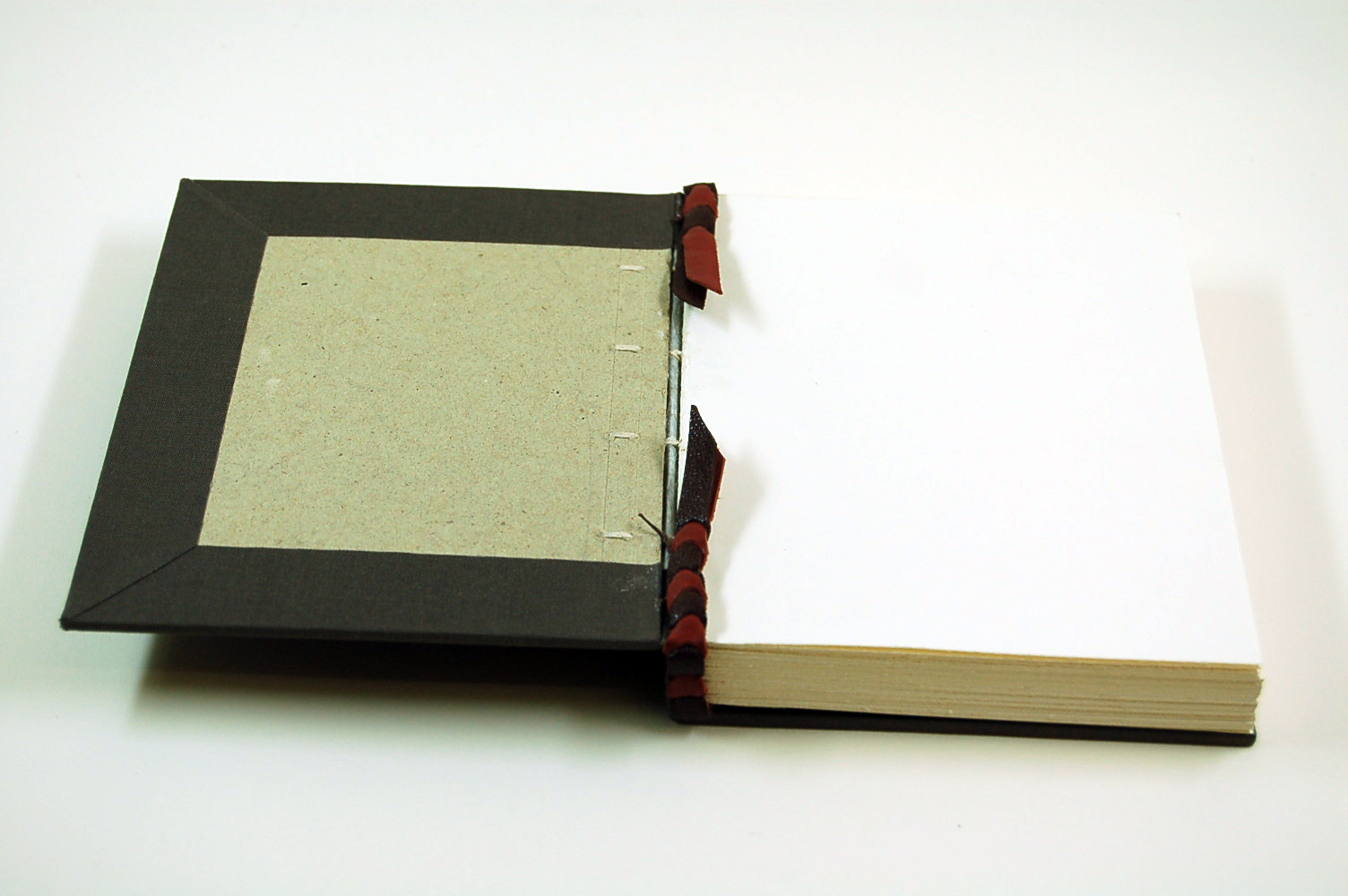
Here is a view of the inside “paste-down” and flyleaf.

We had a lot of fun with this project. The sewn board structure is quite versatile and can be embellished with edge decoration and leather spines or simplified according to one’s taste. These books are also easily stamped – the spine can be stamped before being adhered to the board or the covers stamped after finishing. I also really enjoy the way that these books open. I think that I will use this structure for all of my future notebooks. As a conservation student, I will also be on the lookout for instances in which this particular structure might be used as a viable treatment option. I cannot sum up the advantages of the sewn board binding better than Gary Frost (2004) when he concludes, “This book conservation structure is based on historical prototypes, the historical techniques are adapted to contemporary production methods and the specific sewn board practice is directed to the best applications.”

Paste Papers

Bookbinding

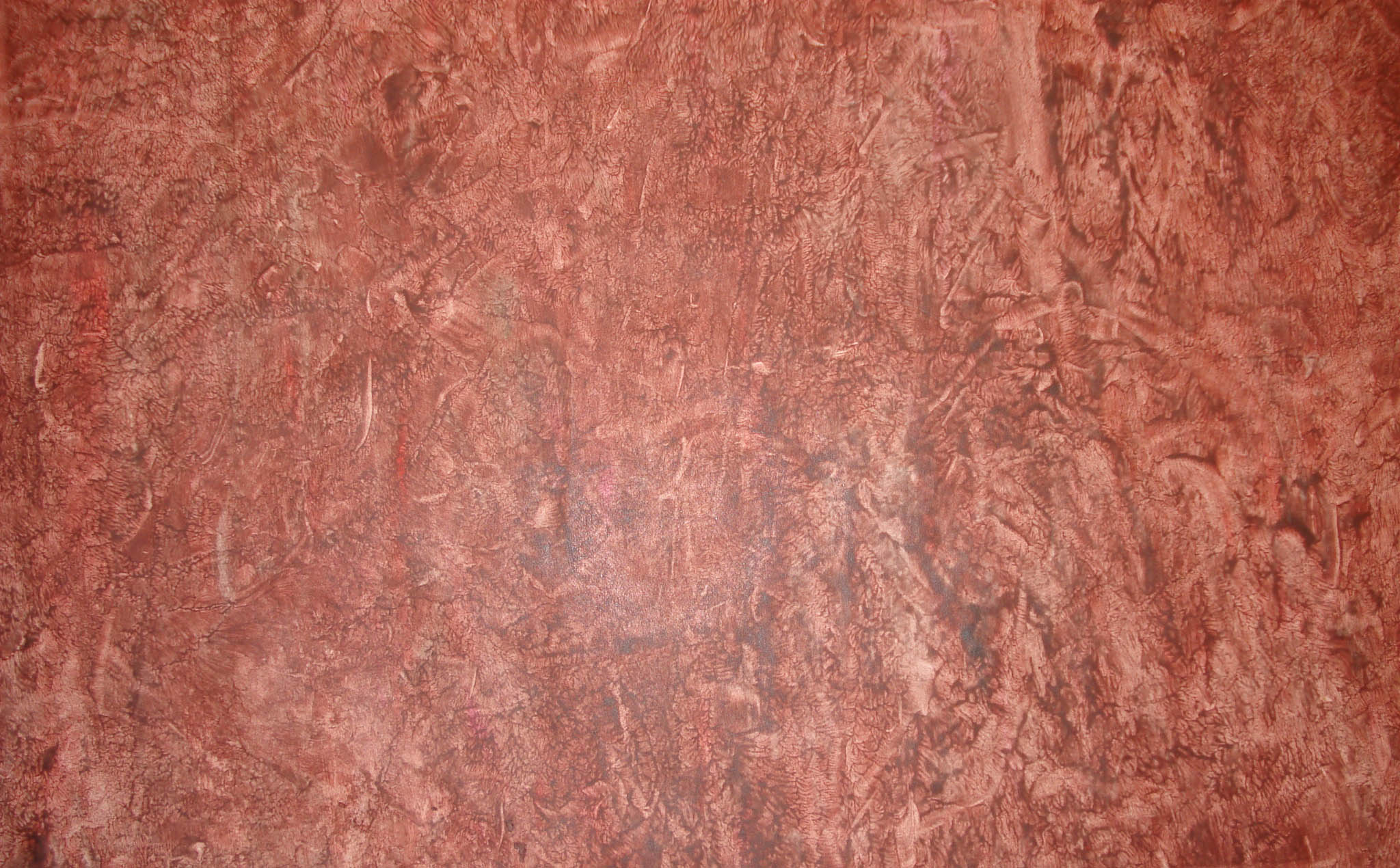
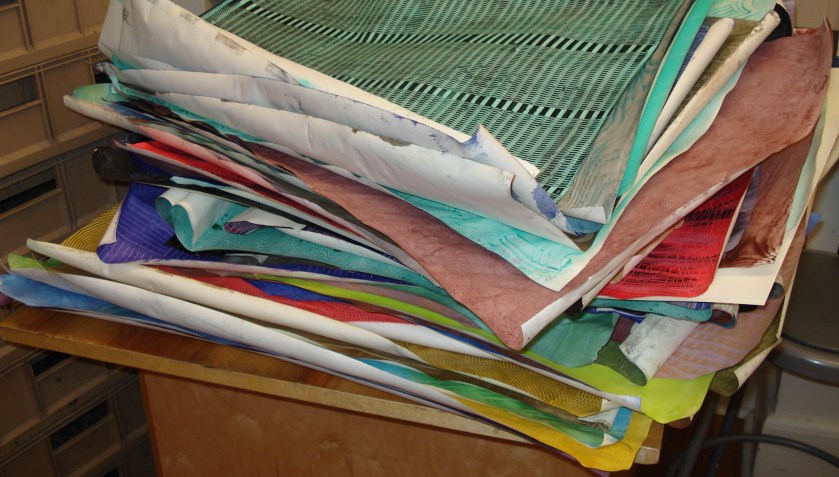
As a first year at NBSS, we make many, many simple book structures in a given week. Plain paper coverings get old rather quickly, so as you can imagine we go through a huge amount of decorative paper. A couple of weeks ago the entire bookbinding department spent the day making paste papers. These papers are created with a paste and paint mixture and are common board covering and endsheet materials for books in the 16th-18th century. If you would care to get an idea of some traditional paste paper patterns, the University of Washington Library has a small collection of digital images available online (found here). Of course modern book artists and crafty individuals love paste papers because of their ease of production and versatility; I’d also wager that their popularity stems from the fact that they are kind of like finger painting in their execution. Case in point, Martha Stewart has even done a segment on paste papers with Sage Reynolds.

I approached this work day as an opportunity to experiment with materials, and, therefore, didn’t really study up on historical patterns and colors – so my papers are kind of all over the place. There is a lot of literature out there on decorative paper for books, so I plan on being a little more focused the next time I do this.  I’ll briefly describe how we went about making these papers and then share some of my results.

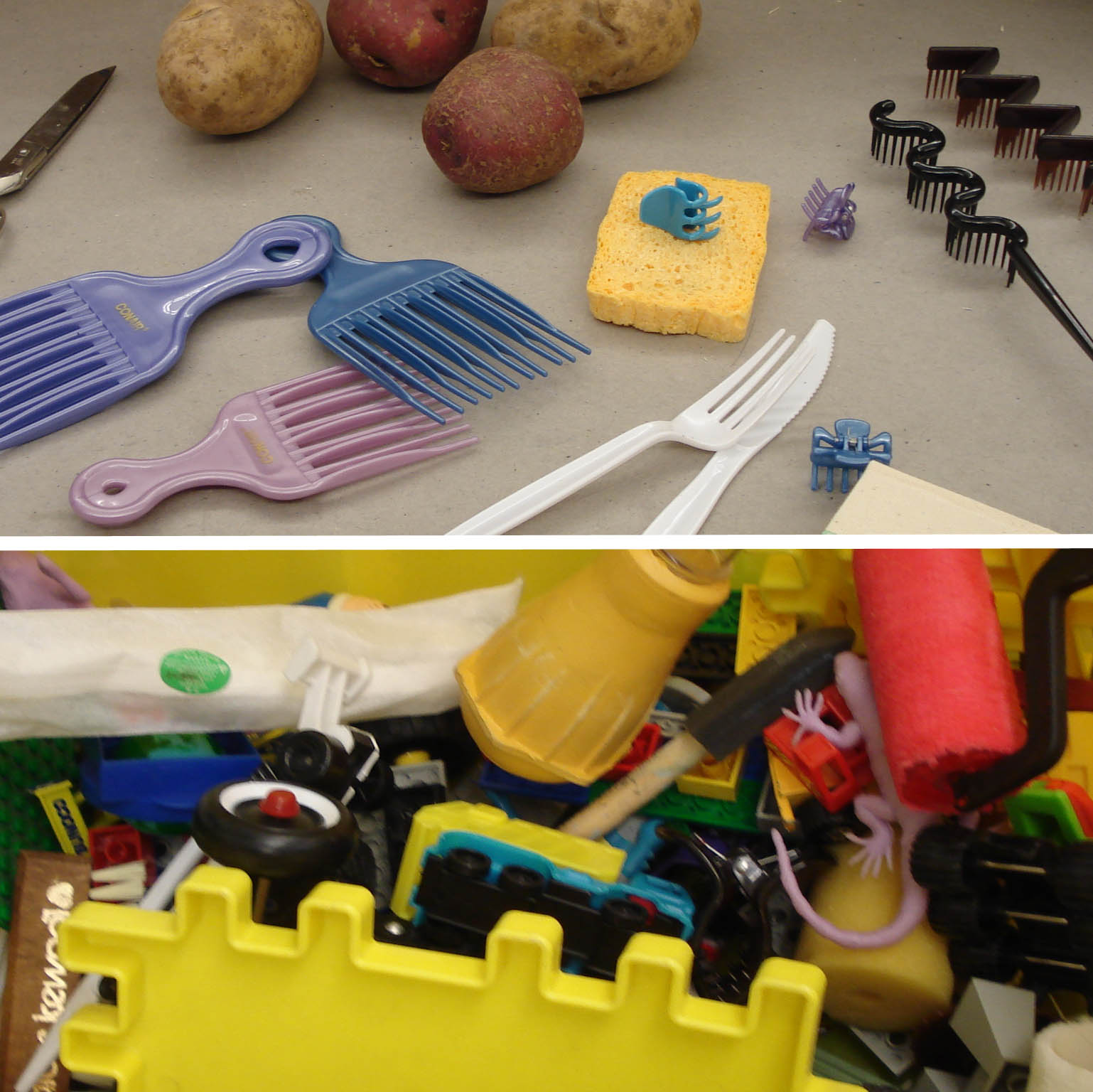
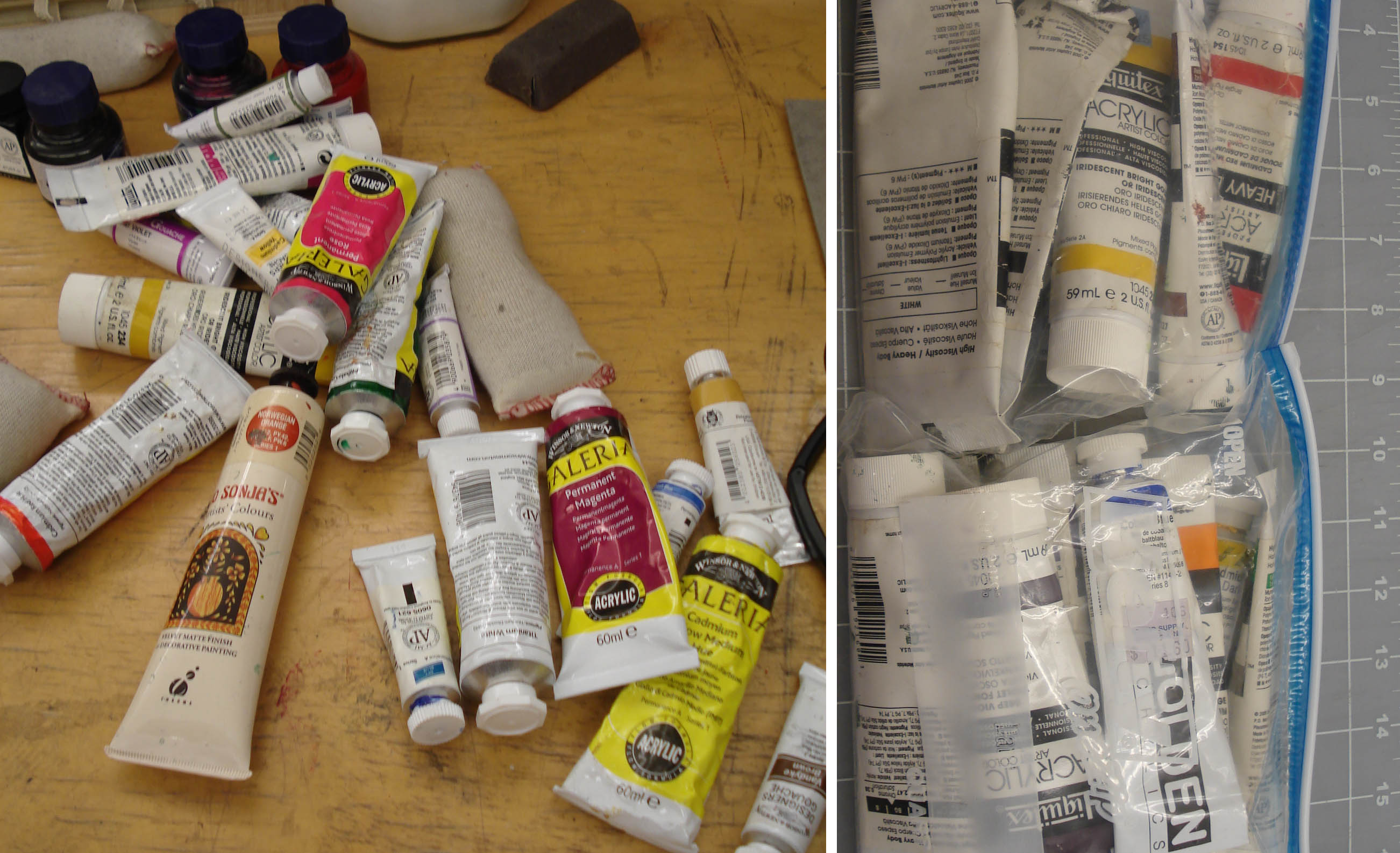
First off, we all rummaged through our respective basements, attics, and closets or went down to the local dollar store, drug store, etc. and grabbed any small object that we thought might make an interesting pattern. Combs, forks, potatoes, brushes, legos, toy trucks – you name it, we brought it in.

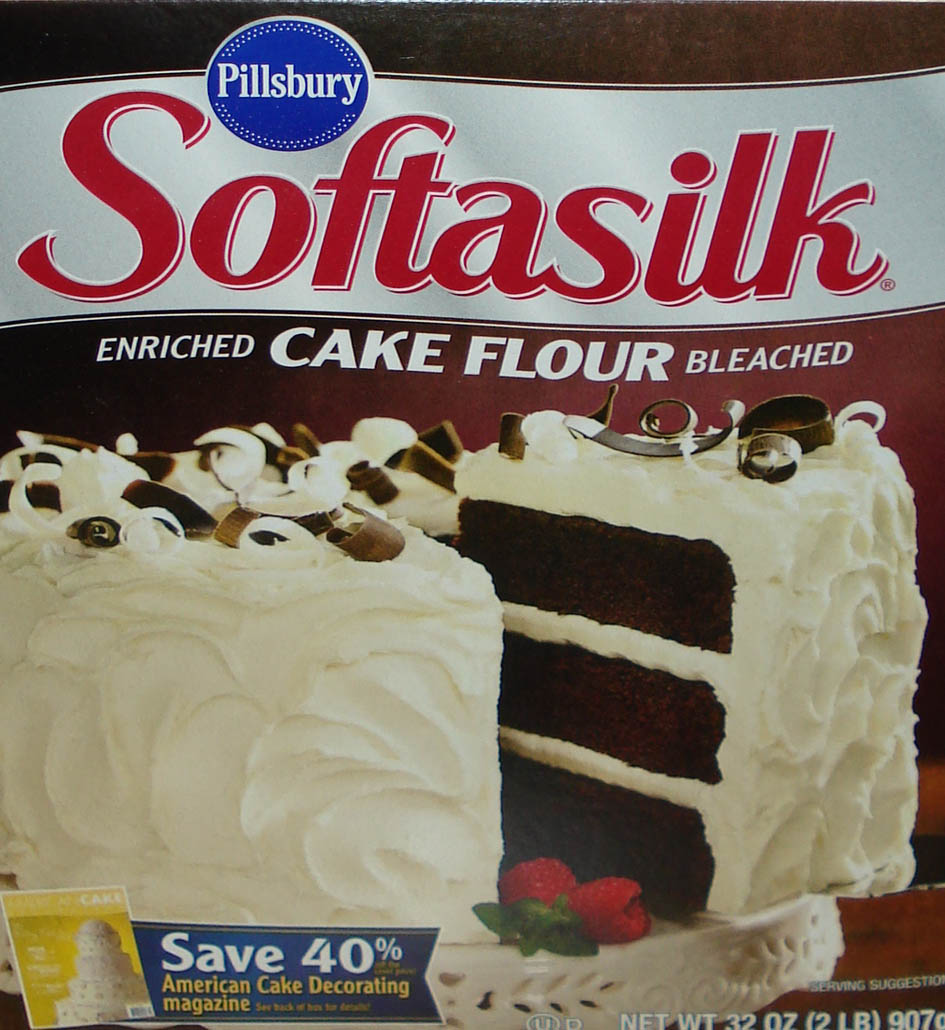
Then we made paste. There are literally hundreds of recipes out there for paste papers – Richard Miller put out a long list in 1995 on the Book Arts Listserv (found here)  – but basically the paste is made by cooking starch and water. You can use wheat starch, corn starch, or even cake flour.

Everyone seems to have a different opinion about which starches and starch to water ratios produce the best results. Some individuals advocate using methyl cellulose instead of paste. Having made few paste papers in my life, I have no real opinion one way or another. Rather than pick and choose, we went ahead and made 6 to 10 different mixtures to see how they compared.

After straining the paste and letting it cool, we divided it up into small bowls and added acrylic paint.

The result is a nice, thickly colored paste.

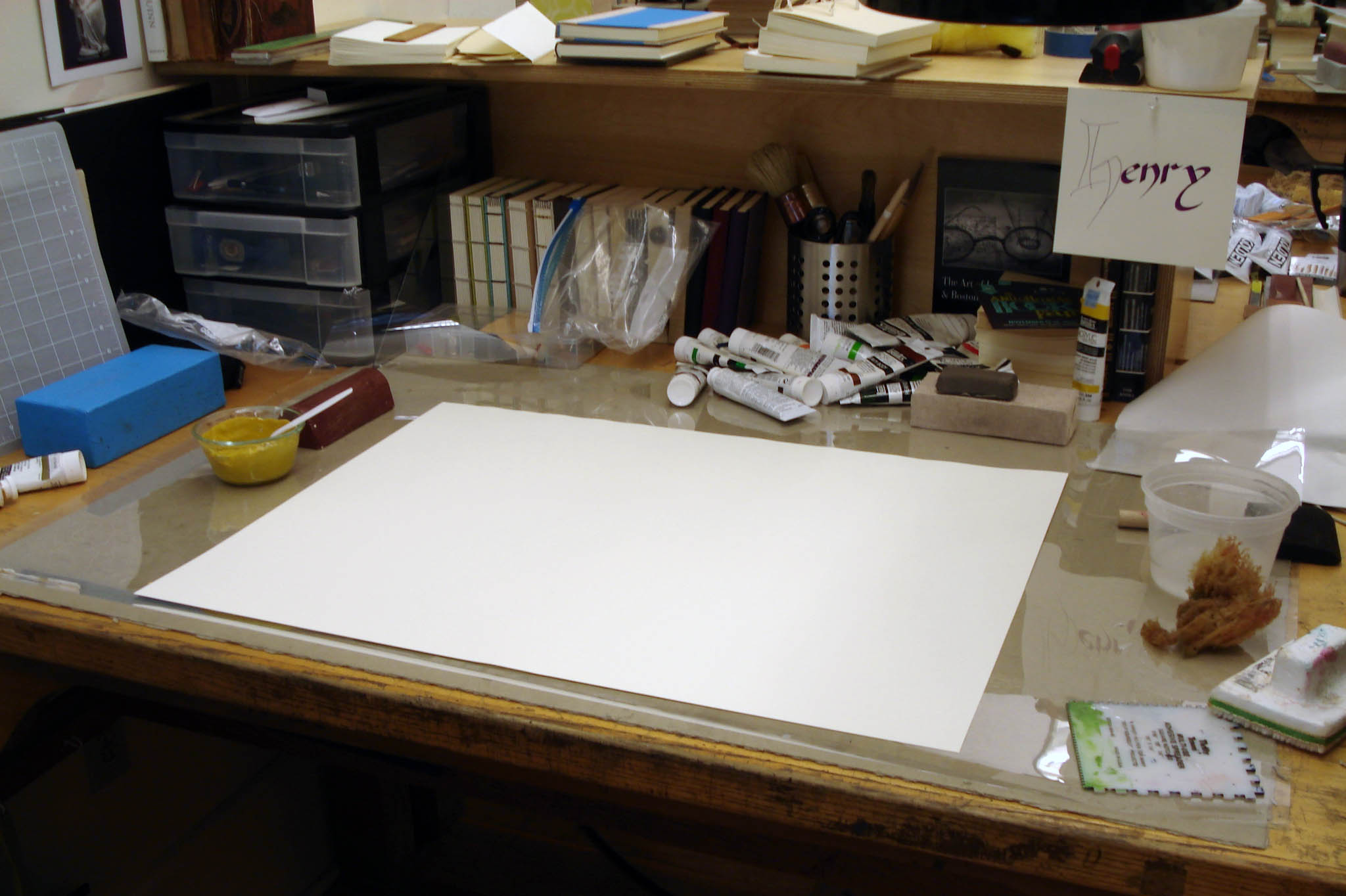
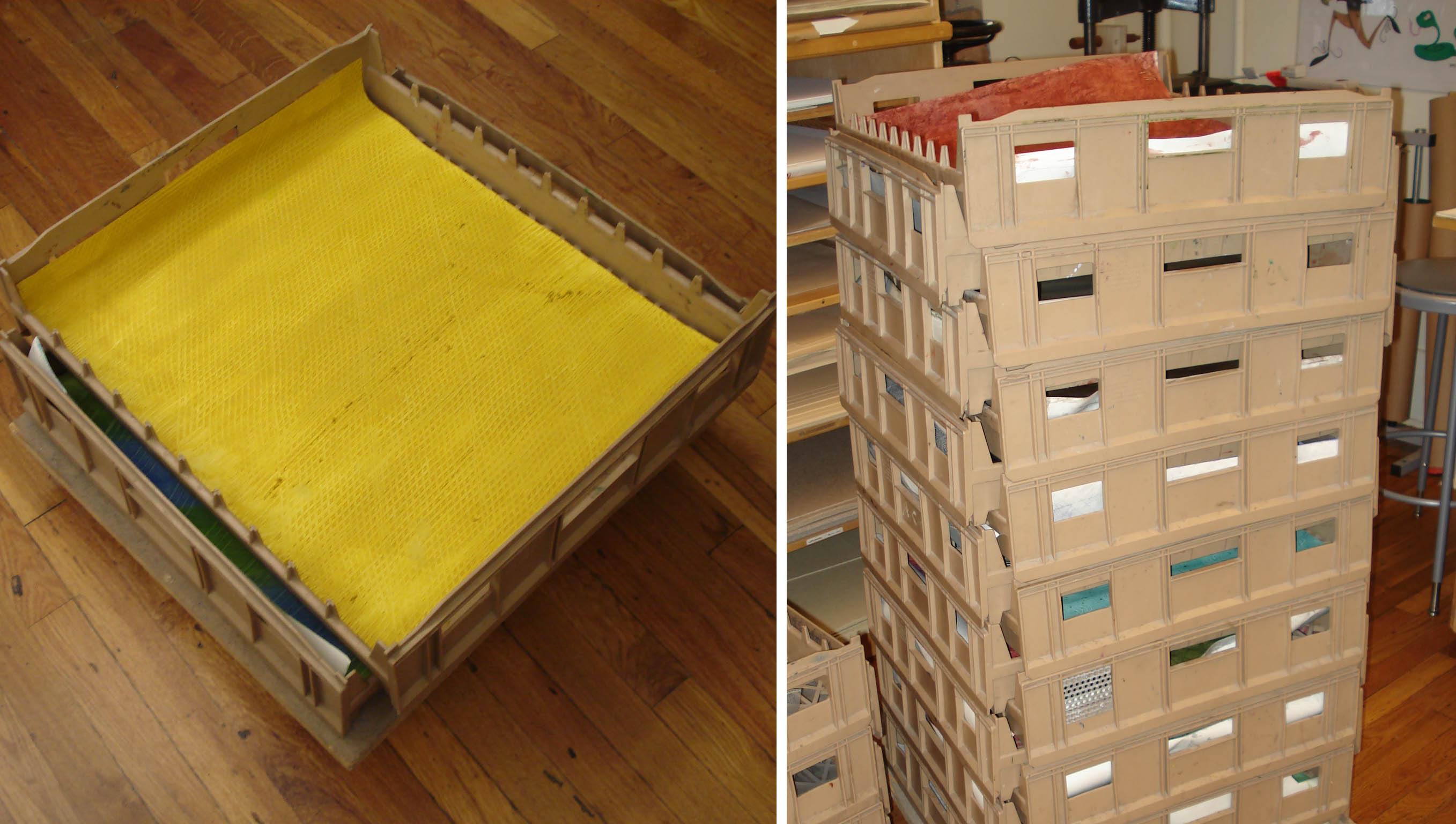
This process can be messy, so everyone cut a large sheet of mylar to protect their bench.

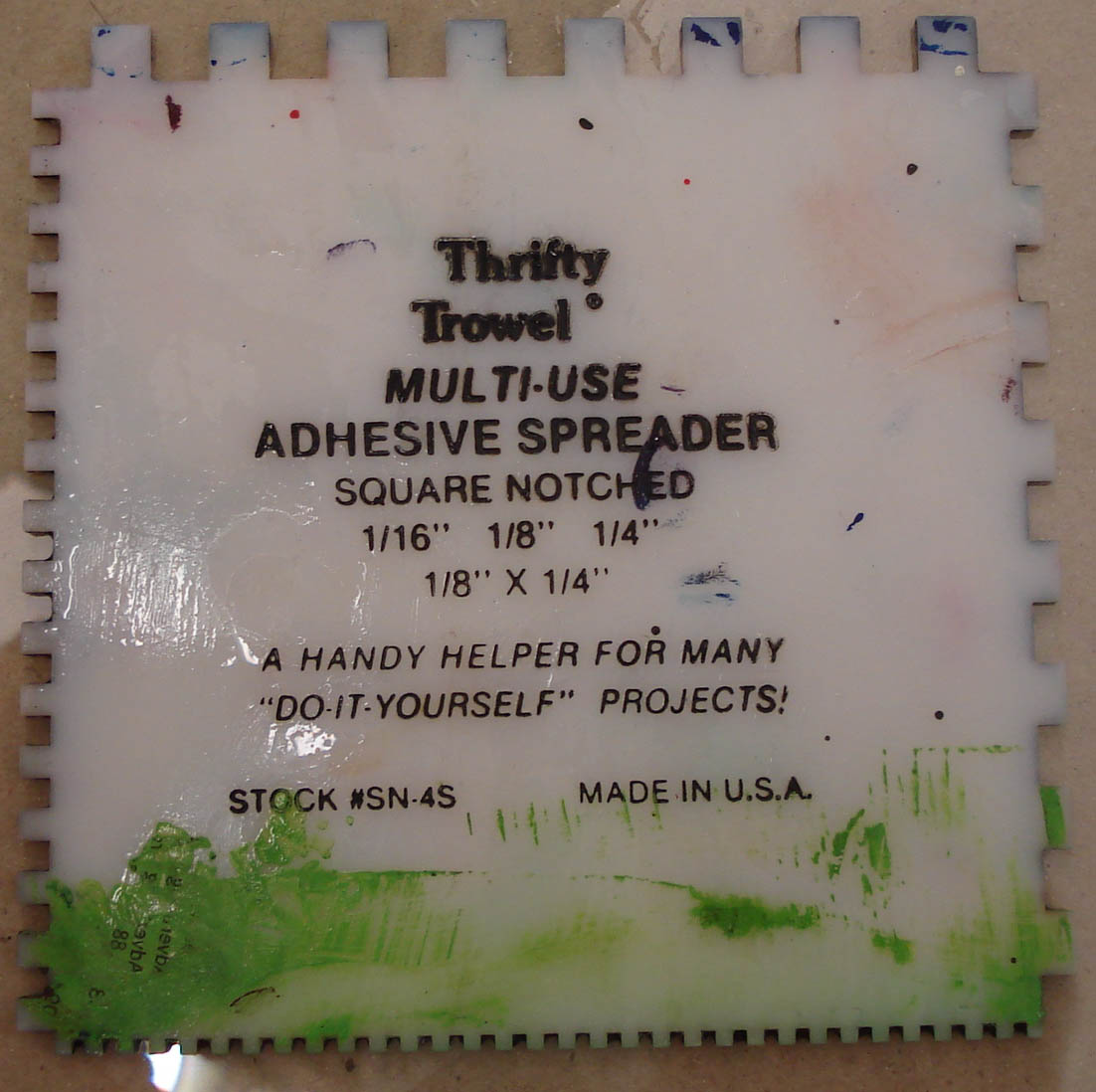
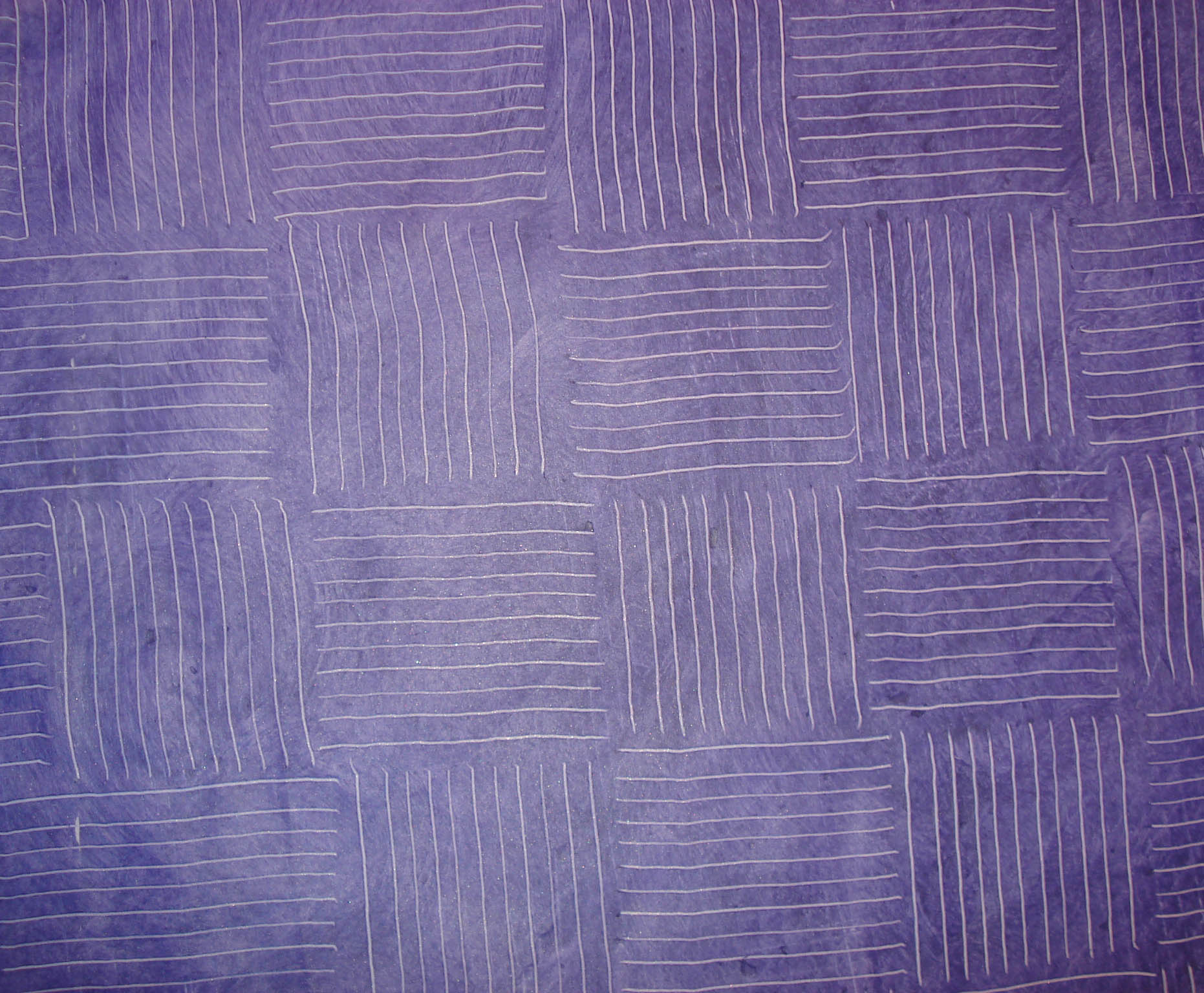
We used 1/2 sheets of Mohawk Superfine for all our paste papers. This type of paper is economical,  good quality, and a 15″ x 20″ sheet will provide more than enough material for a few of our model-sized books. When the work space is ready, the sheet is wet out with a damp sponge. This allows the fibers of the paper to relax in preparation for receiving the paste. The moisture also keeps the sheet stuck to the mylar during the patterning.  The colored paste is then evenly brushed out onto the page and a tool is drawn across it to make patterns in the paste.  I started off with a small square that would give me evenly spaced lines.

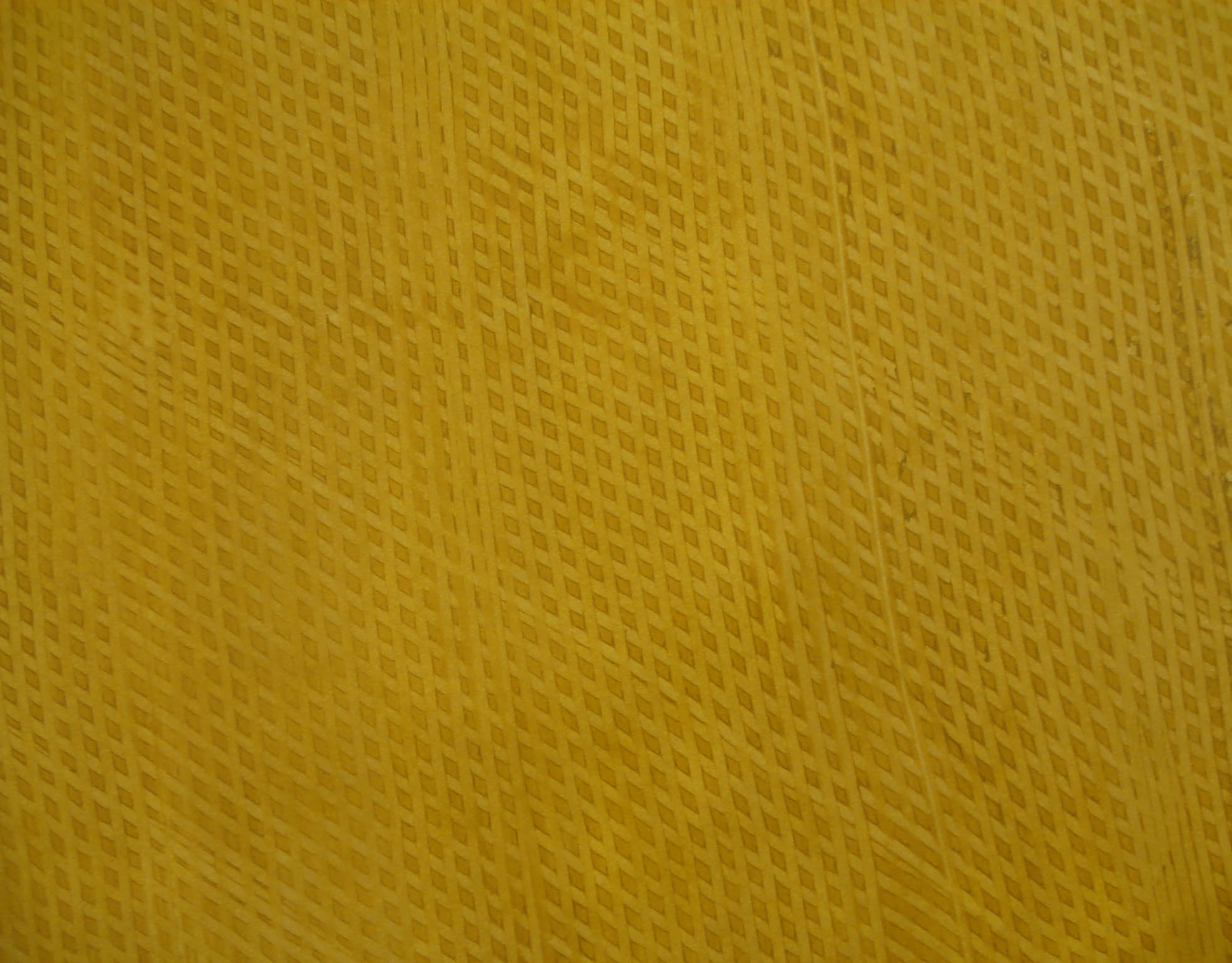
After dragging it across the page in several directions, I got this pattern.

This is pretty rough-looking  because it was done free-hand. To make it look nicer, I really should have constructed a tool as wide as the entire sheet and set up the space with a guide on one side so that my lines are really straight and even all the way across. When the patterning is accomplished, the wet sheet is put in a drying rack for a bit.

With so many people working at once, we quickly ran out of racks – so after each sheet had some time to firm up, we moved them to a clothesline to finish drying.

Below are some examples of the papers that I made. The first was made with that same plastic square.

This one was done with an “afro pick“.

I made a few calm ones with sponges.

I also made a few that had a little too much going on…

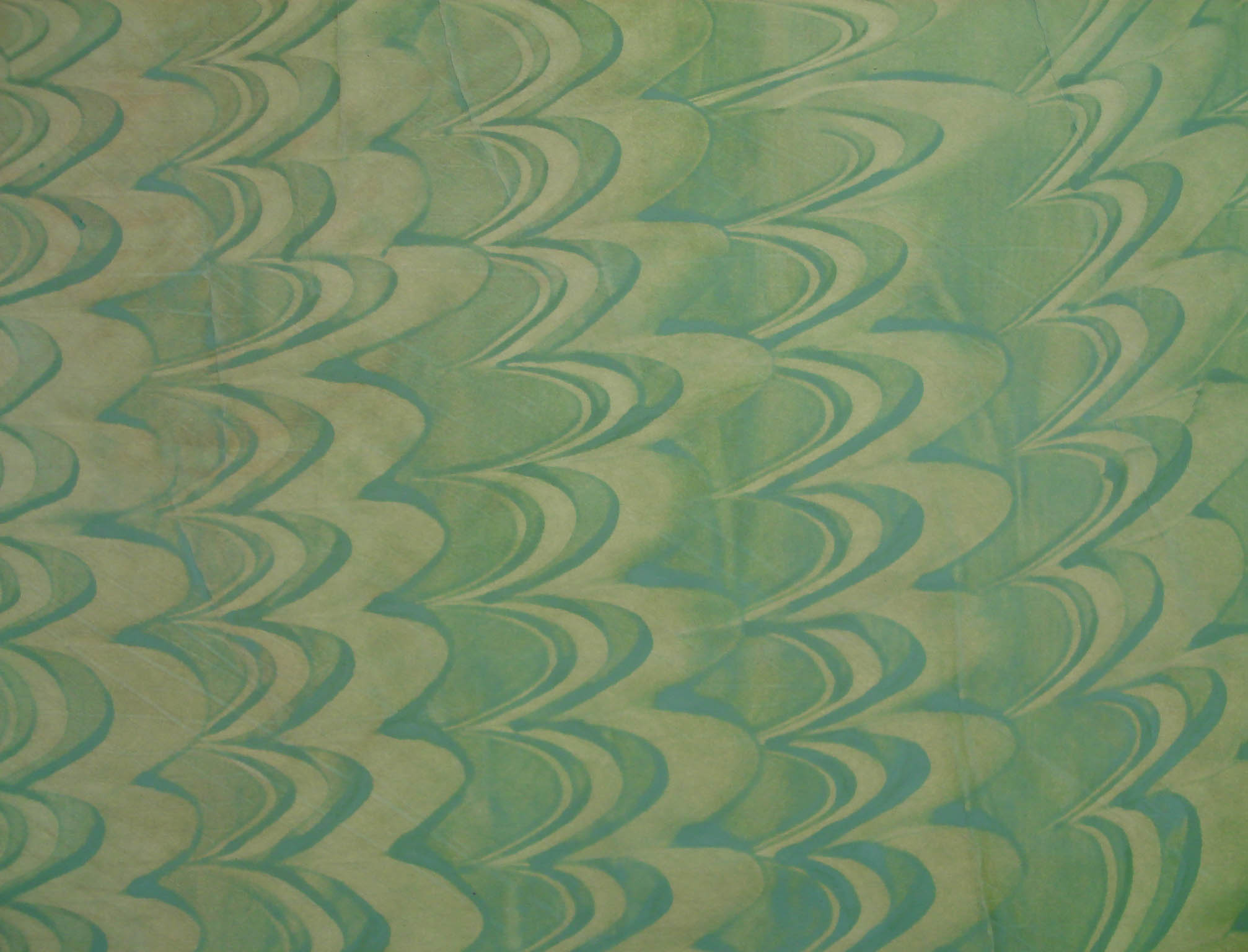
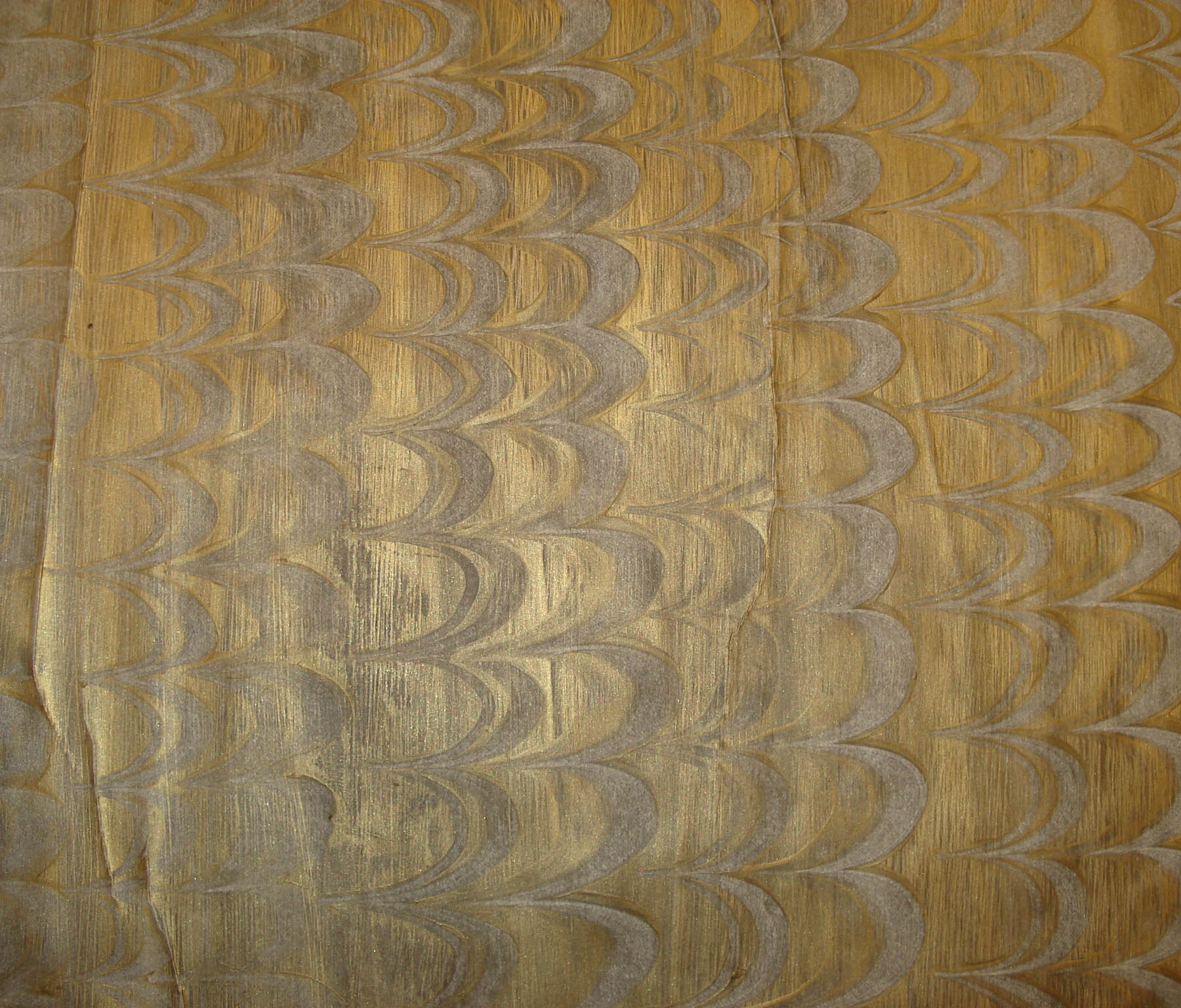
During the course of this, I tried to make a few papers that can be used for an upcoming project – the German paper binding or “pappband”. To get the appropriate pattern, one either sticks the freshly pasted paper together and pulls it apart or uses a sponge. In keeping with the historical examples that I’ve seen (like the one below), I tried to go with dreary, sort of ugly colors.

Below are some of those that I produced.

I confess that I’m not very good at the whole choosing sympathetic colors and patterns thing. I’m pretty jealous of a lot of paste papers that my classmates came up with. But the advantage of paste papers is that they are cheap and easy to produce – so I have plenty of opportunities to practice. In the meantime, I’ll be looking for specific examples in library collections to copy.

Next time, I’ll be sharing a recent production project that made use of these paste papers!

Sharpening with Jeff Peachey

Tools, Workshops

It’s been a little while, but I’ve finally found some time to sit down and share some of our recent experiences in the Bookbinding program.

Two weeks ago Jeff Peachey, conservator and tool aficionado, came up to North Bennet to teach a three-day knife making and sharpening workshop. This past summer I got to work on my sharpening skills a bit with a Tormek grinding system and the conservation staff over at the Parks Library at Iowa State University (you can read that blog post here), but I learned a great deal more about doing things by hand in this workshop. Jeff has been coming up to teach sharpening at NBSS for a few years now and divides his time up into general information sessions and class-specific activities. While the first years were busy making our own sharpening kits and knives, the second years were re-sharpening their blades and modifying spokeshaves for leatherwork. This blog post will focus mainly on the knives as I was too busy to go over and really see what the second years were doing. I’ll just have to write about spokeshaves next year:)

First off, we all gathered around a table in the workshop with a range of abrasives and different styles of leather paring knives.

Jeff went over the typical abrasives that one would typically use to sharpen (silicon carbide, aluminum oxide, and diamond), as well as some of the naturally occurring materials that can be used (shark and stingray skin, garnet, and emery). He spoke briefly of the strengths and weaknesses of Arkansas stones, Japanese water stones, and ceramic stones and which lubricants one must use to keep metal particles from getting lodged in the stone (aka Glazing). Jeff also gave us a crash course in the properties of the various kinds of steel that we would be using that week and which abrasives would work best for each.

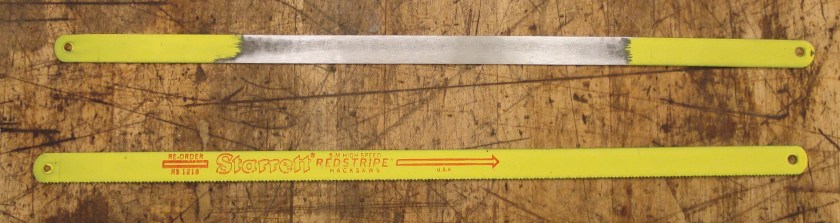
Next we spoke about the different characteristics of English, Swiss, and French style leather paring knives. Jeff demonstrated some different techniques for paring that one might use depending upon the style of knife that they prefer and instructed us to begin thinking about the kinds of knives that we would like to make over the next few days. In the meantime, he got the first years started on small lifting and English style knives. We started out with the 0.5″ Starrett “Redstripe” hacksaw blades.

We used these hacksaw blades specifically because they are fully hardened molybdenum (M3) high-speed steel. You can get them in a couple of different widths – which are useful for making a variety of knives – but we started small to get the hang of the process. After sanding the paint off of both sides of the middle of the blade, I marked the approximate angle of my knife on the blade, tightened it in a bench vise, and hit it with a mallet to break it in two.

All of our leather paring knives have a single bevel with a length that is 4 times the thickness of the blade and an angle of 13 degrees; a bevel that is any lower will be weak and bits will chip off when using the knife. Jeff showed us his method for putting that bevel on quickly with the grinder.

Then we were ready to finish the knives by hand… but first we had to make our sharpening system!

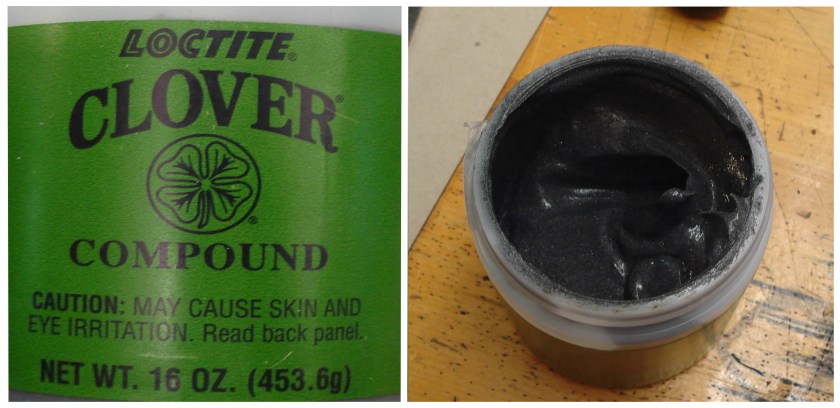
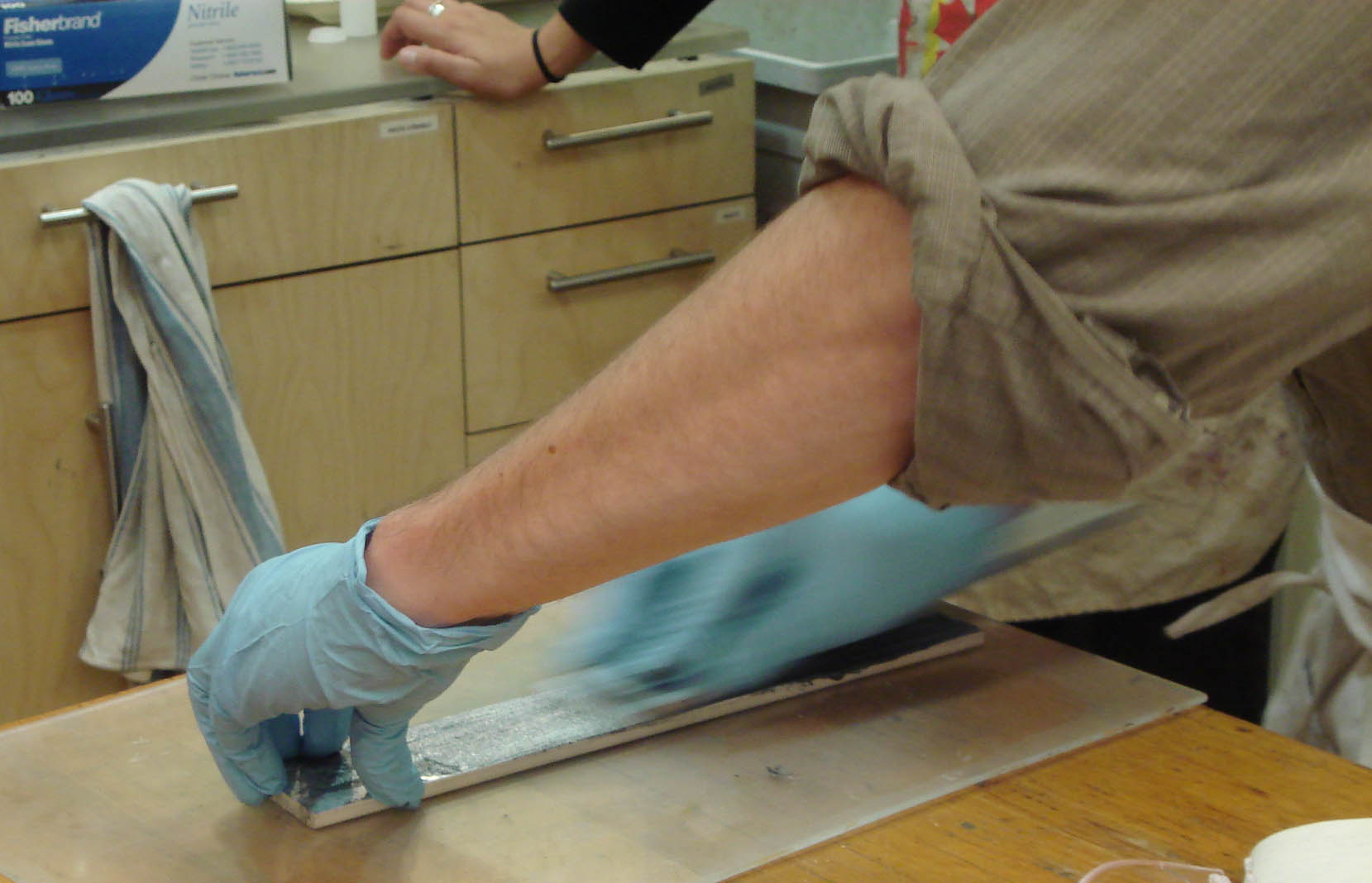
Jeff has been using a set of two aluminum plates with 3M Microfinishing film adhered to each side for some time now. At the beginning of the workshop, everyone received two 12″ aluminum plates. These pieces do not come perfectly flat (they are a bit dished out toward the centers) and we had to fix that in order for our sharpening to be effective. And the only sure-fire way to do that is by hand. So everyone smeared their plates with some silicon carbide grease, placed them together and began lapping.

As you can imagine, this part did not go very quickly. For some, it went on the rest of the day. With the compound on the plate, you can’t really tell if your efforts are having any kind of effect. So you lap for what feels like an eternity, then wipe it away to reveal that your plates are not quite flat yet, and start again.  The image on the left will illustrate – the areas of the plate that are not experiencing contact are lighter than the parts that are making contact. When the aluminum is finally completely flat, different grits of microfinishing film are applied to each of the 4 sides of the plates: 80 micron, 40 micron, 15 micron, and 5 micron. The image on the right shows the completed plates.

If hand lapping for hours (or days) is not your thing, Peachey sells this system on his website (here). One can also use glass – the advantage is that it is already flat, but you have to worry about it breaking.

Now that we each had a sharpening system, we were able to finish the edges of our blades through a two-part iterative process. Starting off with a diamond stone (we used a DMT Duosharp) or the 80 micron microfinishing film and a little water for lubricant, we worked the flat side of the blade until it was actually completely flat and a burr could be felt on the bevel side.

We then worked the bevel side of the blade until a burr could be felt on the flat side – all the while checking to make sure that we maintained our 13 degree bevel angle.

We would then switch to a finer grit and repeat the process until we had used every side of our set of aluminum plates. The cutting edge was finished by stropping with the flesh side of horsebutt dressed with chromium oxide and then polished with the flesh side of calf skin. The result is a mirrored, wickedly sharp knife. These are my first two attempts from the 0.5″ hacksaw blades.

As a side note: this particular knife shape, a kind of English style with a rounded cutting edge at the heel, is apparently favored by Christopher Clarkson. I have yet to really try it out and cannot comment on the situations in which it may be more appropriate to use than a straight bevel at the heel of the blade. But I’ll keep you posted as the year goes on.

After we had made a few blades with straight bevels, Peachey demonstrated the various techniques for sharpening a curved edge.

At the beginning of the workshop I picked up an A2 and an 01 steel blank for making a smaller Swiss style knife and a larger lifting knife. These came with a 13 degree straight bevel already on them, so I just had to modify them a bit. Aside from rounding the sharp corners, I made the bevel on the lifting knife a bit shallower with the grinder. As with the hacksaw blades, these were also finished by hand using the aluminum plates – but with a curving motion. The before and after shots appear below.

On the third day, Jeff went over a few ways to make handles and sheaths for the knives. I tried something different on each of my knives, figuring that I would give them all a try and re-handle the ones that do not feel comfortable. The knife below on the far left is a blade with a double bevel (pretty difficult to do well and mostly me just messing around with a bit of extra 1″ hacksaw blade) and has a wood handle. For the larger lifting knife (second from left) I just rounded the edges and left it without a handle so that, should the need arise, it can be used to lift material in water. The Swiss knife (at center) is wrapped in flax cord, while the lifting knife beside it is covered in calf skin. The small rounded lifting knife to the far right has a simple horsebutt handle. In each case the handle is adhered with PVA.

The sheaths were also relatively easy to construct. Layers of leather and or 20 pt board as thick as the blade are sandwiched between two pieces of horsebutt and adhered with PVA. I gotta say, these are infinitely better than my previous sheath attempts made of Davey board and duct tape. By the end of the 3rd day I had completely sharpened, handled, and sheathed 6 knives of various shapes and sizes.

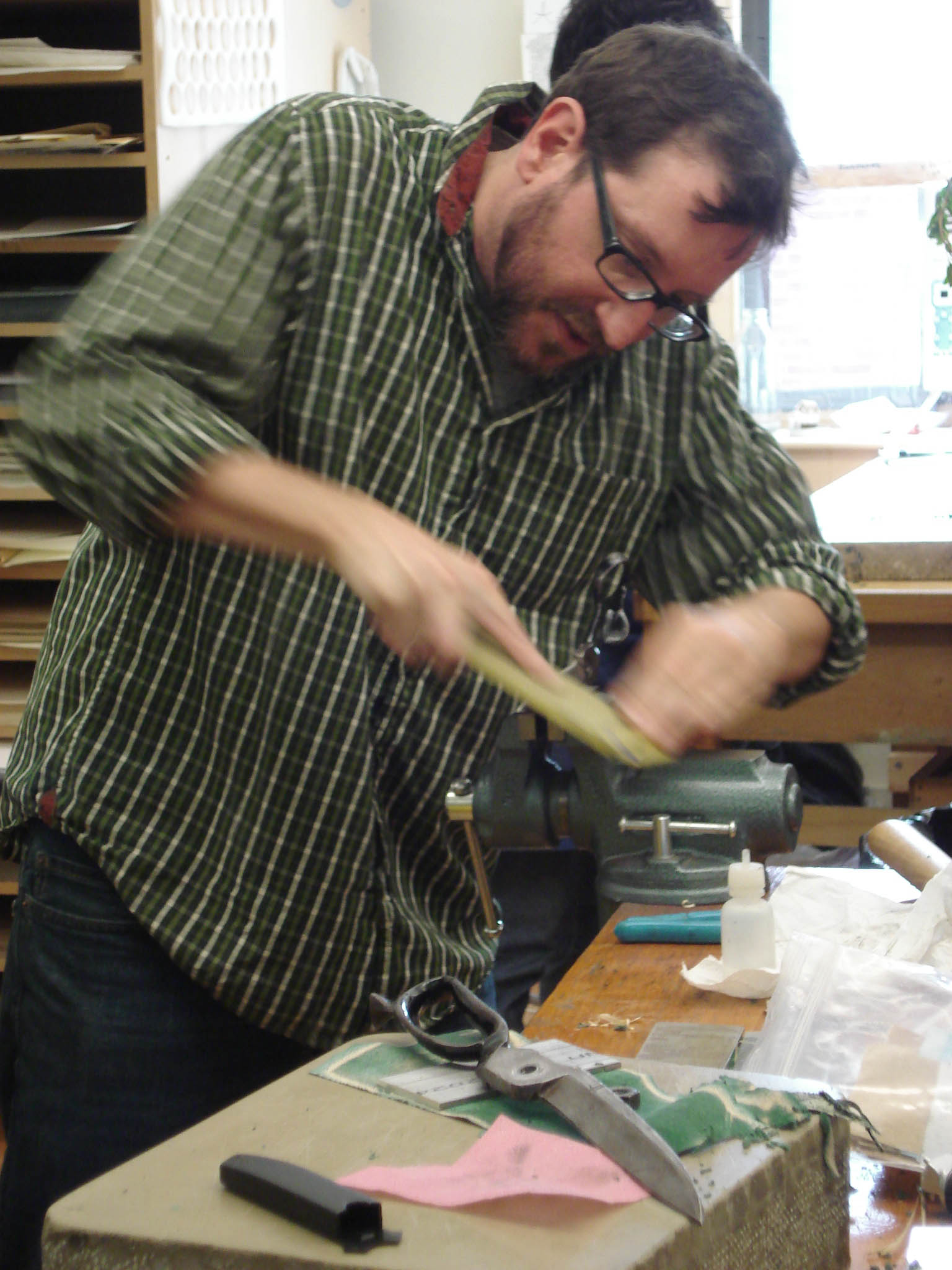
Aside from knives and spokeshaves, Peachey’s workshop included a range of other demonstrations. He showed us a method for sharpening scissors with a diamond stone and a vice.

(Here Jeff’s arms are moving so fast I can’t get them in focus… but the photo illustrates the action.)

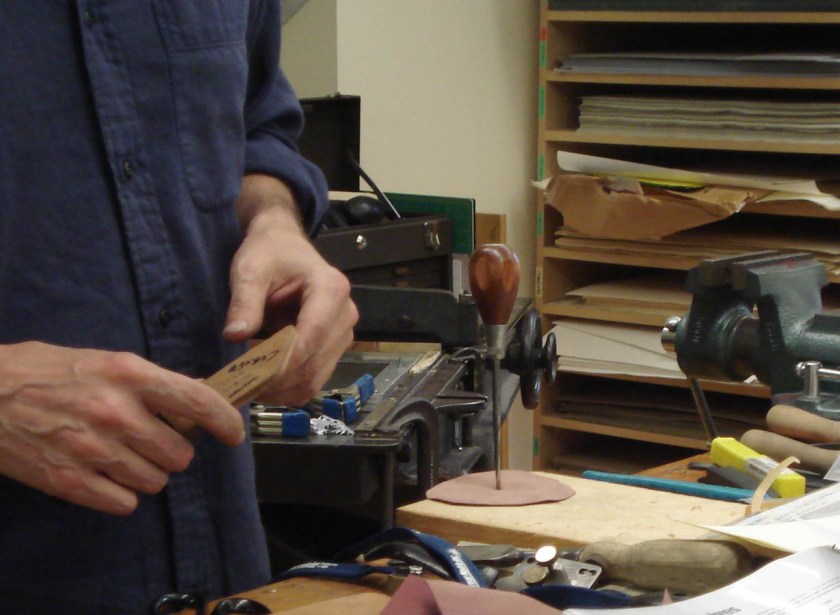
Jeff also blew my mind with this nifty trick to make leather strips. He first cut a circle of leather and basically nailed it to a shooting board with an awl.

Then using a paring knife, he started a thin strip and just kept spinning the leather to make a long, thin length – kind of like peeling an apple.

Finally, Jeff showed us how to make small Japanese bamboo lifting knives, called hera, with a short length of bamboo and a chisel. After splitting a piece of bamboo with a chisel, Jeff squared it up…

… and shaped the blade.

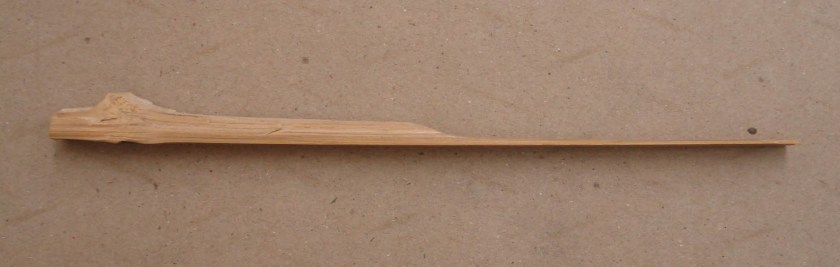
The rough shape from the side looks like this:

The tool is then sanded down with a range of sandpapers (from 150 grit to 400 grit) and polished with 3M Tri-M-Ite polishing paper. Finally a light coat of Renaissance wax is applied to the top of the blade.

You can read his description (with better pictures) of the hera on his blog here.

All in all, this was a fantastic workshop. Thanks to Jeff’s patient and thorough instruction, everyone came away with a much better understanding of sharpening and quite a few more tools. It will be interesting to see how I end up using these tools over the coming months. Will their present form really live up to their intended function? That will be the true test. If not – at least I now have the equipment and know-how to fix them.

Long and Link Stitch

Bookbinding

I realized after my last post that when I took these pictures I did not include anything for scale. Therefore you (the gentle reader) have no idea what size these books really are. All of the models pictured are in fact quite small; the finished page size is about 15.5 cm tall x 11.5cm wide.

We continued our exploration of non-adhesive structures with a variety of long and link stitch bindings. The first was a simple link stitch with covers of single folios of decorated paper sewn through the fold. The folios were then sealed shut with double-sided tape to make a stiffer cover. Unlike the Ethiopian and Coptic bindings, these bindings are all sewn with a single needle.

The long stitch structures are all sewn through slots or holes in the covering material. As this style of binding can become very complex, I began with the most straightforward of pattern in a slotted wrapper of 20pt board.

The covers in my first model are cut to include a fore-edge flap for added protection to the pages. While the sewing can be a bit tricky to start, I was surprised at how stiff the cover attachment became in the end. It opens quite well.

I had a bit of the University of Iowa Case Paper lying around, so a made a better looking version of the same sewing pattern – only this time with a yapp at the fore edge.

After making a few entirely limp structures, we watched a video of  Adam Larsson’s 2004 Guild of Book Workers presentation about a collection of Medieval limp vellum and leather structures found at the Uppsala University Library. The collection originates from a monastery library and contains around 1000 volumes. Many of the items in this collection have stiff spine plates made of wood, horn, or leather and can be highly decorated with inlays or weaving over the exposed sewing.  The covers are usually leather lined with linen cloth (sometimes cut flush with the pages at the head and tail, sometimes turned-in) with a fore-edge flap that ties to buttons on the front cover or spine plate. Larsson reports that while the text of these volumes is typically on paper, the innermost folios of each section are either made of or guarded with vellum. It would appear that the original binders did not believe that the strength of paper alone was enough to hold the sewing together.

After showing a series of images from the Uppsala collection, Larsson demonstrates one of these structures with link sewing and buttons across the spine plate. While the pattern looks very simple on the outside, it is actually very difficult to follow. Larsson is quite fast in his demonstration and the instructions become a  blur of “in section 1, station 2. out station 2, row 1. in station 2, row 2 into section 2, station 2…” Luckily, someone from a previous class was kind enough to make a transcript of the instructions, and after much cursing and resewing, everyone ended up with their own model. My version has case paper covers and a spine plate made from two strips of vellum adhered to a leather core. The ties are woven linen thread that is stitched through the fore-edge flap.

This one also opens quite nicely – although the buttons on the spine do make it wobble around on the table surface.

For my second attempt, I worked on a long stitch structure with elements based upon the common features in the Uppsala collection. This one also has case paper covers and a layered spine plate of vellum and leather. The designs are made by shaping and punching the outermost layer of vellum to reveal the leather underneath. The exposed sewing is woven on the outside of the spine plate and the edges of the covers protected with sewn-on strips of leather.

I had a lot of fun with these limp structures and I will continue to experiment. There are so many different variations of sewing patterns and materials that, as Larsson says in the video, “the only limit is your imagination.” I am currently working on another model with a stained maple spine plate that I hope to share soon. I also found a thin brass plate the other day that I’d like to try out. But more on that later…

Next up, I’ve got pictures from our recent sharpening workshop.

Ethiopian/Coptic Bindings

Bookbinding

In the first few weeks of school, we started with non-adhesive structures. As one  of the oldest known forms of the codex, it is fitting that we started with Coptic style bindings. These bindings have chain stitch sewing that laces through the board. The sewing is done through pairs of sewing stations with a needle on each end of the thread. All of these models (unless otherwise indicated) are made with Mohawk Superfine paper and Davey Board covers. The holes in the board were created with a pin vise. The first model was made with no decoration or embellishment to get a sense of the structure.

(Click pictures to enlarge.)

In this style of binding, the boards are cut flush with the textblock. (Please forgive the crazy colors in these photos… I’m still trying to figure out how to set the white balance on the camera.)

One of the benefits of this binding structure is that it opens completely flat.

As with learning any new skill, practice and repetition are important – so I proceeded to  make a few more of these. First with some decorative paper covering the boards…

… then with a Coptic-style endbands. With this one, I moved the outermost sewing stations in a bit and pre-punched the sections for the endbands. I followed Greenfield and Hille’s instructions and after only about 5 attempts, succeeded in creating something akin to a Coptic headband. However, just a day or two ago while rummaging around the shelves in the workshop, I found a model supposedly done by Adam Larsson (the conservator, not the hockey player) that has an absolutely amazing set of Coptic endbands with links that are way tighter than mine. So I’ll have to work on those.

Next I tried some variation in the color of thread to create a nice pattern.

As well as some crazy marbled paper inside.

I also created a model with quarter sawn oak boards. The holes in these boards were created with a hand drill (like this one) and the bevel was made with a rasp. They were finished with a light coating of Renaissance Wax and polished.

Finally, I attempted a cloth-covered model with the Ethiopian style of leather headbands. The endbands themselves are made with two strips of leather laced together, and while they look nice enough, they put so much extra material in the joint that the boards splay out. 

I guess historically these books would be made with wooden boards and completely covered in leather, so the effect wouldn’t be quite so pronounced. But as for this model, I was not so enthusiastic about the result.

In the next few posts I’ll share some other types of non-adhesive bindings, as well as some pictures from our recent knife making/sharpening workshop with Jeff Peachey. Stay tuned!

Working and Reworking

Writing

I started this blog about a year ago as part of my graduate course work in library school. It offered a useful means to report on my project (a condition survey for small collection of European Travel literature in the Rare Book Collection at UNC) and share some of the more intriguing items that I encountered along the way.

And then I had to write my master’s paper and I could not bring myself to use it anymore…

But today the blog is resurrected! Today it is committed to a new purpose. Like a phoenix from the ashes it shall rise up and share ever more amusing and edifying book-related madness to the masses. Or just to the people that I actually know. From here on out, I’ll be sharing my first year work in the bookbinding program at the North Bennet Street School – hopefully as I finish it.  We are on the fourth week of the school year, and I have quite a few books completed already. I have taken some pictures and they will begin appearing here within the next few days.

So please follow along with me on this two-year journey…

Other Collection Highlights

Surveys

I’m in the process of putting together a report of the results of the project. In the meantime, I thought I would share some more of the interesting items that I encountered while performing the survey. I have little more than basic bibliographic information on these items. At least five languages are represented in the collection, so most of the time I can’t even read the text. My comments here are cursory and represent the information that I could glean just by examining either the item or its illustrations.

In a collection of travel literature, I think it is fitting to show some travel-friendly reading. In the past year, it seems that every ebook reader has touted mobility as a big feature. Well, books have provided super-mobile reading for over 400 years! Here are two of the smallest items from the collection of European travel literature at the RBC. When I snapped these pictures, I didn’t have a ruler to illustrate the size of each volume – so I used my cell phone as a visual reference. The first is a volume from 1619 by Pomponius Mela, titled De sitv orbis libri tres

Highlight001

The text size is a bit difficult to read, but it would fit in your pocket better than a Kindle! The next tiny item is The Hibernian Atlas from 1775 by David Williamson.
Highlight002

This item is really amazing.  It describes the counties of Ireland and features tiny, colored maps (one example below). All text and illustrations are completely done in manuscript. The pictures do not do it justice – I apologize for the blurriness.

Highlight003

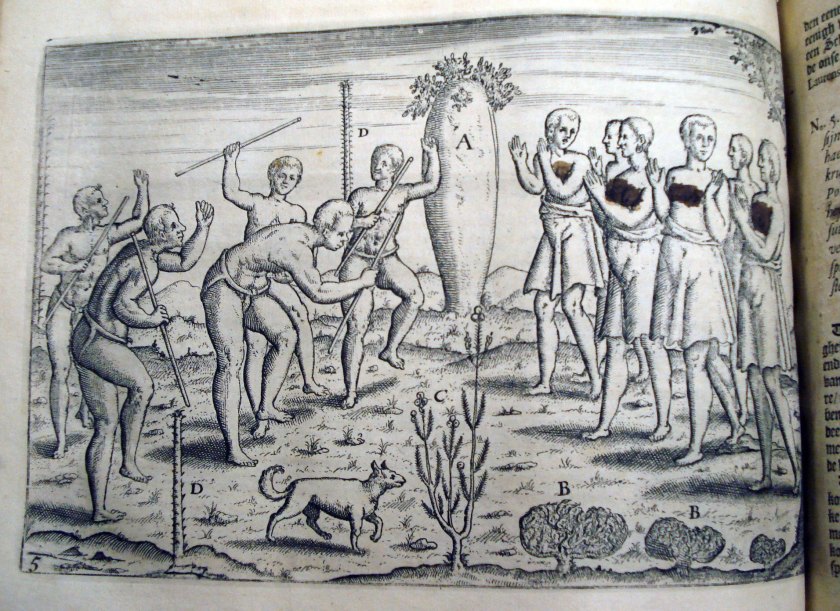
Deviating from the topic of tiny books, another book in the collection caught my eye because of the evidence of its reception and use.  The bibliographic information I have from the survey says it is a volume from 1646 by Commelin. The work documents voyages by the Dutch East India Trading Company and the native peoples, animals, and vegetation that the sailors encountered. The title page appears below. At some point in this volume’s long life, the illustrations have been censored. The engravings depict the native peoples in their traditional dress. Images showing women with exposed breasts have been heavily inked. The ink is now a dark brown color. The two images below will illustrate this method of censorship.

Highlight004

Highlight006On certain pages, offending images are gone. I cannot determine if they were physically removed from the page by the censor or if this is the result of ink corrosion. Engravings with these lacunae were later repaired with paper.  The white shape on the following image is an example of one of these repairs.

Highlight005

Sea Monsters

Surveys

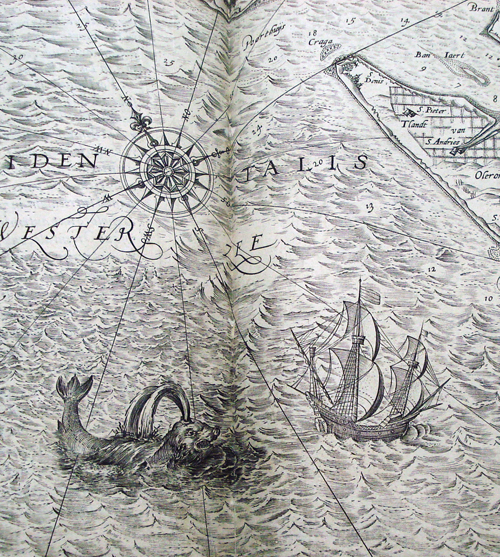
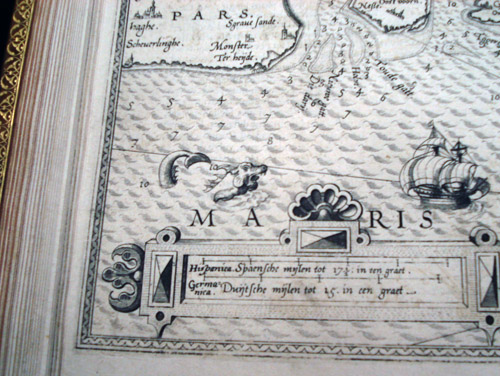
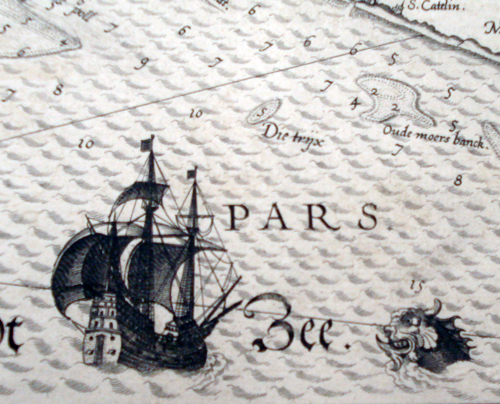
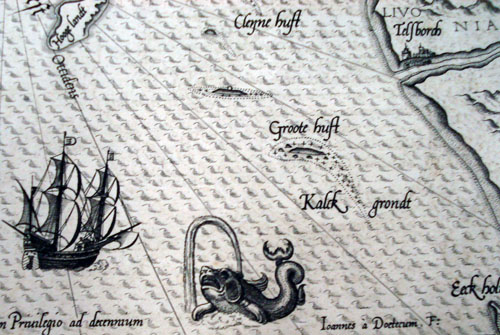
I think I’ll take a moment away from talking about surveys and book structures to share one of the greatest things I found while looking through the maps in this collection. Before modern cartography, it was a common practice to decorate the water on maps with illustrations of dolphins and other sea creatures. Judging from engravings that appear in other parts of the collection, I think a lot of these sea monsters are actually the artist’s interpretation of sharks and whales. Considering first hand accounts of large sea creatures were probably just a glimpse of teeth or a tail – it’s really no wonder that a lot of these things end up looking more like dogs or dragons.

One particular volume in the collection – a 1586 text by Lucus Janszoon Waghenaer titled Speculum Nauticum – is in wonderful condition and is absolutely filled with maps featuring these sea monsters. I really enjoyed these things, so I’m inserting a few images of them below. This volume is not all that much younger than the Carta marina, and while these particular monsters aren’t as colorful, they are just as fascinating.
map01

map02

map03

map04

map05

map06

map07

Common Conditions: Part 2

Surveys

Following my post on textblocks, I will now move on to describe some commonalities in the condition of bindings in the collection. The vast majority of the items in this collection are bound in leather. They range in size from atlas folios (~30 inches in length) to 32mos (3.5 inches in length).  Many are bound onto cords – exhibiting the characteristic bumps across the spine. Some have had the leather of the spine replaced, others have been repaired with book cloth. Several volumes in the collection have been rebound, but many remain in (probably) their original binding. I will revisit this topic in a forthcoming post on repairs.

During the survey, my first focal point for evaluating the structure of a given volume was the spine. Books smaller than folio-2 are shelved upright in the stacks at Wilson library. In this position, the faces of the boards are relatively protected. While the edges and corners of the book may be bumped and torn, this damage presents a minor threat to the overall stability and usability of the item. Over the course of the survey, I began to notice very common features in leather volumes from this time period. These characteristics could depend upon the size of the volume and the forces to which it has been exposed; however, it is important to remember that some of these items have existed for 500 years – so the exact causes are unknown.

This first volume has a characteristic “wedge” shape. The exact causes of this condition are unknown to me; however, I can guess that over the book’s life, environmental factors have introduced moisture to the textblock and binding. Moisture could cause the paper to swell where unrestrained by sewing or the boards to warp in such a way that the fore-edge ends up thicker than the spine.  Jan also suggested that this shape could be the result of too little sewing or thread that is too thin. The image of the tail end of the book below will illustrate.

binding01

Another commonality in leather bindings of this period is splitting of the leather where the boards meet the spine – otherwise known as the outer joint. I’ve noticed several volumes in the collection have minor splitting at the endcaps. While endcap damage could be caused by a reader improperly removing an item from the shelf, it often probably indicates other structural issues. Once the joint is separated at the head and tail, it may be only a matter of time before the rest of the leather in the joint gives way. This depends upon the type of leather and the book’s storage conditions over time. The image below shows a book with splitting in this fashion. Unfortunately, this item has been treated with an unidentified plastic coating (giving it a bit of a shine), which resembles a product called “Liquid Leather”. This coating was probably applied in an attempt to halt further damage, but Jan reports that it is nearly impossible to remove. This limits the possibilities for future conservation treatment to the item.

binding05

A third type of damage that came up regularly as I was surveying items was splitting of the inner joint. This damage occurs to the paper of the endsheets on the inside of the cover where the board attaches to the textblock.  While damage to the endsheets can sometimes parallel damage to the leather, inner joint splitting is more likely the result of basic use over time. The image below shows an example of a split inner joint.

binding03

In this type of book structure, the sections of the textblock are sewn onto cords that are laced through holes in the boards. As deterioration to the binding continues, eventually the cords could be the only thing holding the boards on. Handling a book in this condition is risky because labeling from the spine or pieces of the leather from boards are more likely to come off. Should the cords finally break, the boards will be totally detached – as in the item below.

binding04

While the first set of images came from octavo and quarto sized books, the item above is a folio sized volume. This format is much larger and the textblock and boards are much heavier. In some cases, the boards are made of wood and are very thick and heavy. As I surveyed volumes of this size (and larger), board detachment appeared to be more common. This could be due to the extra force exerted by the weight of the boards and textblock.

I have also noticed that the front board attachment tends to be in worse shape than that of the back board. I hypothesize that this occurs because the front joint experiences considerably more use than the back joint – the typical reader picks up the volume and opens the front cover to find their place. After repeating flexing of the joint for a couple hundred years, the leather at the front of the volume will be weaker and more prone to damage than at the back.