German Paper Bindings: Stiffened Paper Bindings

Bookbinding

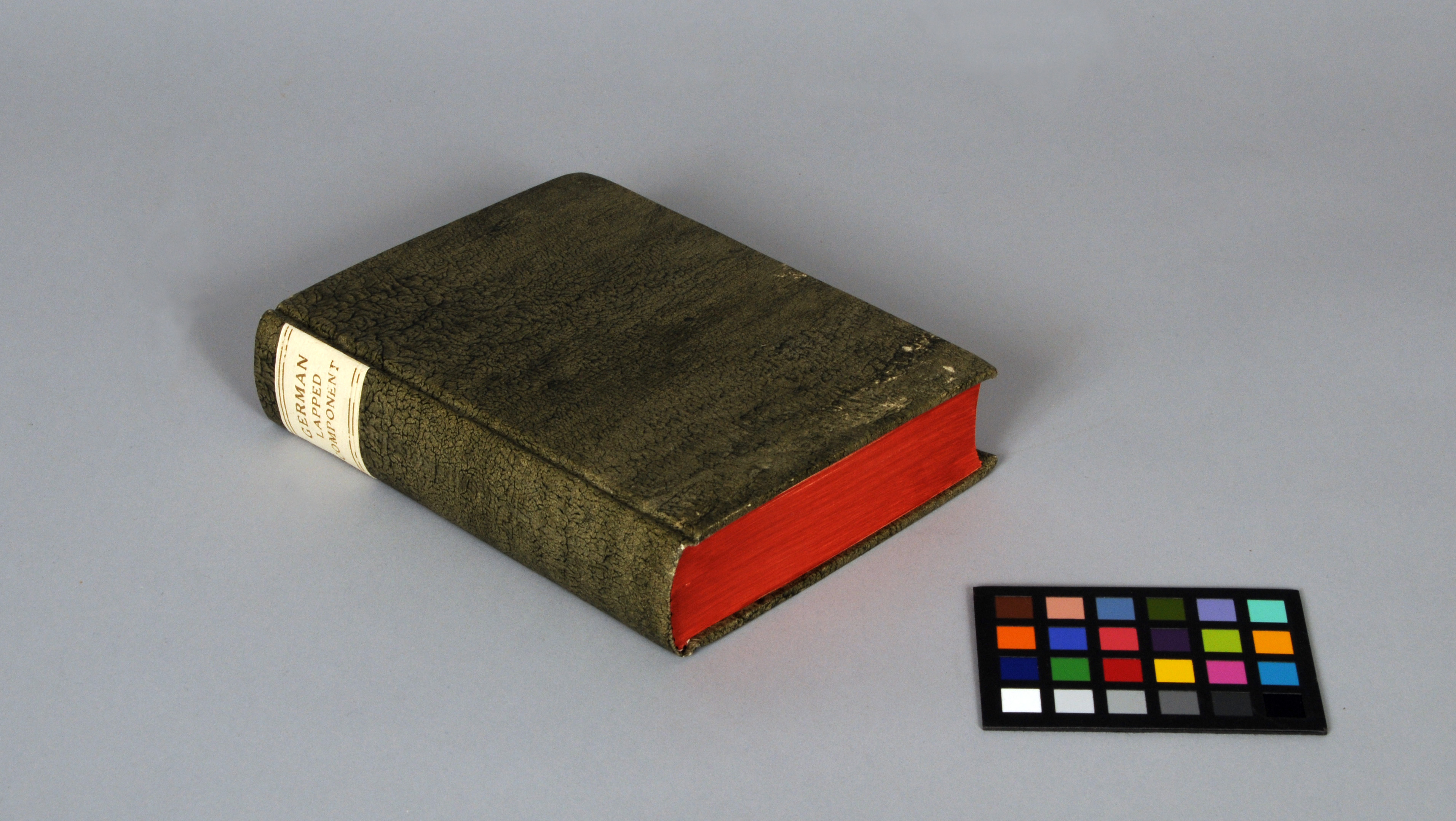
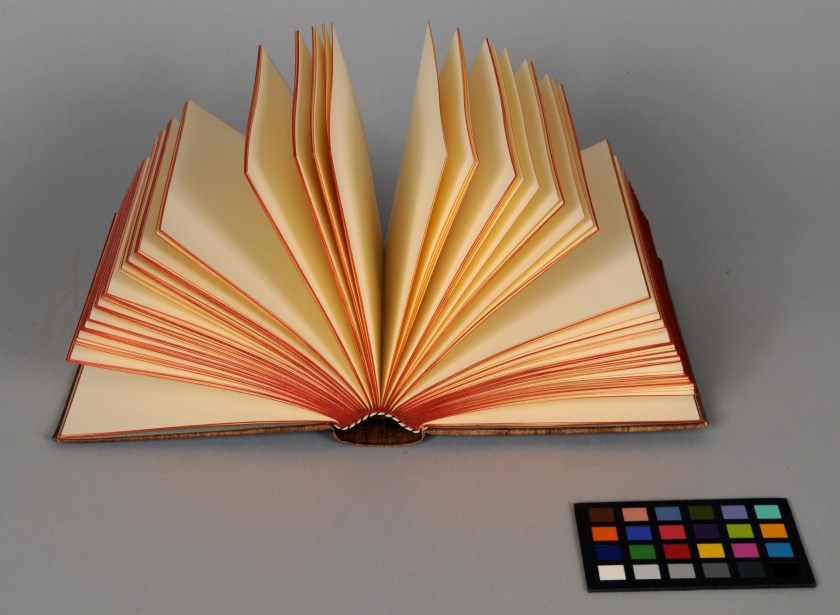
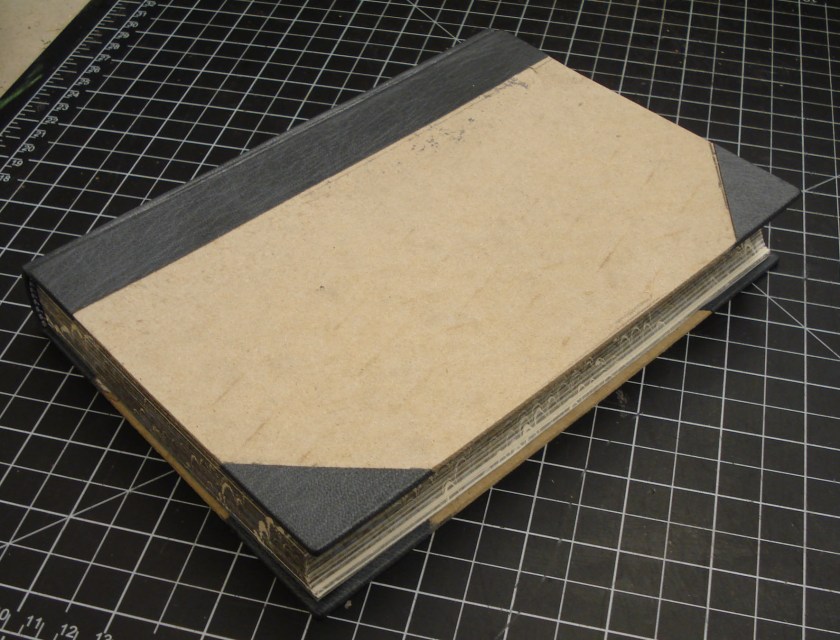
The next paper binding that I’m going to share is by far the simplest structure that we’ve done. Rhodes (1995) describes these stiffened paper bindings as “beefed-up wrappers with thin board or thick paper supports” (p. 58). While they appear very similar to the typical modern, adhesive-bound trade paperback, these books are much more durable. Cloonan (1991) states that this structure was typically used to bind up issues of periodicals (p. 8), and in fact the example in the school’s collection is a gathering of German pharmaceutical journals from 1804.

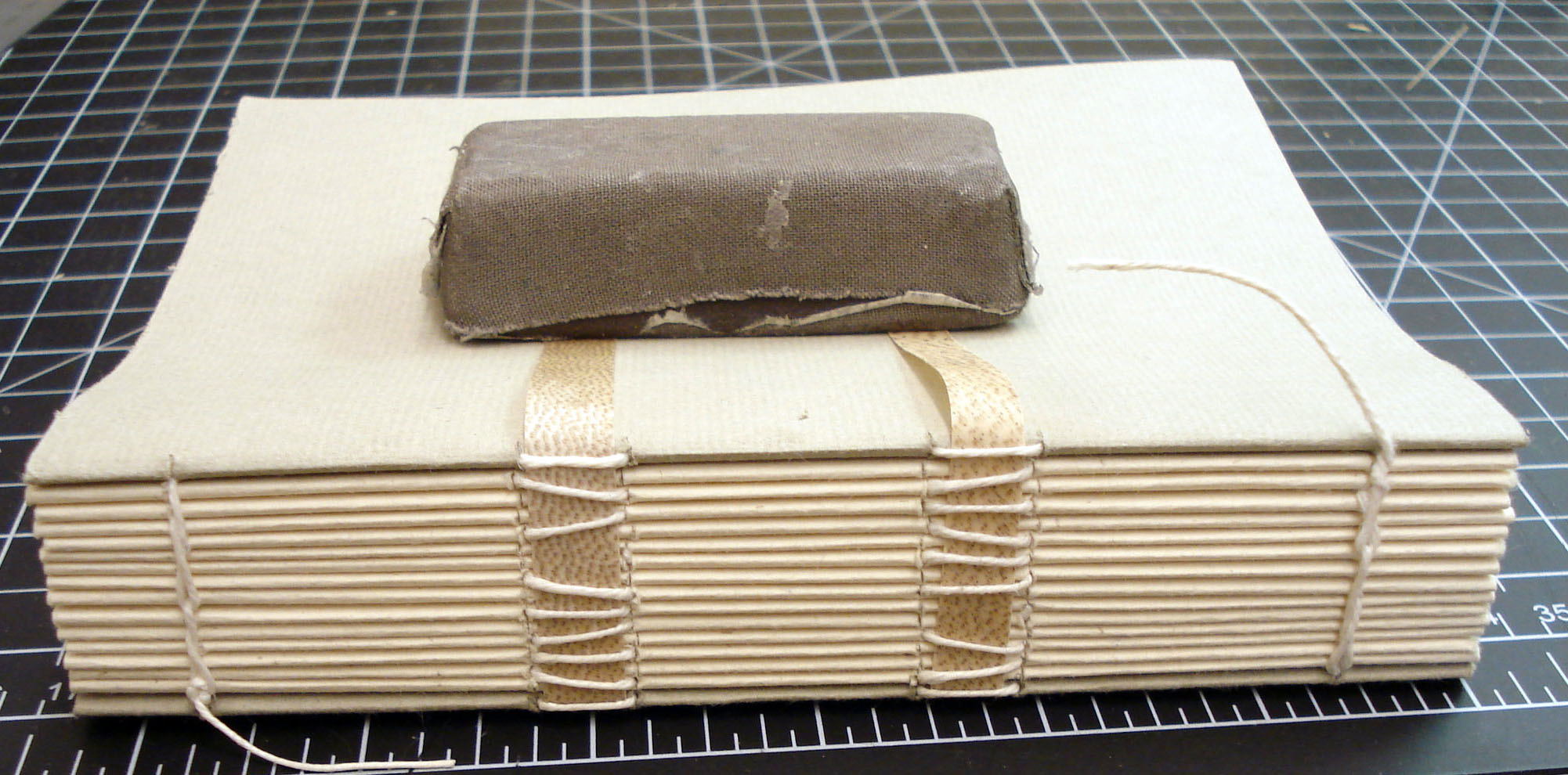
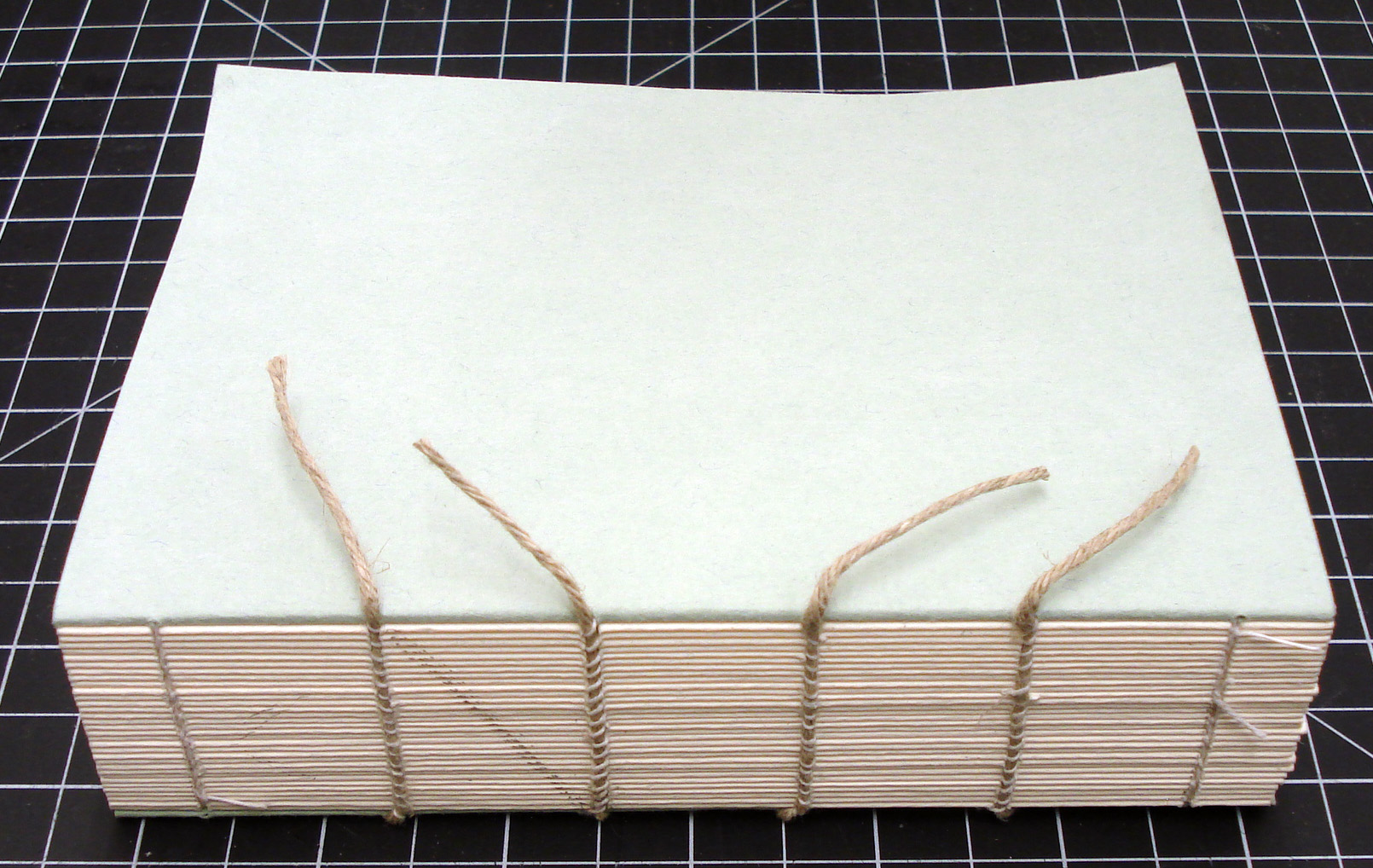
Textblocks of this variety are often sewn unto supports, such as cord or vellum slips  (Frost, 1982, p. 64) – the latter variety contributing greatly to the overall strength of the structure. I made my models based on the example in our collection – sewing the textblock on two thick vellum slips in the same somewhat erratic abbreviated pattern.

While the thread used in these bindings is rather course, the softness of the paper absorbs a lot of the swell and allows the textblock to remain square.

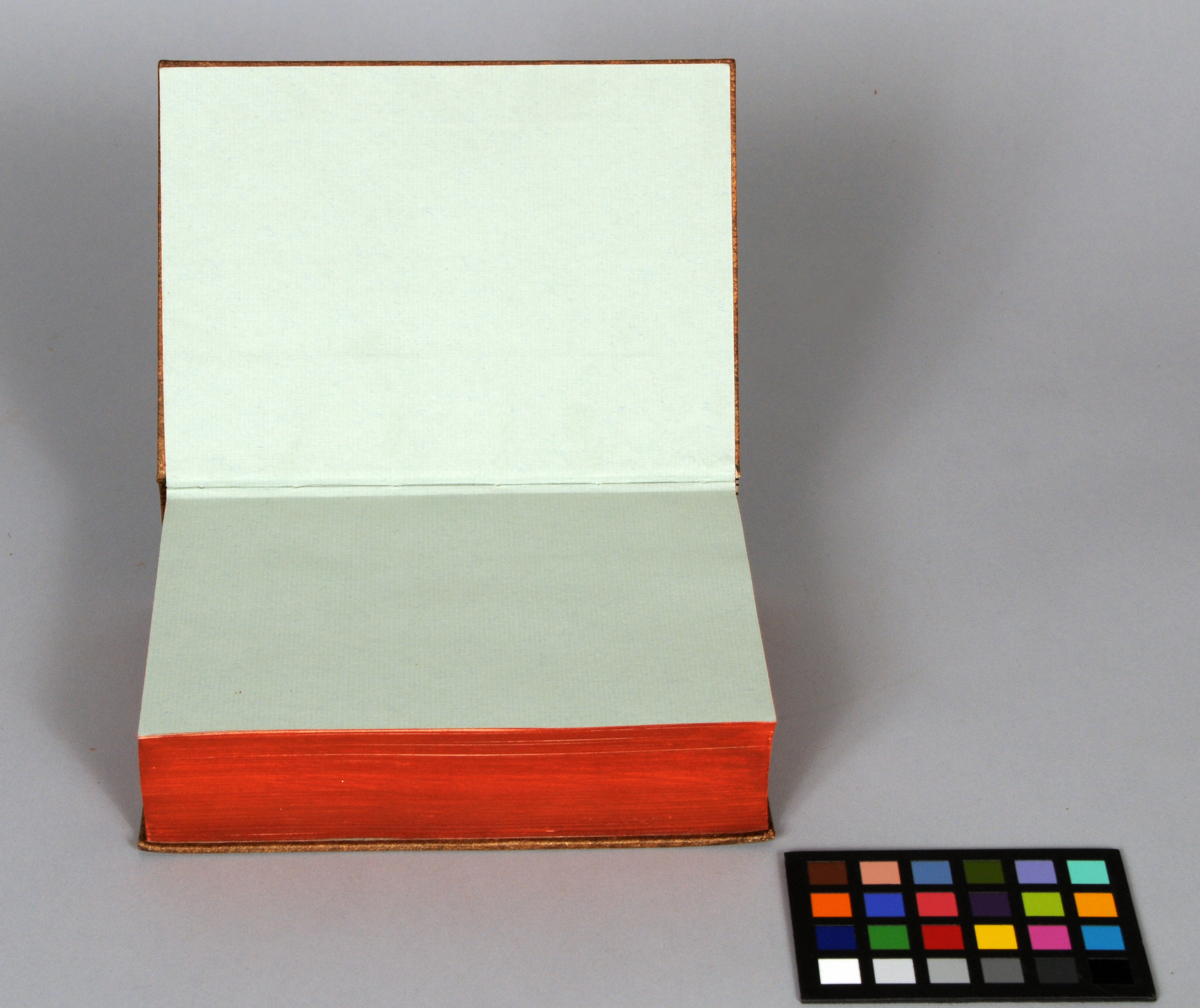
The endsheets in the historical example are a variation on the hooked endsheet used in my lapped component models. In this case, a whole bifolio is not used. Instead a leaf  is cut to the size of the textblock, but with approximately half an inch added to the width. One fold is made so that the leaf is now the width of the textblock + 0.25″. Another parallel fold is made  0.25″ from the first, creating a hook in which the first or last section will sit. This endsheet, therefore, has a small stub instead of a flyleaf.

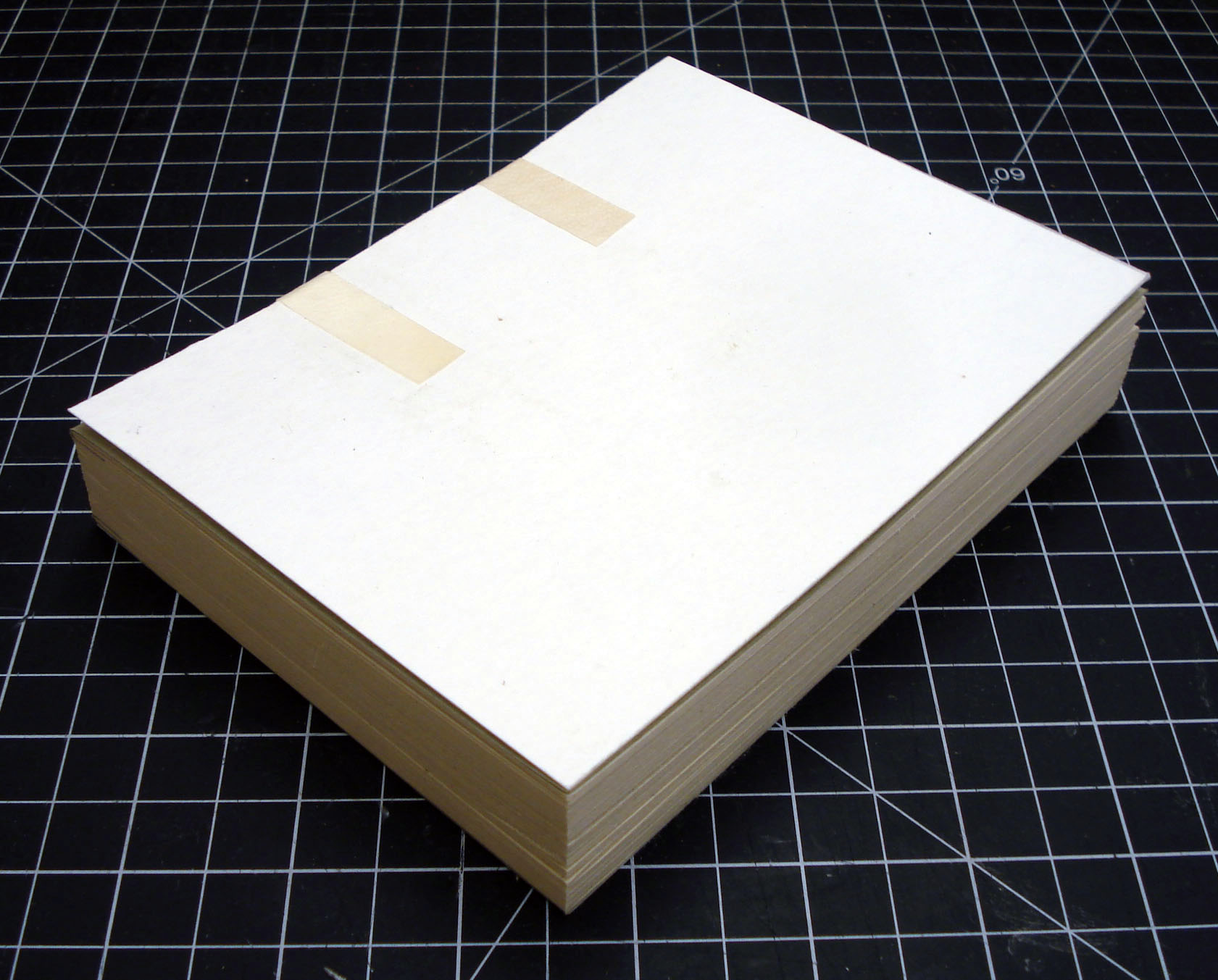
After sewing, the textblock is set square and the spine glued up with hide glue. Thin pasteboards are adhered to the vellum supports and the fore-edge is plowed.

While the examples that I have seen are very square, I don’t see why a round couldn’t be put into the spine at this point – assuming this is considered a permanent binding structure. If these bindings were just meant to be temporary wrappers as Cloonan suggests (p. 45), however, shaping and trimming would not be necessary and could make rebinding more difficult.

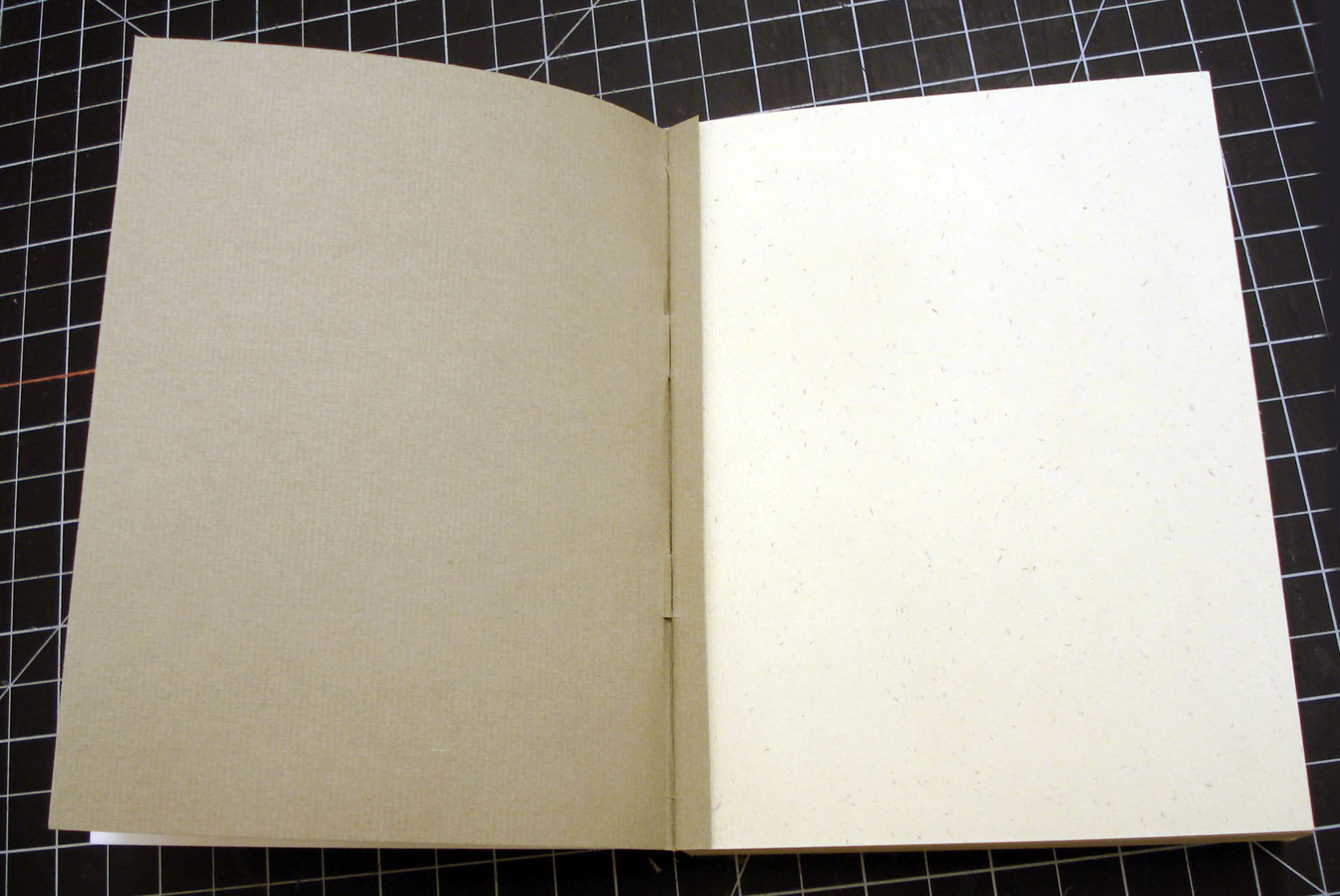
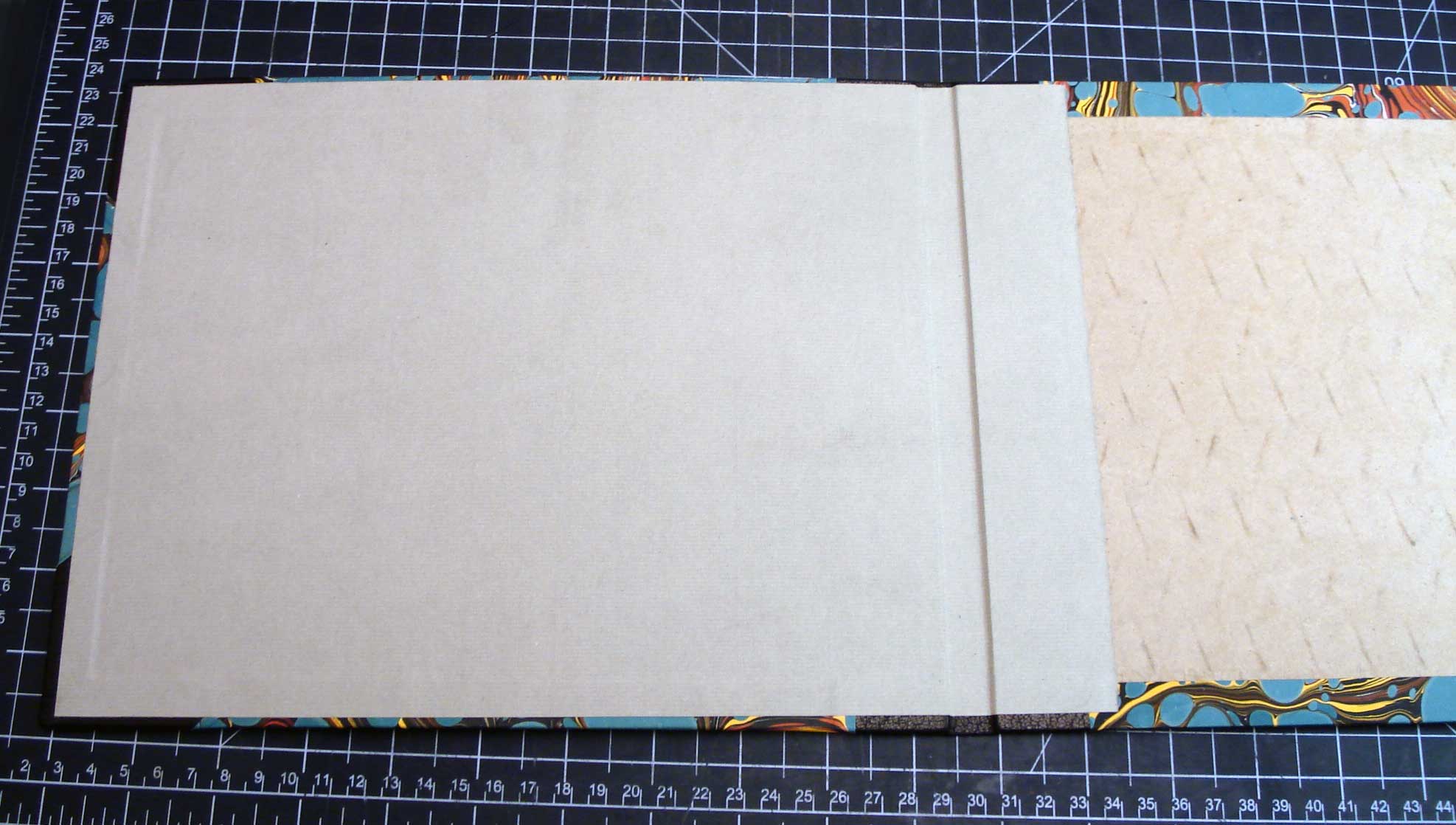
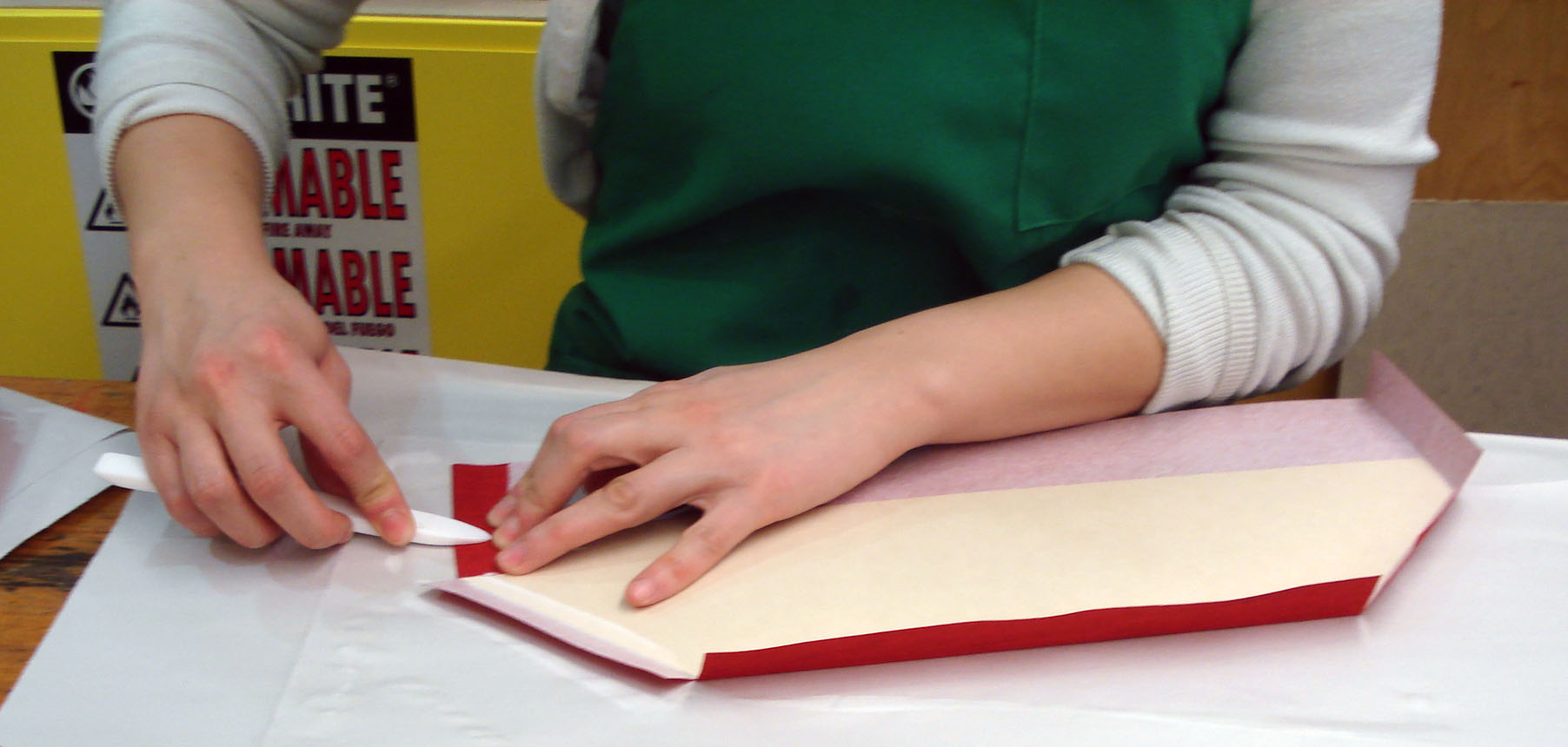
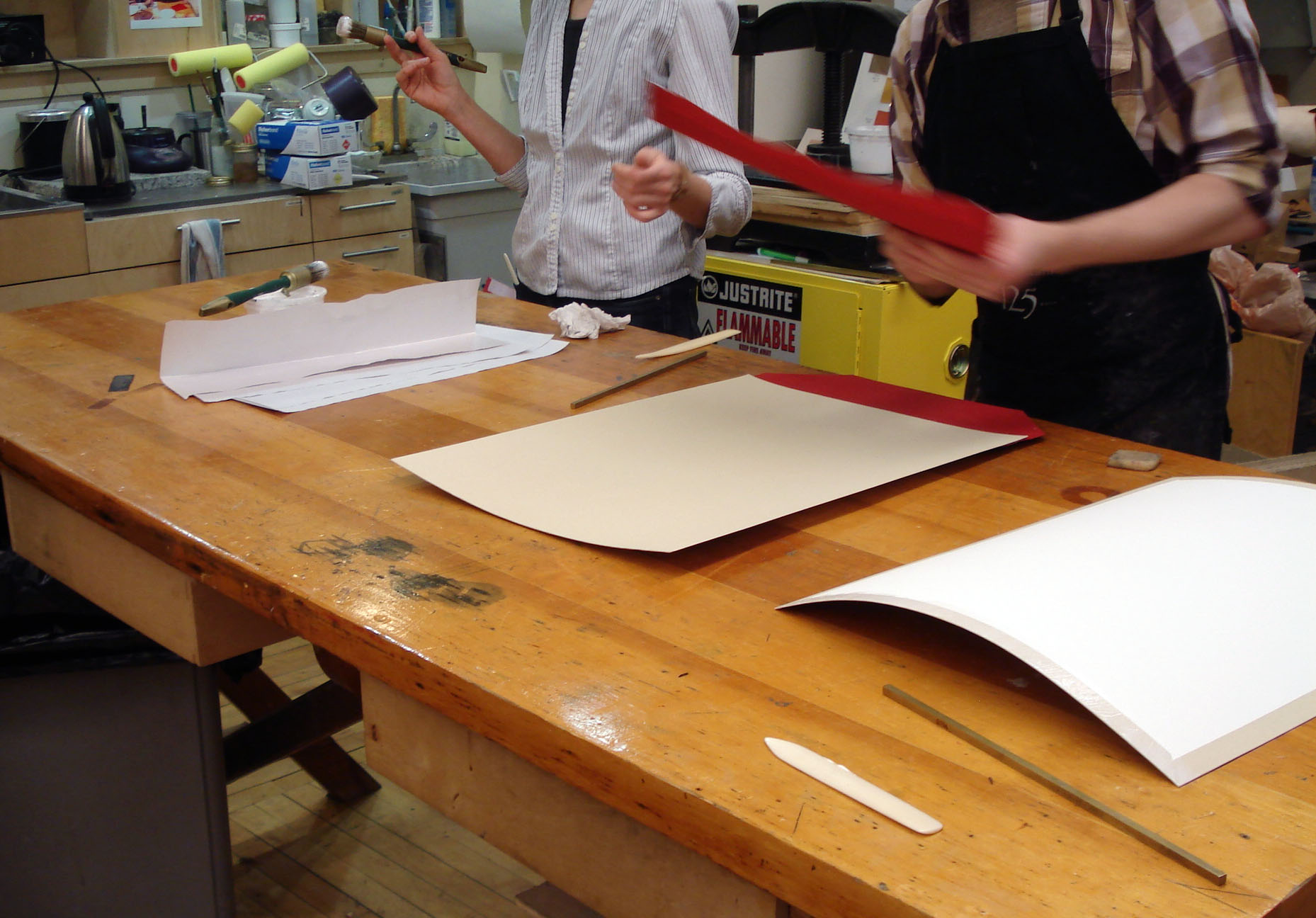
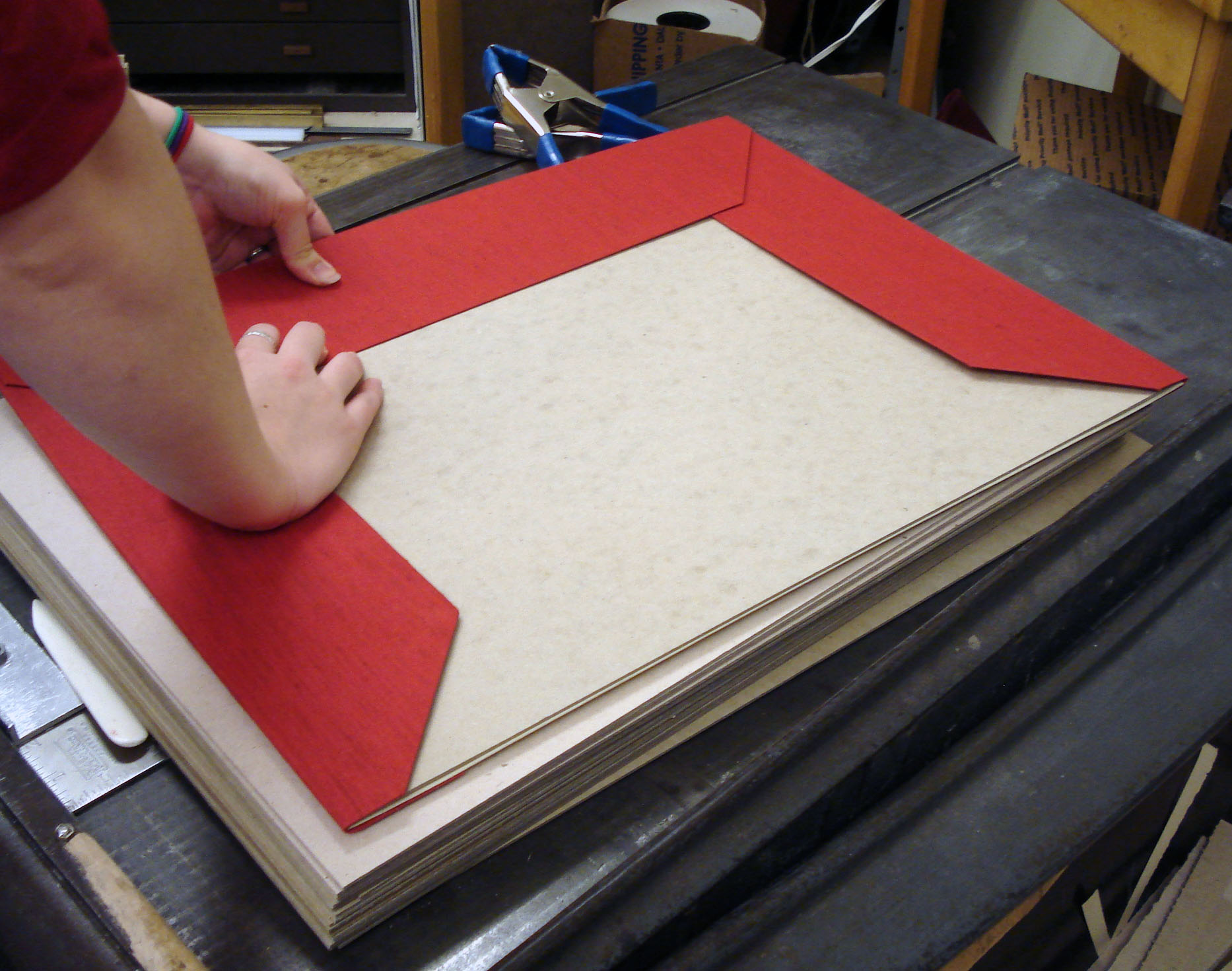
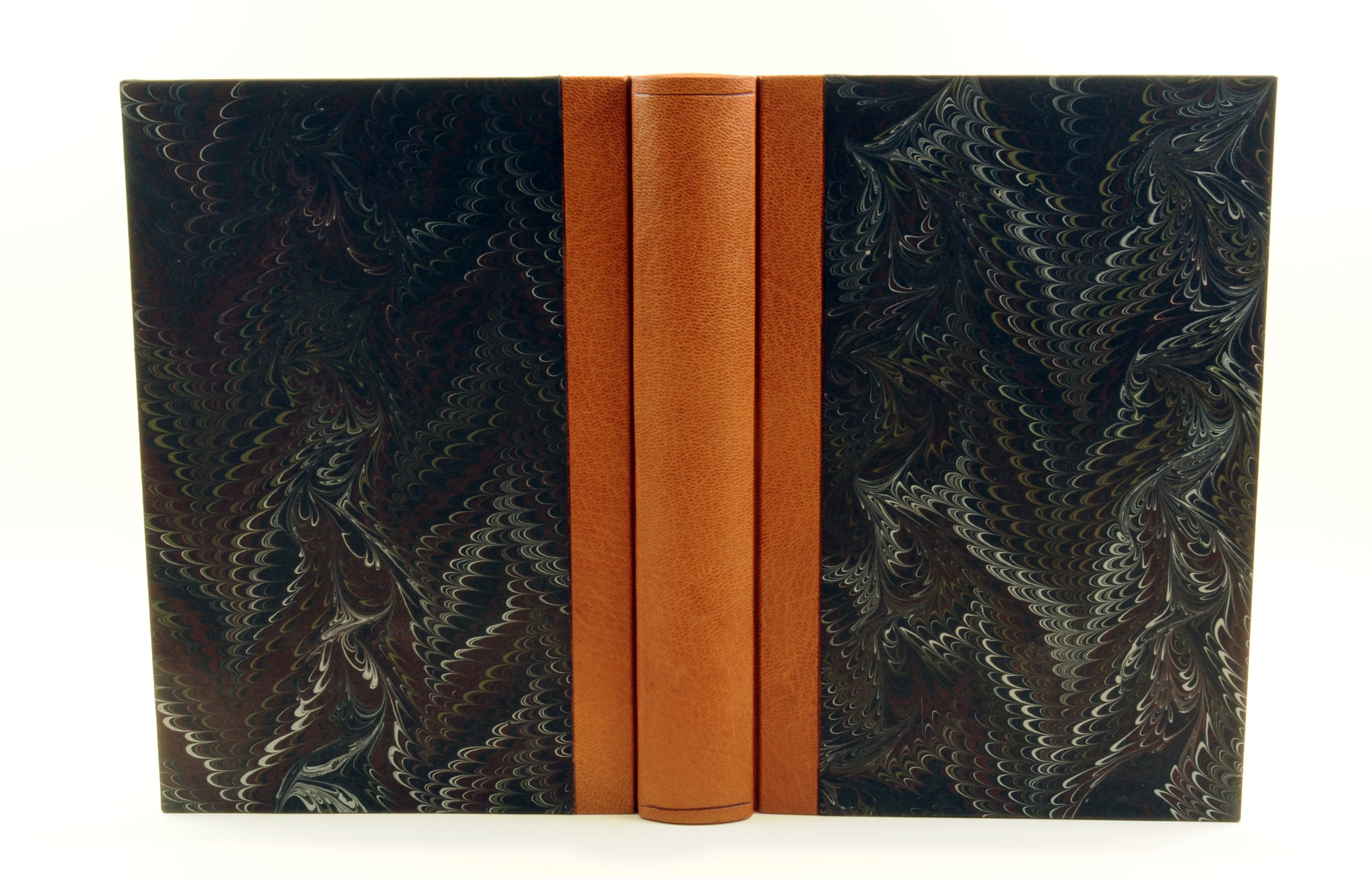
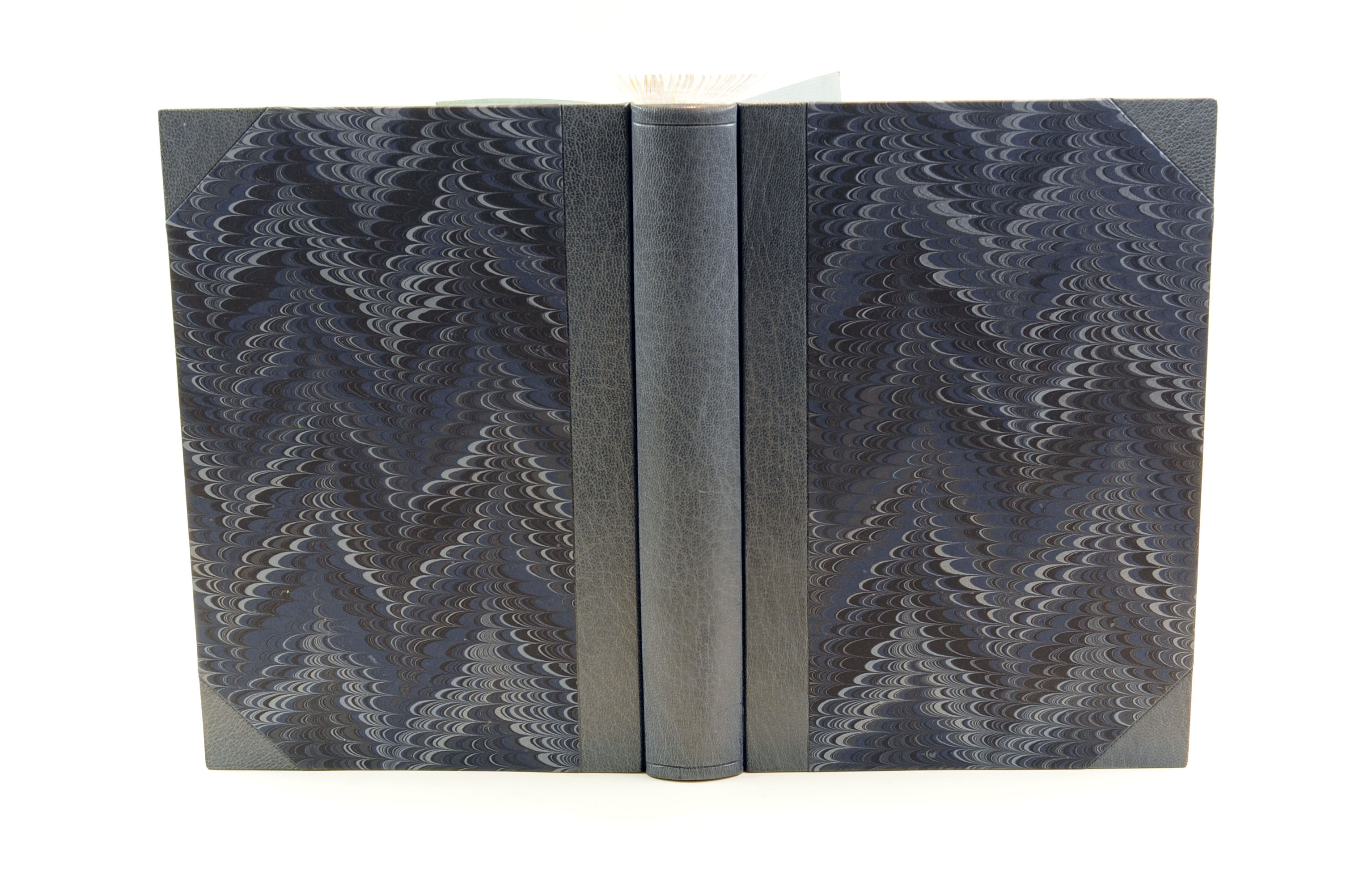
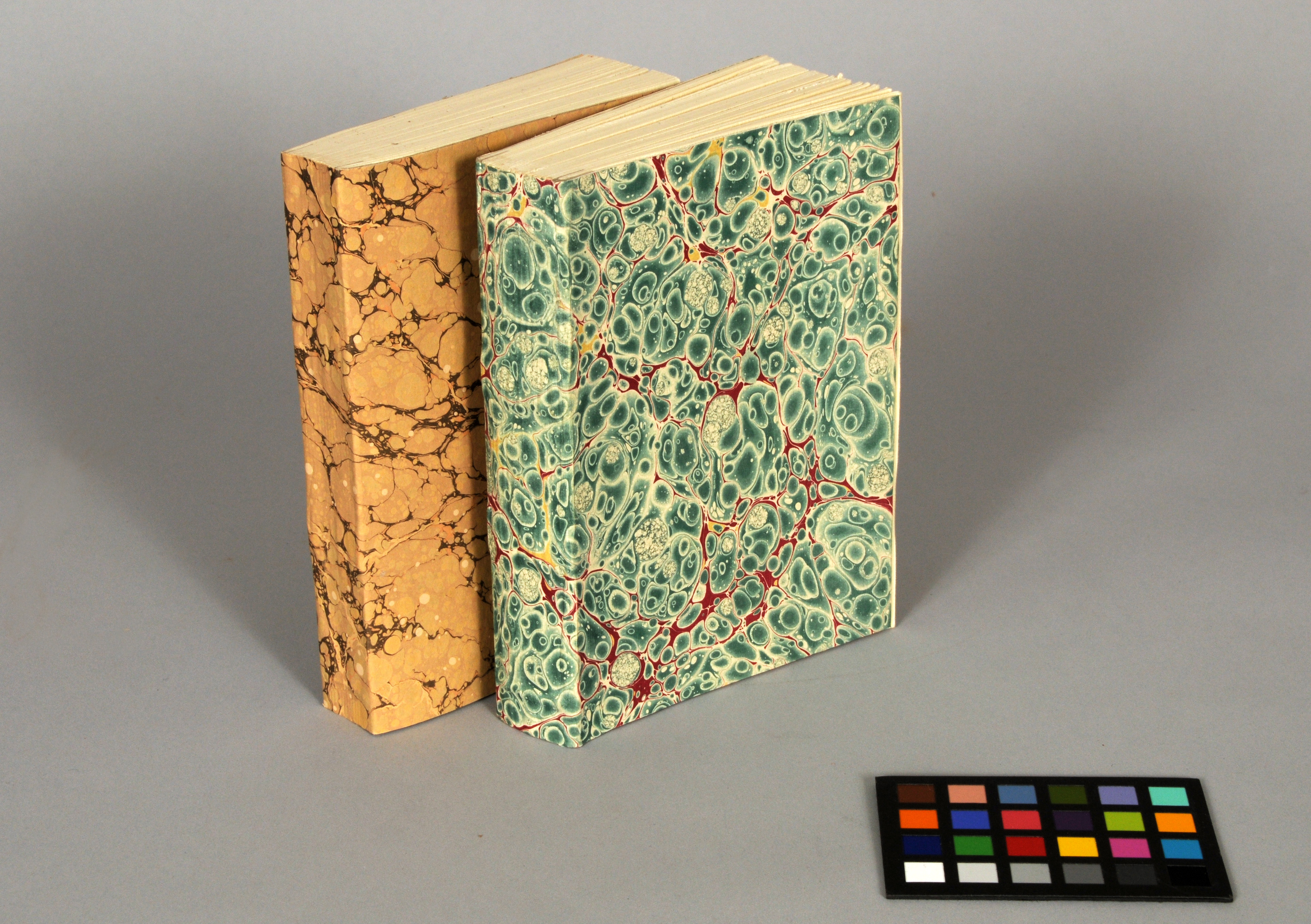
The outside of the boards are then covered in decorative paper and the pastedowns are adhered to the inside. I used marbled paper as the covering material for my models. The green is a Atelier Flavio Aquilina paper, while the tan is a paper that I made during the workshop with the Chena River Marblers. To finish, the head and tail are trimmed, leaving turn-ins (and sometimes squares) at just the fore-edge.

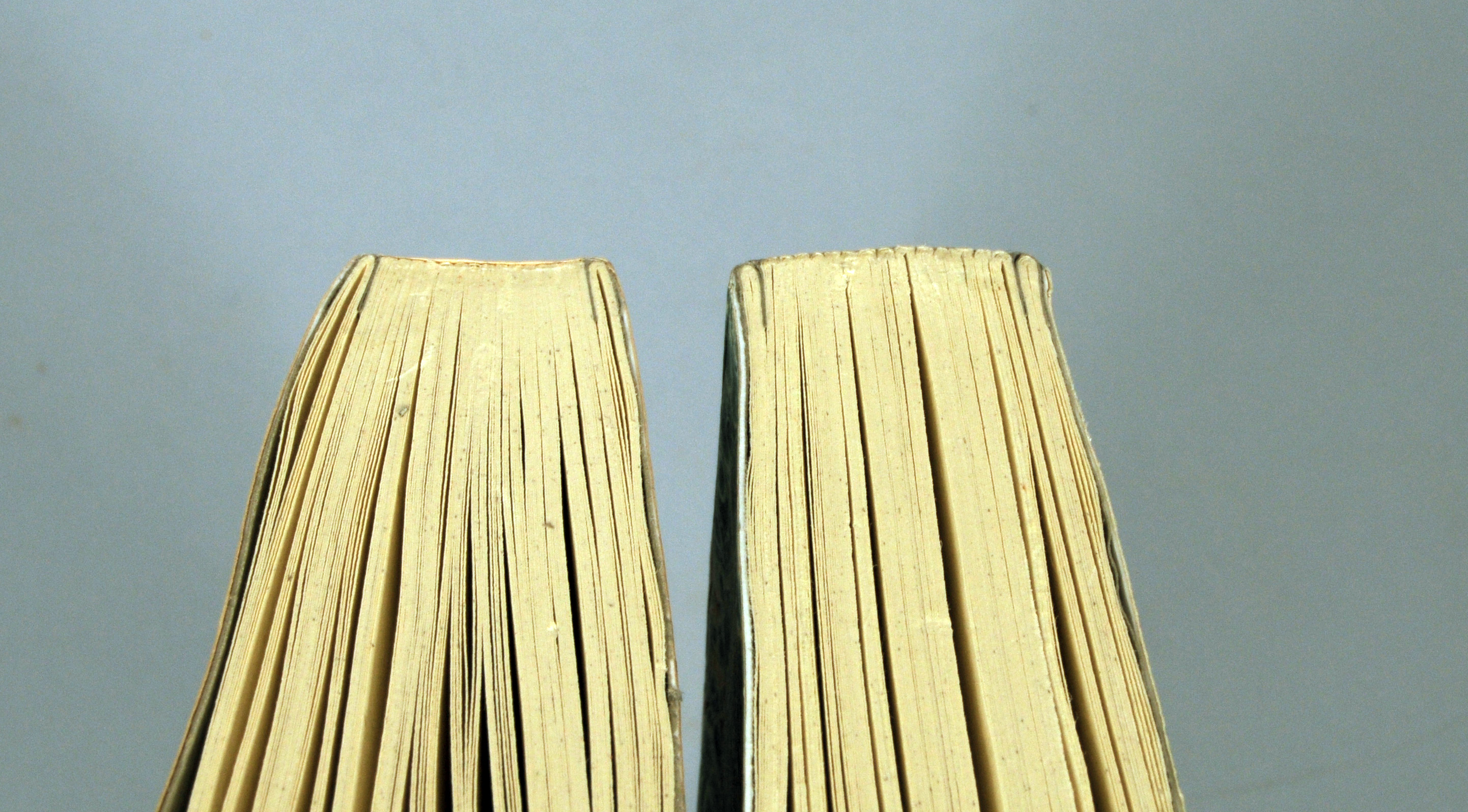
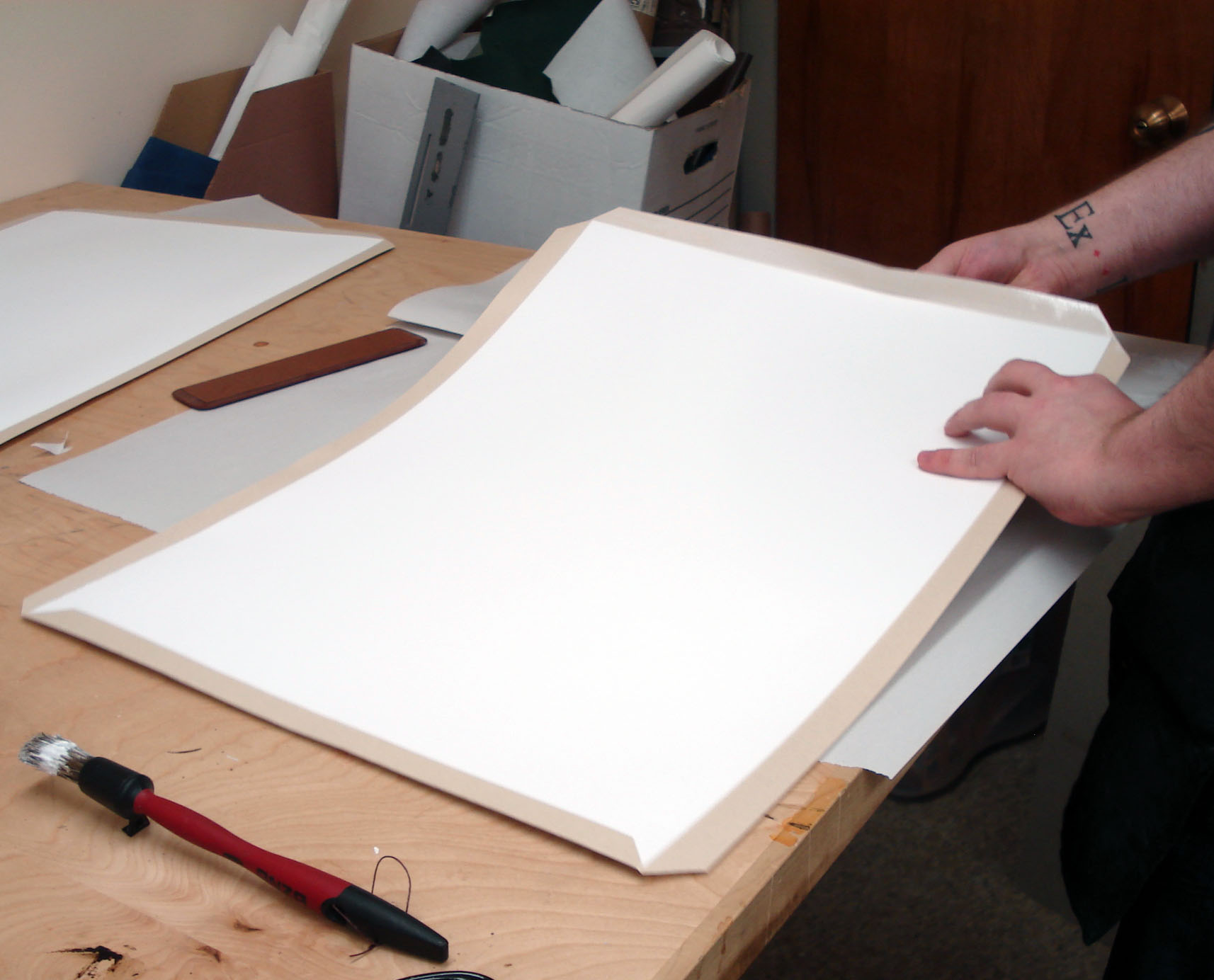
Back to the subject of spine shaping, I made two different models to see how they would act. After fully opening and handling the version with the completely squared spine, it began to go concave rather quickly (left). On the second version, I rounded the spine just a bit before covering and it has retained its shape better (right).

All in all, I really like this structure for its speed, durability, and adaptability; repairing or rebinding this structure is relatively easy.  I just wish that I could buy modern editions in this form, rather than the glued up stacks of single sheets that you find in the bookstore today.

Ω

Next up, I will be writing about the laced paper case and limp vellum structure. In an effort to be a little more productive with this blog, I’m going to try and make the posts a bit shorter, but commit to publishing one every Sunday.

_____________

Cloonan, M. V. (1991). Early Bindings in Paper : A Brief History of European Hand-made Paper-covered Books with a Multilingual Glossary. Boston, MA: G.K. Hall.

Frost, G. (1982). Historical paper case binding and conservation rebinding. The New Bookbinder, 2, 64-67.

Rhodes, B. (1995). 18th and 19th century European and American paper binding structures: a case study of paper bindings in the American Museum of Natural History LibraryBook and Paper Group Annual, 14, 51–62.

German Paper Bindings: The Lapped Component

Bookbinding

In the spring of last year, we started to work with a couple of different paper binding structures that came out of the trade binding traditions in Germany and Italy. I really enjoyed the way that some of these look and function. Keep in mind that this is a very cursory look at a small variety of historic paper structures –  but I will share some models and explore some of the literature that deals with the topic.

Ubiquitous today, the paper binding has a long history as a quicker and more affordable book covering material than animal skin. Cloonan (1991) states that despite the availability of paper in Europe from the twelfth century, the earliest known paper binding, a woodcut-printed wrapper produced in Augsburg, dates from 1482 (p. 5). There is some disagreement in the literature on whether early paper bindings were considered permanent coverings for the text or as temporary protective enclosures between bookseller and binder (Cloonan, p. 45); however, from the 16th to 19th century, paper bindings evolved into a variety of forms. For the purposes of my discussion, three distinct types emerge: limp paper wrappers, case bindings, and “boards” or “in-boards” bindings. This will be the first in a multi-part series on particular paper structures, more specifically the “lapped component” or stiff-board case binding, the stiffened paper binding, the laced paper case, and the more modern millimeter binding.

The Lapped Component

Many examples of paper case bindings structures, dating from the 17th -19th centuries, have been found in Italy and Germany (Frost, 1982, p. 64). The case binding is generally defined as composed of a textblock and cover that are prepared separately and then joined.  Rigid paper case bindings were popular in Germany from the 18th century and could be considered the handmade forebears to modern machine-made case bindings. Like the modern paperback, these could be fabricated relatively rapidly en masse, driving down the cost of production. German binders made a variety of rigid paper case structures, but, beginning in the late 18th century, a distinct style of paper case emerged that was composed of paste boards “spanned and bonded together by a heavy paper spine wrapper (Frost, p. 66). Frost dubs this structure the “lapped component”.

Having only examined a handful of these bindings held in the collections of two research libraries, I cannot speak to the complete range of characteristics that one might encounter with this binding structure. I will, however, discuss the binding characteristics that are identified as most common to this structure by Rhodes (1995) in her survey of paper bindings from the collection of the American Museum of Natural History Library. The models pictured here follow the descriptions of endsheet construction, sewing style and supports, and case construction from that survey. Certain aspects of style are copied from the two or three historical examples held in the collection at NBSS.

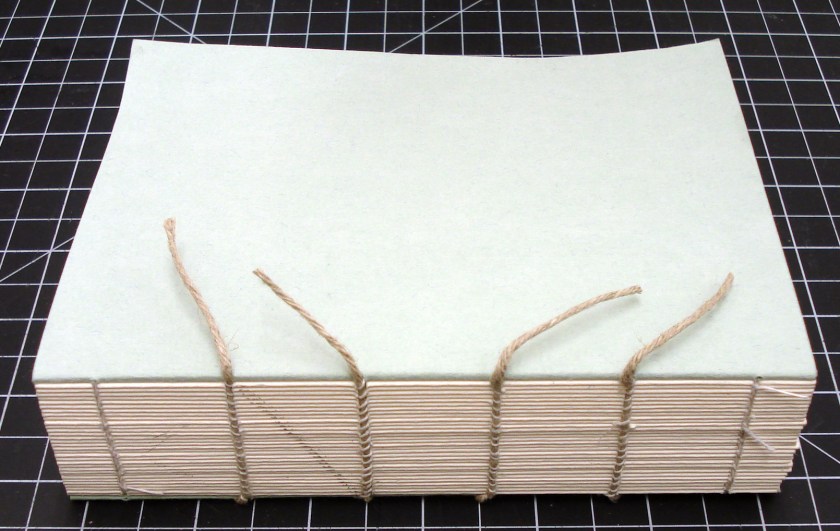
Rhodes (1995) indicates that the most popular endsheet structure among lapped component bindings in her survey was a “wrapped stub” endsheet (p. 52). This endsheet as formed by folding ¾” of a folio toward the inside of the text and “sewing through the fold thus created” (Rhodes, p. 52). Rhodes also reports that the vast majority of paper bindings surveyed were sewn in an abbreviated pattern (2 or more sections at once) on cords. The sewing stations of the bindings in our collection were d sawn-in, rather than pierced. Sawing the sewing stations into the backs of the sections is much quicker than piercing them individually, but is more destructive to the text and produces different book action.

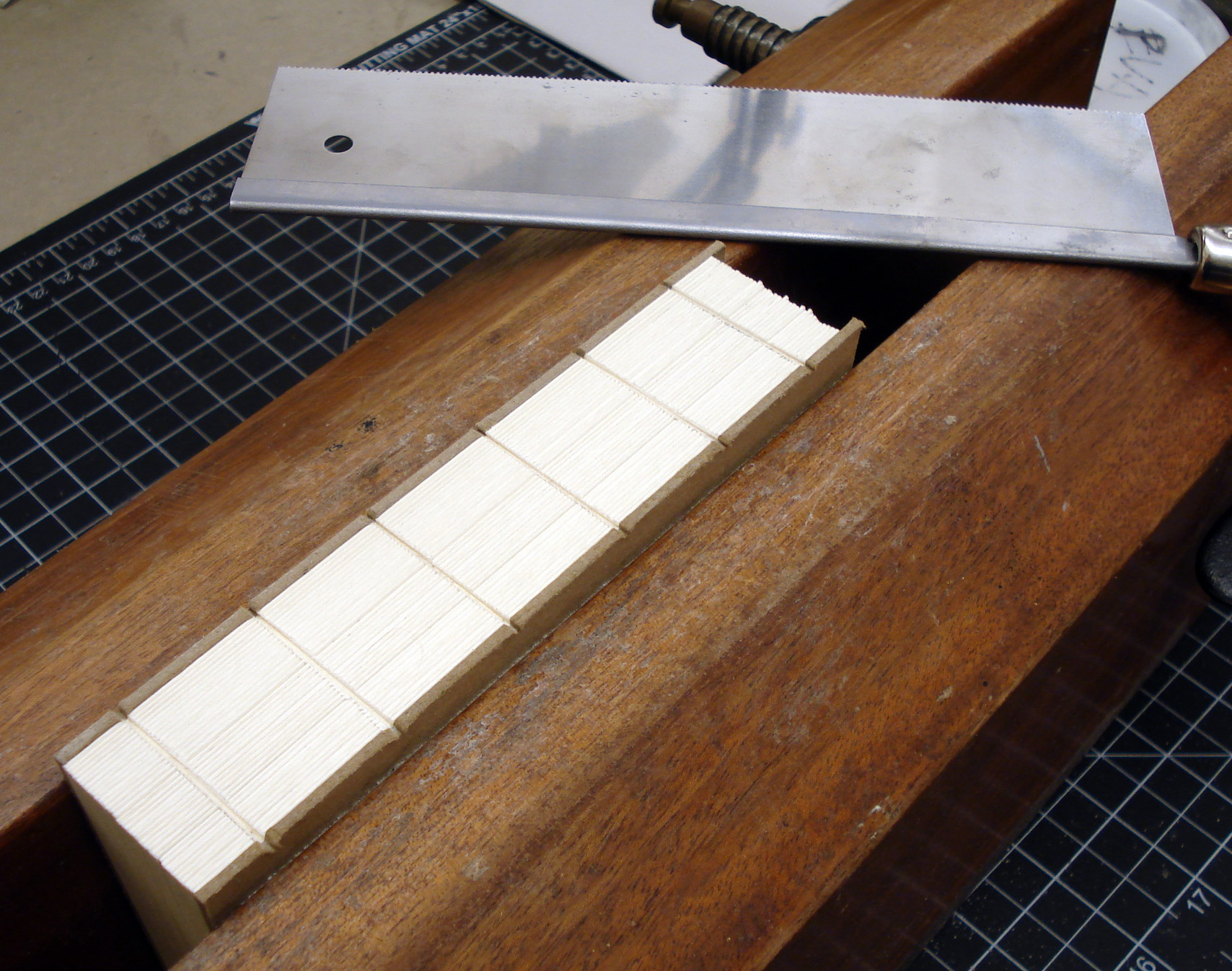
I decided to treat my models in the same way. After folding and pressing the sections, the endsheets are folded and their stubs wrapped around the outermost sections. The textblock is squared up and put in the lying press. Sewing stations are marked out with a pencil (including four support stations and kettle stations at the head and tail). The sections are then sawn-in using a backsaw.

The saw kerfs are made to complement the size of the cord, so that it sits into the fold, rather than against it. As a result, the sewing support does not contribute so much stiffness to the opening of the book as if the stations were pierced and the same cords were sewn on.
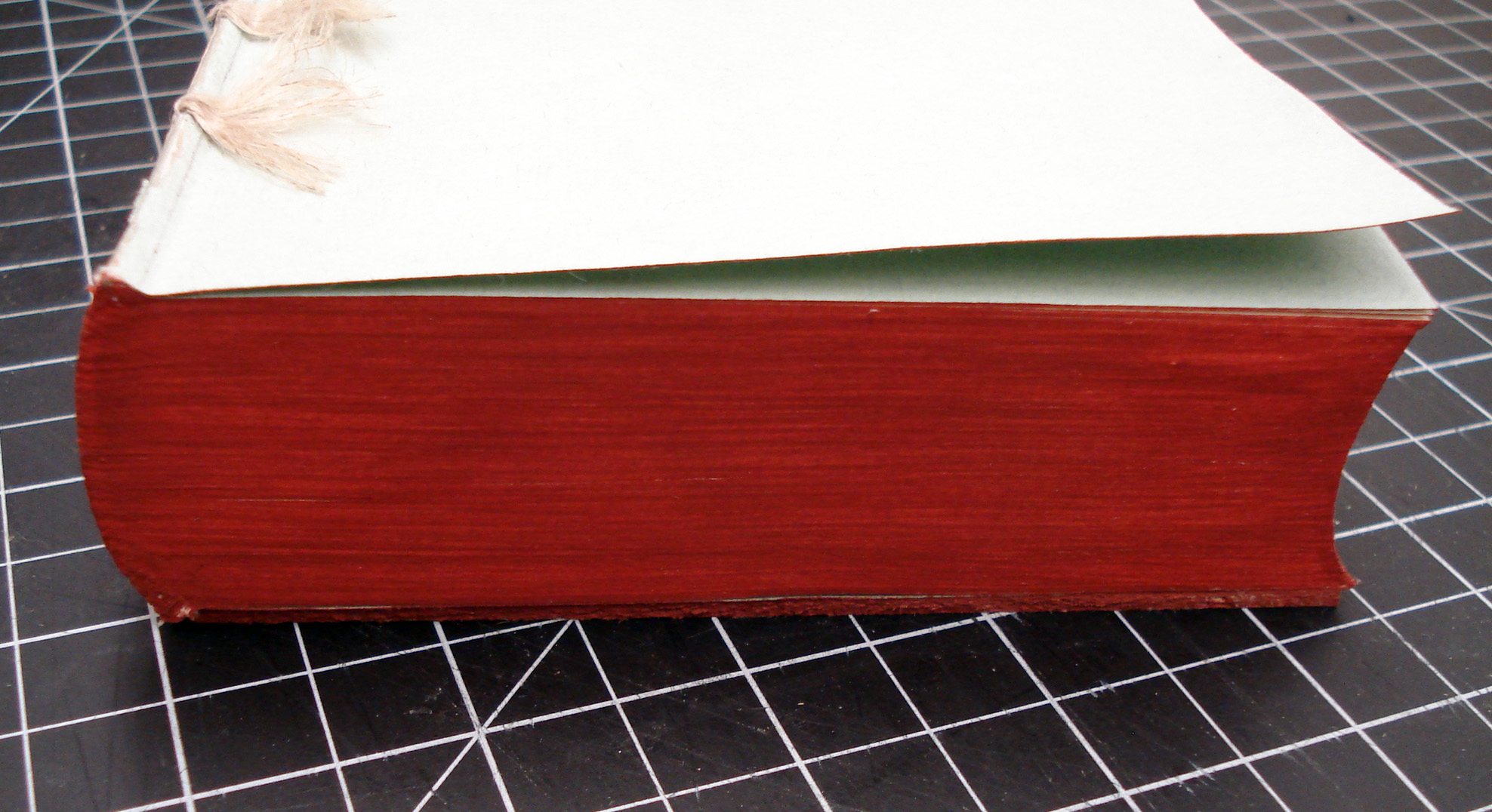
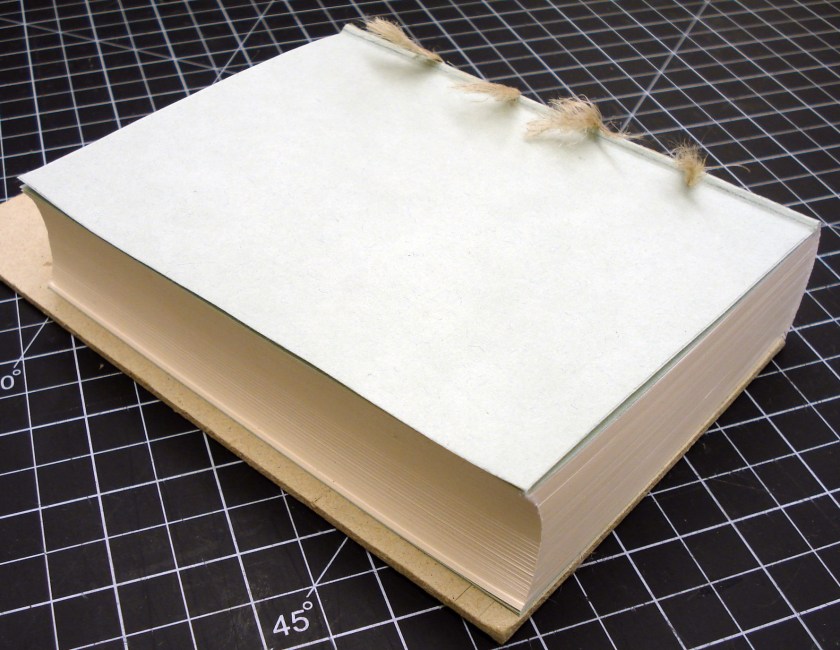
Rhodes indicates that most (84%) of the lapped component bindings in the survey were plowed and that, of those, the majority (88%) received some sort of edge coloring (p. 53). Trimming and coloring the edges takes a couple of steps. The fore-edge is first plowed with the book squared up. The textblock is given a gradual round and severely backed so that it has small shoulders for thin pasteboards. Finally the head and tail are plowed.
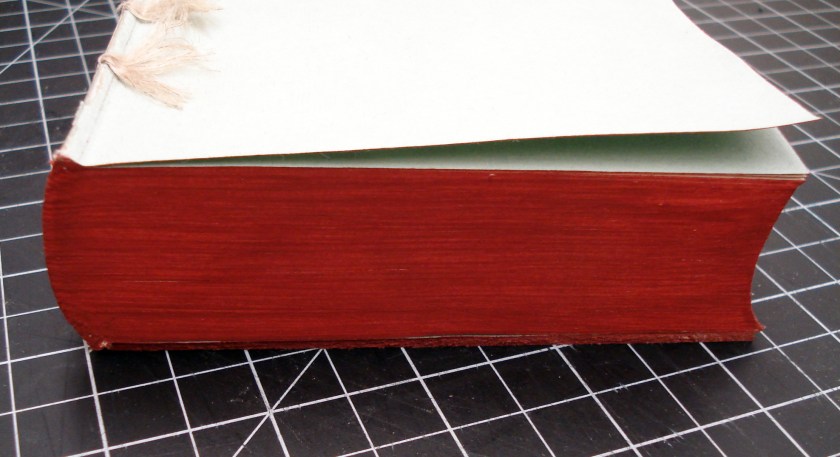
To get that authentic, hastily done production look, I colored all three edges of these models using a mixture of gauche and paste in one pass with a wide brush. The literature does not state which colors are more prevalent, but I suspect that bright yellow edges were more popular than red.
In my reading, I did not see much discussion of endbands for this style of binding. Cloonan states that headbands were commonly absent from the paper bindings  described in her dissertation (p. 41). This makes sense as a time and cost saving measure for the binder. The lapped component bindings in the school’s collection have stuck on endbands, however, and I copied them for my models.
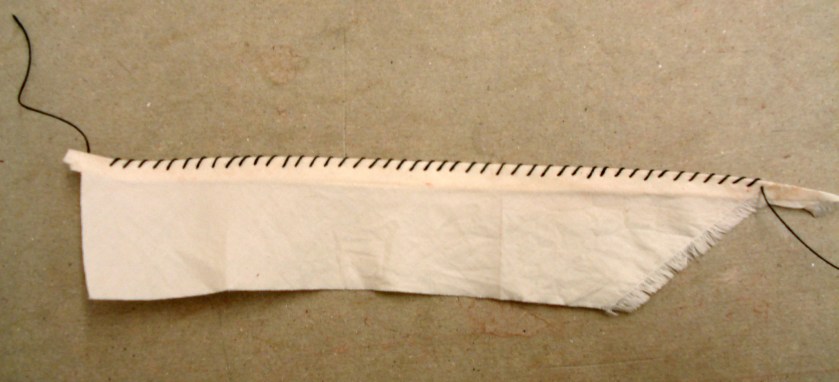
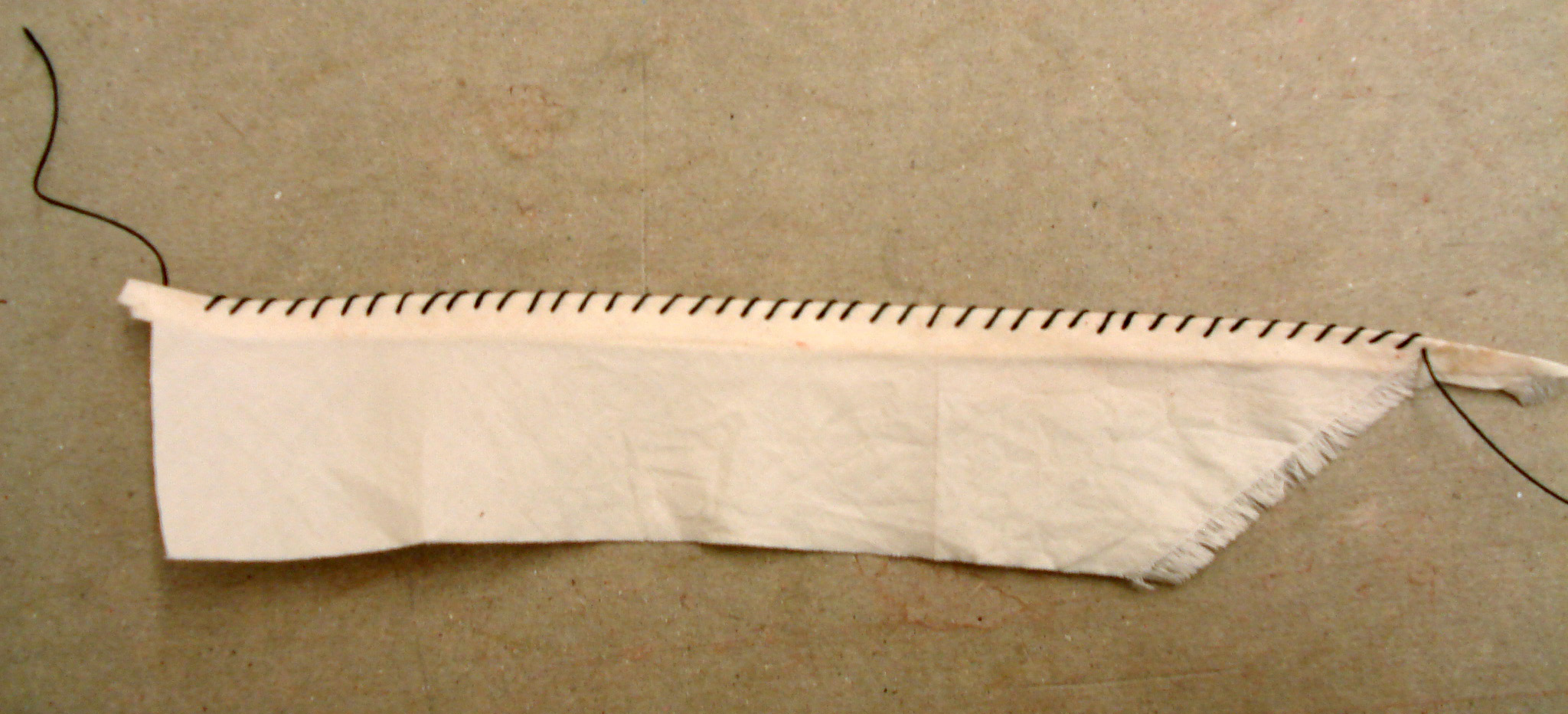
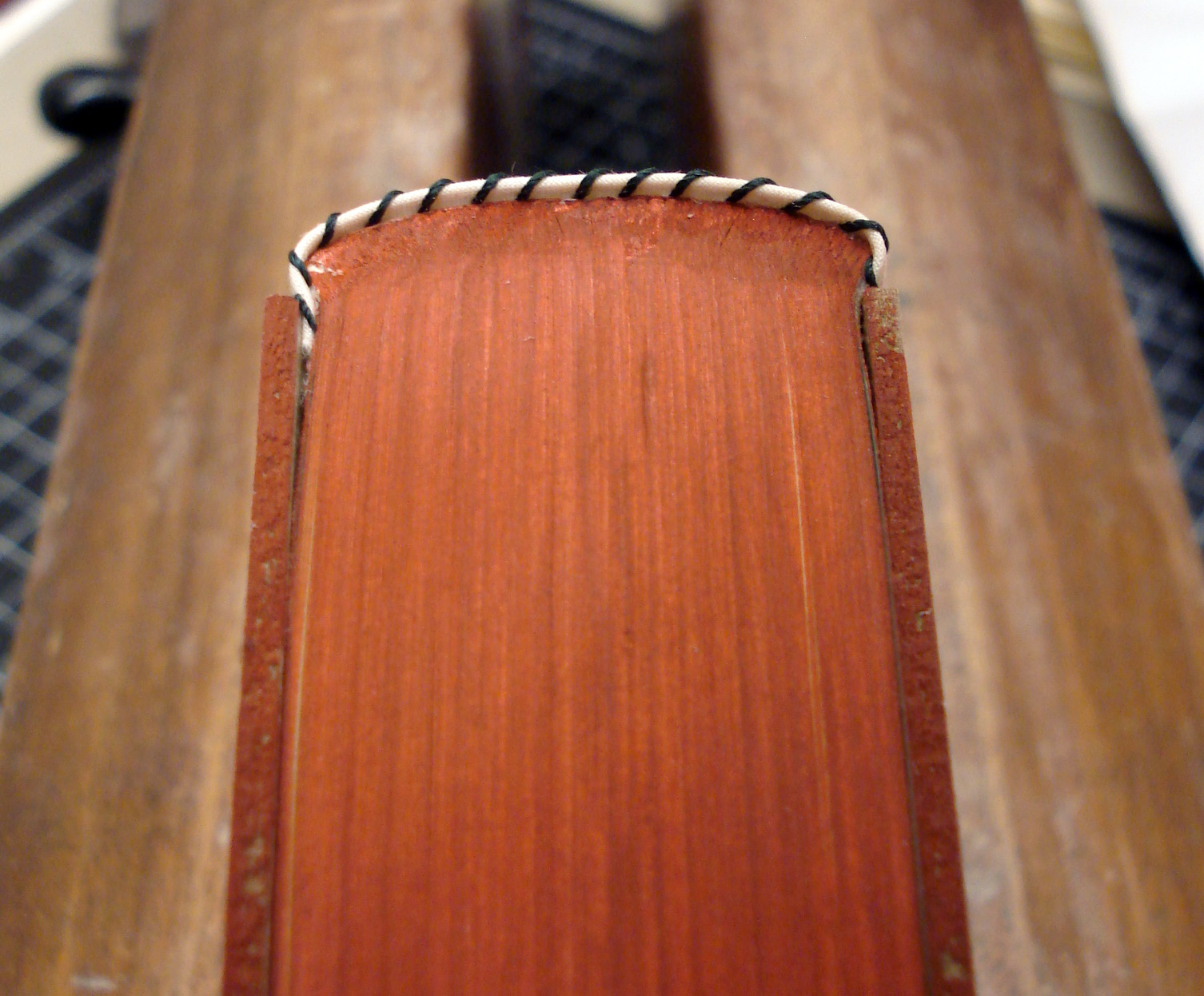
These are made by folding over a piece of linen and whip stitching along the top with colored silk. The endband is cut longer than the width of the spine and is pushed just under the edge of the textblock at the seat of the shoulder. The process goes very quickly and looks quite attractive on the book.

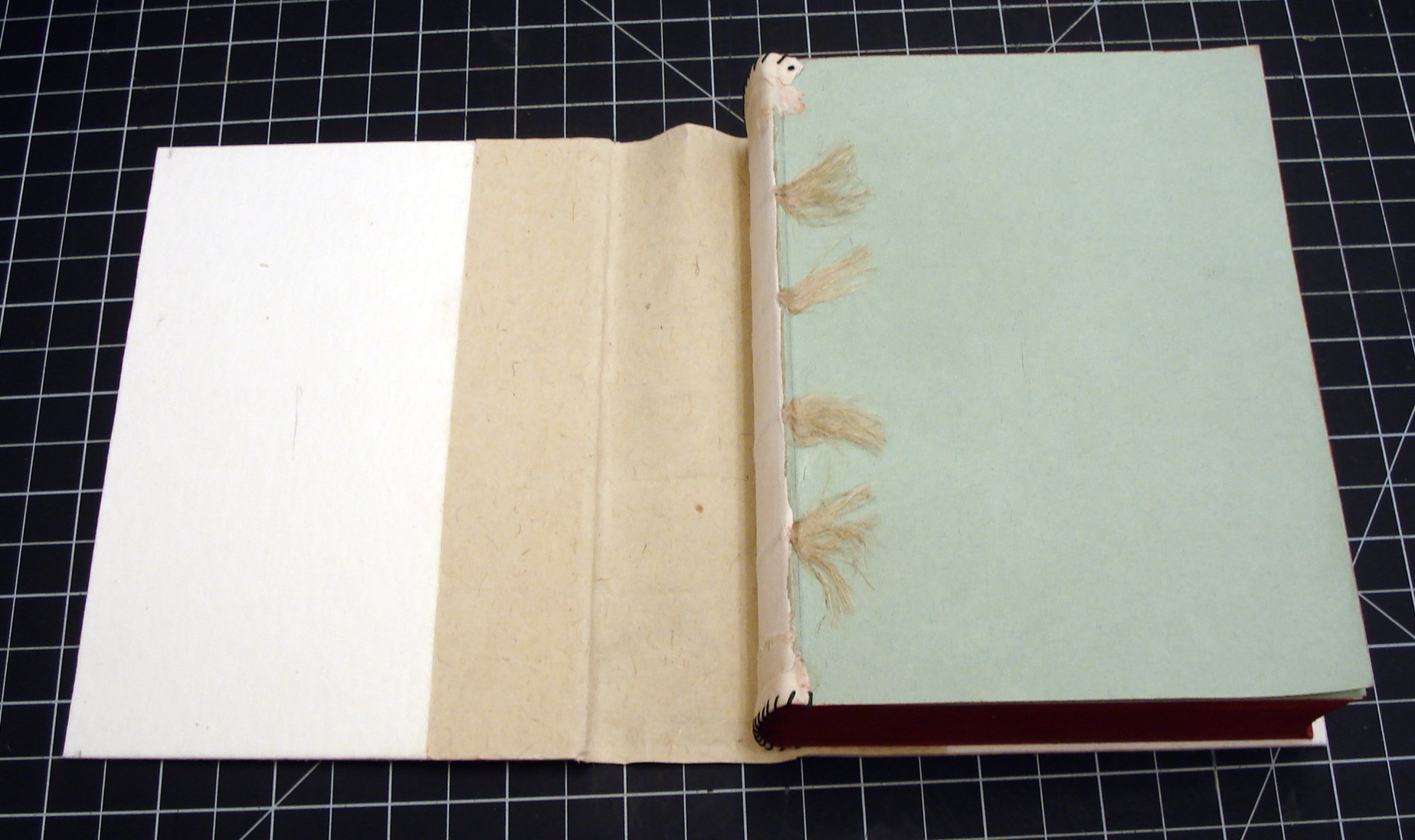
According to Frost, early German trade paper case bindings typically have no spine linings (p. 66), although Rhodes states that over half (63%) of the lapped component bindings surveyed at the AMNH library had spine linings (p. 53). I can see stiff linings of paper would interfere dramatically with the opening (especially on a small chunky book), so I opted for a lining of kozo paper applied with wheat starch paste and pounded-in. To finish off the textblock, the cords are trimmed to size and frayed out with the back of a knife.

Next, we turn our attention to the case and it’s lapped component:

The case is composed of two pasteboards that are connected by a heavy paper spine wrapper that extends about ¼th of the way onto the inside of the boards. The spine piece is molded to the contours of the textblock, while the soft pasteboards also conform to the lapped component, assuring a good bond. This moulded covering, according to Frost, “charges up” the gutter margin of the text, “assuring a tight adhesive bond at that crucial position” (p. 66).

The molded spine piece is made by first wrapping the spine of the textblock in plastic wrap. After being thoroughly wet out, thick handmade paper, cut slightly longer than the height of the boards, is gloved it onto the spine.  Press boards are placed into the joint and the sandwich is allowed to dry under weight. When finished, as Frost says, “a light embossing from underlying sewing appears which exemplifies the moulded fit familiar to binders” (p. 67).

Although I could have created pasteboard with cotton linters (Puglia, 1996), for the sake of time economy, I made up boards from museum board with thin blotter laminated to each side. This imitates the soft and light qualities of pasteboard without all the pressing and drying time.

The boards are adhered to the spine piece and the case trimmed to size. Frost indicates that the components of the binding are often trimmed out to the height of the text, “producing a bare, turn-in-less cover” (p. 66). In the historic examples from our collection, the cases did have  small squares. Therefore, my models have squares.

 The case is then covered in decorative paper. I made pulled paste papers that appear similar in color and texture to the historic examples available for study. After covering, the inside of the boards are trimmed out to give even turn ins.

Rhodes states that, of the books in her survey, over half had labels supplied by the binder that were tooled or stamped on glazed paper (p. 53). I stamped mine on the Kwikprint with gold foil.

The text to board attachment for this structure is adhesive alone. Frost’s article has a very clear illustration of the hinging position of various styles of paper binding. As the lapped component falls under the “case constructon binding” style, the hinging point is a the seat of the shoulder – an “identifying characteristic of case binding structure” (p. 64). This contrasts with the text to cover attachment of laced-in structures (upcoming post), in that the laced or in-boards binding has the attachment at the point of the shoulder. Frost indicates that this characteristic alone is responsible for the “openability” of the case (p. 64) – although I would say that the case structure is far less durable than the laced-in variety.

Note: The bibliographies that I post at the bottom of my posts are always incomplete. If you know of further reading on this topic, I welcome your suggestions in the comments!

_______________

Cloonan, M. V. (1991). Early Bindings in Paper : A Brief History of European Hand-made Paper-covered Books with a Multilingual Glossary. Boston, MA: G.K. Hall.

Frost, G. (1982). Historical paper case binding and conservation rebinding. The New Bookbinder, 2, 64-67.
Puglia, A. (1996). Pasteboards. The Book and Paper Group Annual, 15.
Rhodes, B. (1995). 18th and 19th century European and American paper binding structures: a case study of paper bindings in the American Museum of Natural History Library. Book and Paper Group Annual, 14, 51–62.

Tools and Tooling

Tools, Writing

I promised to put up an example of some more refined tooling. Here is my finished plaquette (in a slightly blurry photograph):

The design is pretty much dictated for the assignment and is meant to demonstrate specific techniques. The border and top panel illustrate blind tooling with lines and dots. The second panel has three circles to demonstrate blind and gold tooling with a gouge, as well as an onlay with a gilt edge. For the white circles, I used alum tawed goat skin. This proved to be significantly more difficult to do than tanned skin, as the tawed skin gets spongy when pasted out. As a result, the gilding around the edge is not as flat (making the gold less reflective) than it would be had other leather been used for the onlay. The third panel down illustrates blind and gold tooling and onlay work as well. These diamond shapes are actually made with two impressions – the tool is an equilateral triangle that can be turned and doubled up. The central diamond is entirely an onlay with gilding. The two on either side just have onlays in the central part of the shape. The fourth panel from the top has a curvilinear line made with an Ascona tool and has alum tawed skin laid into the impression. The final panel demonstrates gold tooling through repetion of lines and a small square tool.

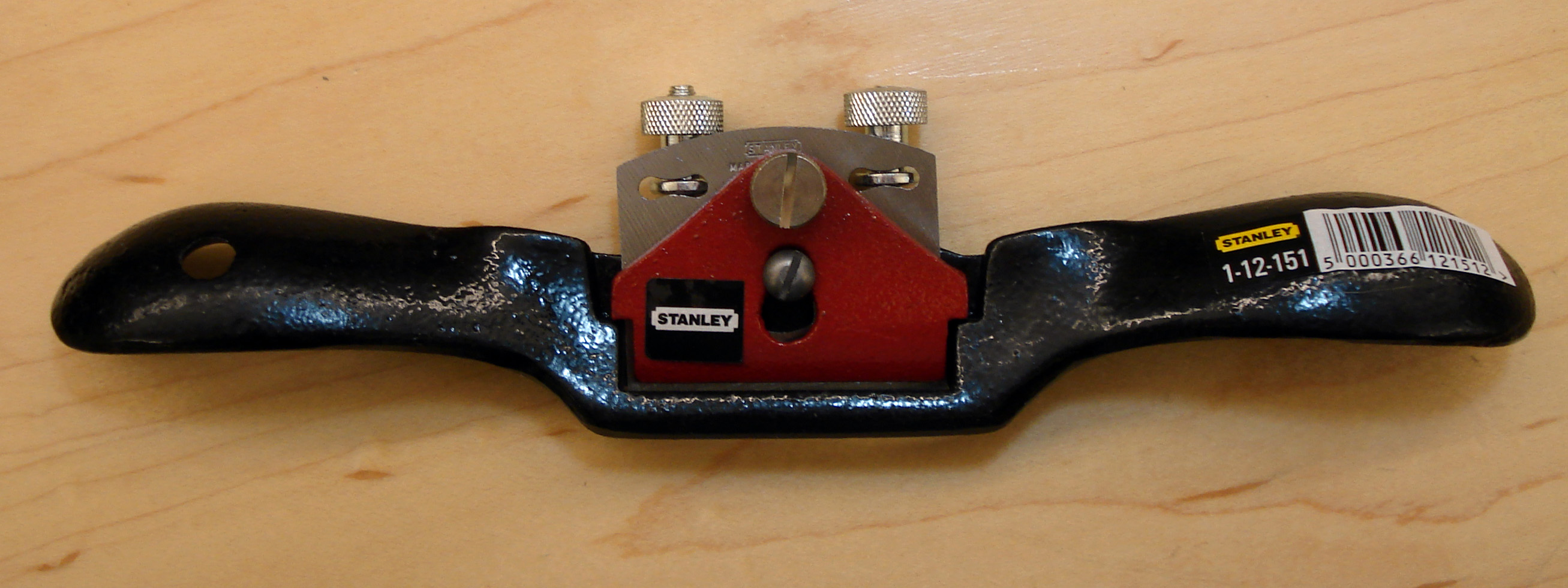
In the week following Standards, Jeff Peachey came to do his workshop again. As a second year, my main focus during the workshop was to modify a Stanley No. 151 spokeshave for leather paring.

This was not an easy procedure, and I’m very glad that Jeff was there to keep me from completely ruining mine. Peachey has a rather extensive essay about spokeshaves that includes a bit of a history lesson, instructions for the modifications, and links to other articles on the topic. Well worth the read.

During the workshop, I also had time to make a much larger English-style paring knife from an A2 steel blank. I am quite pleased with the result.

The handle is made from water buffalo horn that is mounted with brass screws and epoxy. I also made a horse butt sheath for it.

Finally, I’d like to point to an article that I recently wrote for Archival Products News about a scrapbook rehousing project. During my summer as a Lennox Foundation intern at Iowa State University, I went on a tour of the Archival and University Products facilities. I had a really great experience there, so when Janice Comer asked me to contribute something, I was happy to do so. You can read that article (in PDF form) here.

Ω

I’m still working on my post about German paper bindings. Soon to come…

Standards 2011

Bookbinding, Conferences

The Guild of Book Worker’s annual Standards of Excellence in Hand Bookbinding conference was held at the Park Plaza Hotel here in Boston this past weekend. Overall, an excellent time was had by all. I volunteered to assist throughout the conference and was able to see two demonstrations and meet a host of bookbinders and conservators whom I greatly admire. It was a good opportunity to stock up on supplies for the school year and got me fired up to experiment with some new materials and structures.

Each year the guild gives out several awards and the second-year students were asked to make some portfolios for the certificates.

This is a simple structure that is done in two parts and offers a quick, but elegant enclosure for important documents. As first years, we had made this style of case before for the graduating second year students. My photos show both the portfolios fabricated for graduation and for the conference.

The outer case is made from Davey board, cut 1/2″ larger in the height and width than the document it will house. Any material may be used in covering, but we did these in either a quarter or half style with goat skin.

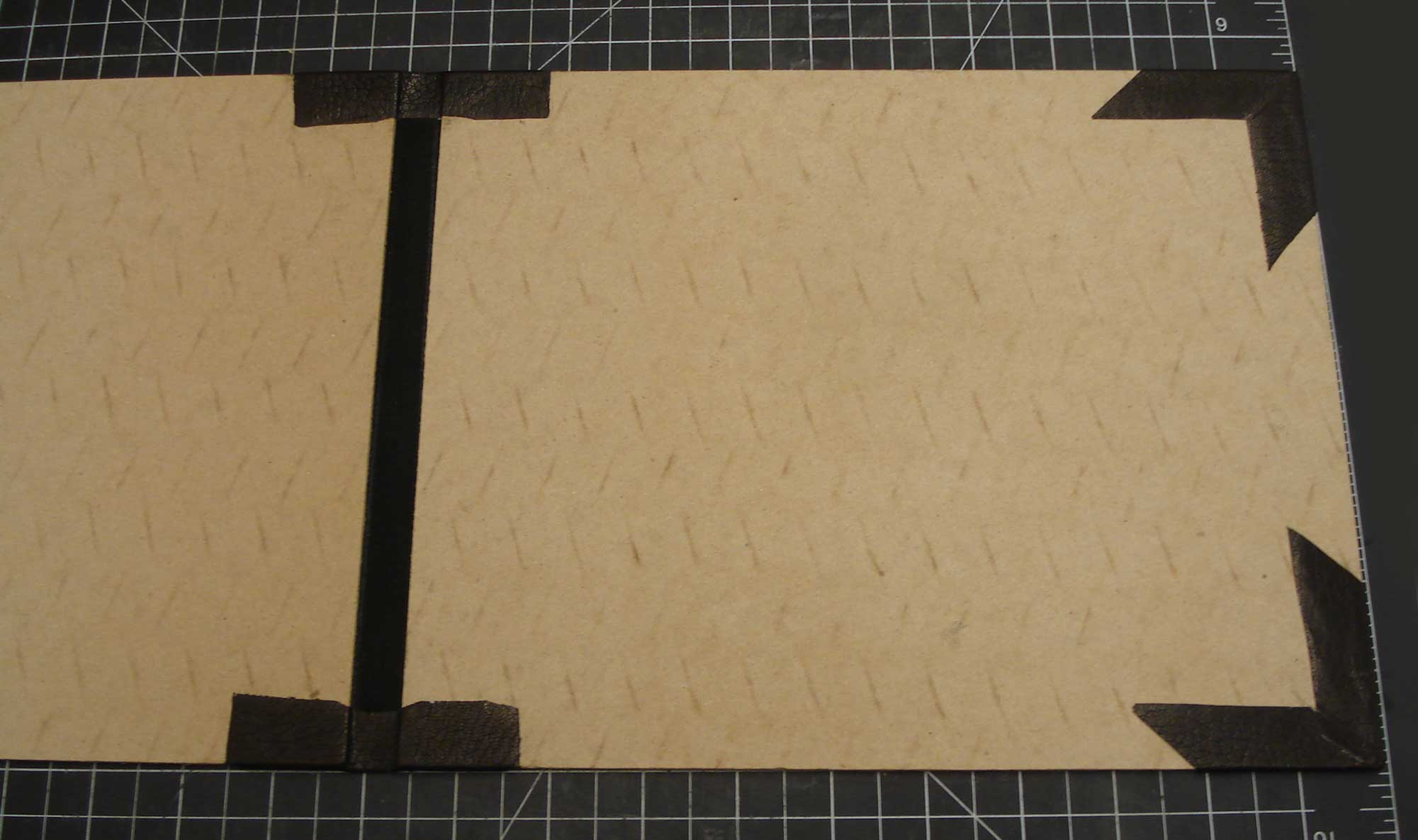
The spine strip and corners were flat pared to the thickness of the in-fill material, then the turn-ins further pared until they could hold a fold. The joint area of the spine is a also scooped out a bit at the headcaps so that the turn-ins will not show through the outside of the spine. They were pasted up and attached in the usual way.

The outside of the boards are then filled with thin board or paper so that the whole surface was flat and the siding up material (in this case marbled paper) is put on.

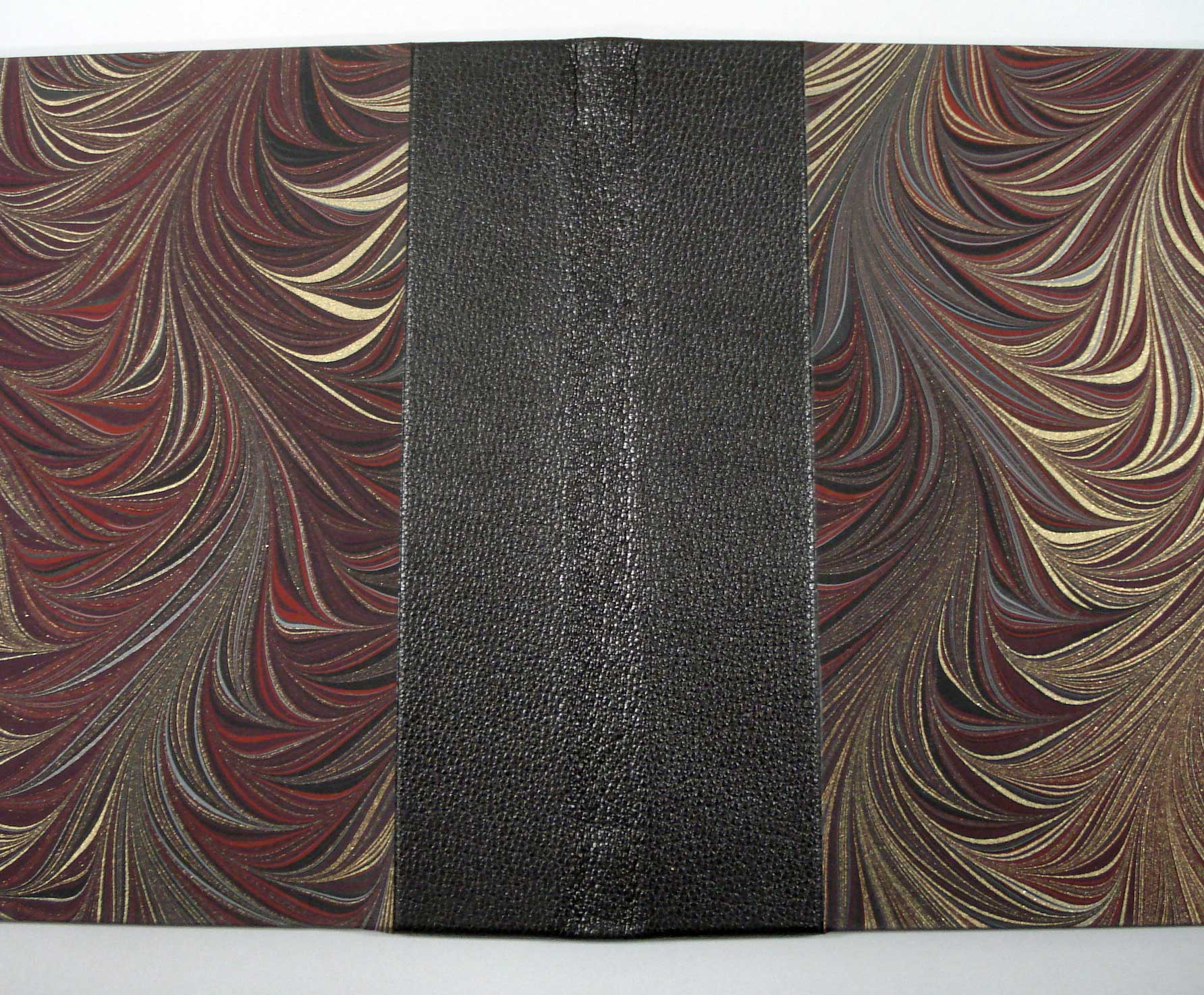
In each case,  I cut the siding up material for each board from the same sheet, so that the marbling pattern was continued across the spine of the case.

The case was finished off by tooling a single blind line at the edge of the paper to give a nice, crisp edge.

After trimming out the inside, the pastedown can be done with either paper or cloth and is cut wide enough to cover the inside of the joint. Depending upon the lining of the outside of the boards, the inside can also be in-filled to counteract excessive pull.

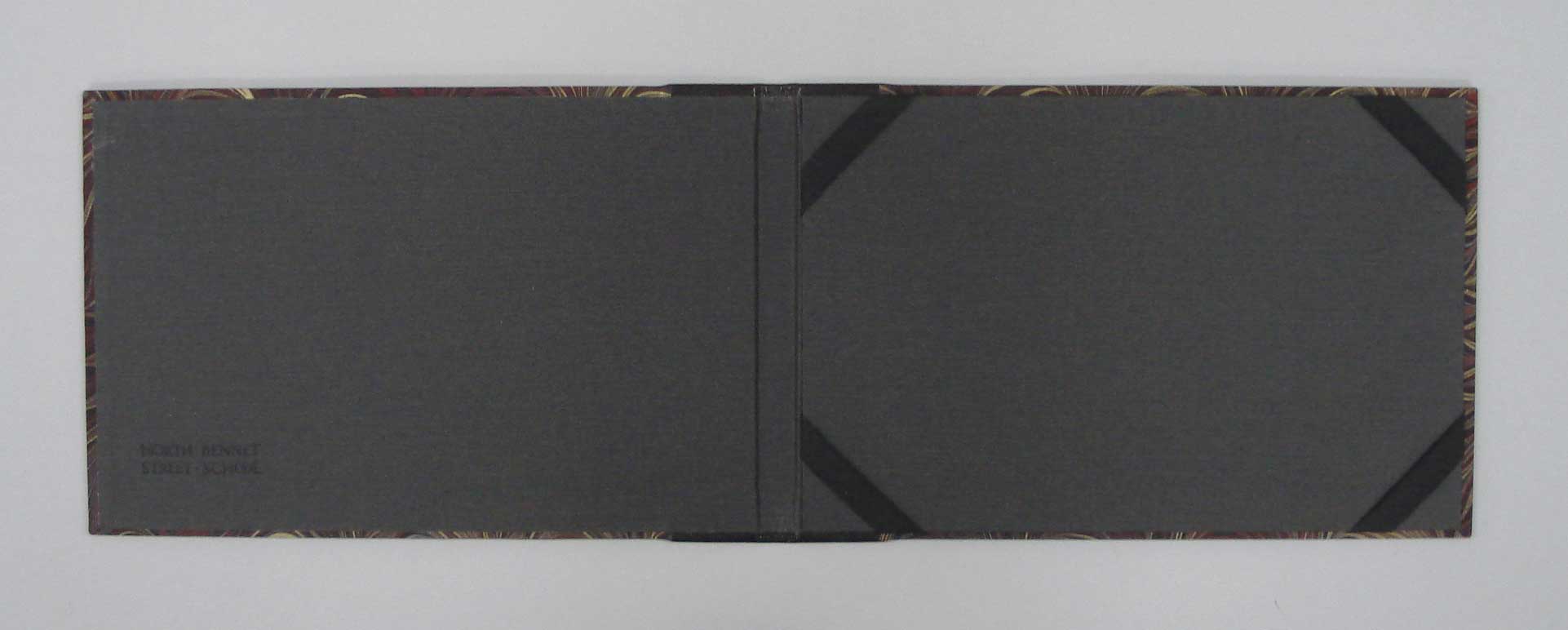
The second component of the portfolio is the back pad that holds the document. This is constructed of thin board (such as museum board) and is covered with the same material as the pastedown. Short sections of ribbon are glued to the back corners, and the whole thing is adhered to the inside of the back board.

At this stage, the case can be decorated or titled as desired. We used magnesium dies to stamp the guild logo in gold on the outside of the front board (see top) and the school logo  in carbon on the inside.

These portfolios are a good example of the ways that traditional binding materials and style can be adapted for uses other than the covers of printed books. With a little adjustment, this structure could probably be used for e-reader or ipad cases.

Ω

Back to work…

Bibliography, Bookbinding

The second year of the bookbinding program starts off with gold tooling, and this is probably the first part of the curriculum that I had absolutely no prior experience with before beginning coming to Boston. To be honest – it’s going pretty slowly. I have burned a lot of leather over the past few days trying to get my head wrapped around just the process of blind tooling, but then you add gilding into the mix and it all goes south. After seeing Jeff demo the process a number of times and watching the GBW video from 1997 with Don Glaister, it is starting to make a little more sense. I have quite a ways to go.

We start off by laying waste to a handful of simple plaquettes. These are just a scrap of leather, flat pared in the scharf-fix, and pasted to a board.

The goal of the exercise is to completely cover the surface with repeated lines and decorations in order to get at a consistent depth and color of impression. After 4 or 5 of these, the results are becoming a little more uniform.

This is something we will be working on for a while and I will share more when I’m able to produce something decent.

Over the summer I had put together a rather extensive list of books to read. Of course I only managed to get to a tiny portion of them, but one thing that I did cross off the list was a review of some chemistry. Like all aspiring conservators, I’ve gone through several general and organic chemistry lectures and labs. The college level courses I took gave me a pretty good understanding of general principles and at least made me familiar with the periodic table, but did little to address the specific questions I had regarding the materials and reactions commonly found in a book conservation lab. Now that I’m not forced to do stoichiometry problems everyday, I was concerned that I would start to forget things. Use it or lose it!

I wasn’t too excited about going through the material in my old chemistry textbooks again, so I began looking for new curriculum material online. I started with MIT’s Open Courseware. This is an open and free web publication of MIT undergraduate and graduate course materials. While it might be good for other subjects, their chemistry material is a bit spotty. Most courses have posted old homework assignments and exams with answers, but few have class notes or videos of the lecture.

After reading this article in Wired Magazine, I also checked out Khan Academy and found it a more comprehensive online resource. Also free and open to the public (thanks in part to funding by the Bill and Melinda Gates Foundation), this site offers a catalog of approximately 10 minute instructional videos on a topic or principle. I was surprised at the sheer quantity of material offered under their general and organic chemistry sections.

In the end, however, I spent most of my time with printed books – most notably with the 3-part Science for Conservators series from the Conservation Unit of the Museums & Galleries Commission.

These books offered exactly what I was looking for. Volume one goes through a complete review of basic chemical concepts, while the second and third volumes take on the subjects of cleaning and adhesives/coatings, respectively. Throughout the discussion, example reactions are pulled from cases of material degradation or conservation treatments. While not all of the examples were applicable to book and  paper conservation, the writing was clear and well presented. This series would probably not be as helpful to someone with no previous chemistry experience. I think it is an excellent resource, however, for individuals with a few chemistry classes under their belt. The perspective these books take really had an impact on my thinking. The volume on cleaning, particularly, completely changed the way that I think about certain types of reactions and cleaning in general.

Ω

I keep promising posts on German paper bindings, laced paper cases, and limp vellum bindings – they are still on the schedule! I’ve just finished re-assembling a new and improved photo documentation setup and reshot photos of them for your viewing pleasure. Stay tuned!

I’m not dead.

Writing

You might be thinking after months of internet inactivity that I (or my blog) have expired. But this is not the case! You see, I am very much alive and kicking – I’ve just been gravely injured. A few days after my last post, I managed to fracture my left elbow and break my right thumb in a bicycle accident. I was unable to hold my hand flat for typing and general computer operation for a while, but, to tell the truth, I also didn’t feel much like writing during that time.

I was only completely laid up for about a week after the accident, and since then I’ve had an interesting time trying to work around my injuries at the bench. While losing the most important digit on my dominant hand for a time has not been a pleasant experience, it has had the overall effect of improving my manual dexterity. For starters, I had to rely on my left hand almost entirely for a month. I’m not totally ambidextrous now or anything, but I can now complete a solid and attractive page repair using solvent-activated tissue using only my left. Soon after the accident, I also developed new ways of holding tools with the right that didn’t involve the thumb. Now, that the bones have healed, I’m having to re-learn to use the affected joints. The result is a profound change in the way that I approach hand work. Now I have to consider every part of the hand movement, including picking up the tool, how I will hold it, and how I will use it to complete the task. It’s all shifted to more of a higher brain function than a spinal response – and I think that it is allowing me to become more precise and correct some bad habits.

While this blog has been hibernating, I’ve been writing a few things for other virtual venues. I finished a board slotting tutorial for Jeff Peachey’s Board Slotting Blog (found here) and wrote a short piece on a treatment for the Parks Library Preservation Blog (found here).

School is starting again next week and I still have plenty of projects to share from the end of last year. I’m planning on churning out quite a bit here soon, so stay tuned.

Ω

Highlights of AIC

Conferences

It’s interesting how the activity of my blog is inversely proportional to the activity of real life: when I’m busy, nothing happens here! May was a pretty hectic month with the end of the school year and a trip to Philadelphia for the American Institute for Conservation‘s 39th Annual Meeting.

It was really great to catch up with all of my former employers from UNC-Chapel Hill, Duke, and Iowa State University, and to see some of the many conservators from the North East. I had never visited Philly before, and the conference location was very conveniently located downtown. During the afternoon breaks, I had a few opportunities to play tourist at Independence Hall and the Liberty Bell.

There were several great talks over the course of the three days, and I thought I’d mention a few of my favorites. By the by, I’m liking the new AIC blog that was launched just before the meeting and session notes/summaries are flooding in every day.

There was quite a bit of discussion on digitization this year. Gabrielle Beentjes, from the National Archives of the Netherlands, presented an extensive process chart for pre-digitization treatment decisions during a general session. There were also several talks sponsored by the Archives Conservation Discussion Group about mass digitization projects in different institutions. I am particularly interested in this topic, since just last year I finished my master’s paper on conservator collaboration on special collections digitization projects in research libraries. It is apparent that workflows and collaborative models surrounding library digitization projects continue to evolve, but it was encouraging to hear that conservators maintain an active role.

Quite a few presentations covered treatment techniques that were new to me. I really enjoyed Samantha Sheesley’s talk on applications of Lascaux in paper and photo conservation (nice writeup by Stephanie Growler here). I look forward to experimenting with some of the procedures she described.

The most entertaining talk came from Salvador Munoz-Vinas, of the Polytechnic University of Valencia, with his discussion of the “Frankenstein Syndrome” of conservation treatment. He is an excellent speaker and highlighted several fascinating architectural conservation projects as examples. Henceforth, I will always think about Robocop before making any treatment decisions. I’m definitely adding his book to my summer reading list.

Of course the session that has prompted the most post-conference internet discussion was the Library Collections Conservation Discussion Group panel on the models for educating library conservators. There are several very good summaries and responses out there – most notably from Beth Doyle, Jeff Peachey, Kevin Driedger, and Suzy Morgan. Last year, this discussion was geared toward “pie in the sky” thinking about the most useful curriculum for library conservators and questioning the need for an MLS. This year, the discussion focused on the three art conservation programs that have stepped in to fill the UT vacuum – while still debating the need for an MLS.

I can’t comment on whether or not a Winterthur, Buffalo, or NYU grad will be, on average, more effective as a conservator in a library/archive setting than a UT grad. Does a graduate degree in  library science and certificate in conservation beat out a graduate degree in conservation and a certificate in library science? As long as a “hiring monoculture” doesn’t develop, I don’t see how it will make that much of a difference. I certainly hope (for my own sake) that the individuals out there hiring library conservators are more concerned with the experiences and demonstrated skills of the individual applicant than their alma mater.

After each of the three graduate programs laid out the core elements of their curricula, plenty of audience members pointed out topics that they believe were not emphasized enough in these educational models. Apparently the list of qualifications that we would like the average library conservator to have is unrealistically long for the number of years the typical student spends in school – and shifting library initiatives means that list is getting longer all the time. As a ronin library conservation student, these discussions provide a valuable perspective on my self-directed curriculum. For example, I’m thankful that I have an MLS and that my library program placed so much emphasis on digitization, digital preservation, and preservation outreach. I’m also thankful that I can spend two years developing my bench skills at NBSS. I am, however, envious of the materials science and lab training that can be had through one of these new programs. Will I ever work in a lab that has access to that level of analytical equipment? Probably not – but it would be nice to have in the arsenal. I’m also jealous that I my training hasn’t included financial incentives to maintain my interest in book conservation so that I’m not “wooed away” to art conservation. Apparently I got on the wrong boat.

Of course the session ended with a call for more entry-level professional jobs. This I actually found pretty amusing, because it seems like there aren’t that many professional jobs of any variety up for grabs these days. How are libraries and archives supposed to create any new conservation positions when their budgets are still being cut? In the last mailing from my old university, I read that the University of North Carolina system was getting another 10% budget cut this year and I have a feeling that the libraries are not  exempt. The story could be different everywhere else – but I doubt it.

But enough gloom and doom about grad schools and getting a job… I’ve got work to do.

Ω

Upcoming discussions include split-board bindings, German Lapped Component and paper bindings, limp leather, laced paper case, and limp vellum. Stay tuned!

Bone Folders

Tools, Workshops

A few days back, when it was sunny and moderately warm for the first time in this god-forsaken land, we took an afternoon to make some bone tools. Here are three that I finished that afternoon.

These are only my latest attempts at bone shaping: as a Lennox Foundation Intern at Iowa State University, I also made a few bone tools last summer. You can read about that experience here.

Even though we were using elk bone, which is much harder than the deer and cow bones that I used before, I was able to dramatically speed up the process this time. Although I had a much better idea of the tools that I wanted before starting this time, the factor that significantly improved the process was using a Ferrier’s Rasp.

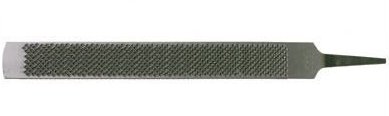
These are designed for removing or leveling the hoof wall, so they are much wider and longer than a typical wood rasp. The increased surface area allows you to really cut quickly using the rasp side, then smooth out the shape evenly with the file side. As always, one has to be ever-mindful when rasping for an extended period of time. I lost a few of my fingerprints when I allowed my attention to wander. Hopefully they will come back soon:)

So far, I’m finding the largest of my bone tools (I think it looks like a butterknife) to be the most useful. In addition to the usual folding of paper and scraping of gunk, I find the increased length to be very helpful in compressing sections while sewing.

Portfolio Production

Bookbinding

In February and March, the Boston University College of Fine Arts showed works by South African artists in two exhibitions celebrating the Caversham Press. Founded in 1985, the Caversham Press was created to give South African artists access to a professional and collaborative printmaking studio. Featuring over 120 works by 70 artists, the exhibition titled South Africa: Artists, Prints, Community, Twenty Five Years at The Caversham Press celebrated Caversham’s history and the diversity of South African printmaking. You can find a short article with a digital slide show here and the original press release here.

A central figure in the early years of the press, William Kentridge was also featured as the seventh annual Tim Hamill Visiting Artist Lecturer and in a concurrent exhibition, titled Three Artists at The Caversham Press: Deborah Bell, Robert Hodgins and William Kentridge.  As a side note, Kentridge also directed War Horse, an adaptation of Michael Morpurgo’s World War I novel, currently playing at the Lincoln Center Theater in New York. While I haven’t yet seen the play, I recently watched the TED talk featuring Basil Jones and Adrian Kohler of Handspring Puppet Company and thought it was absolutely amazing.

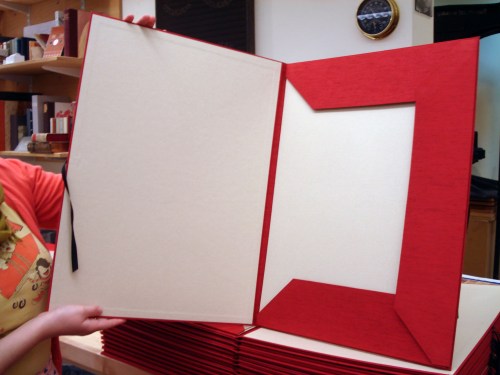
But what does all of this have to do with bookbinding? As part of the exhibition, our program was approached by BU to create a number of large, custom portfolios for selections of prints from the show. This project gave us an excellent opportunity to experience the particular challenges of designing and completing a larger production project. The initial design called for a cloth-covered portfolio with three flaps to hold the prints, all enclosed in a case secured with ribbon ties.

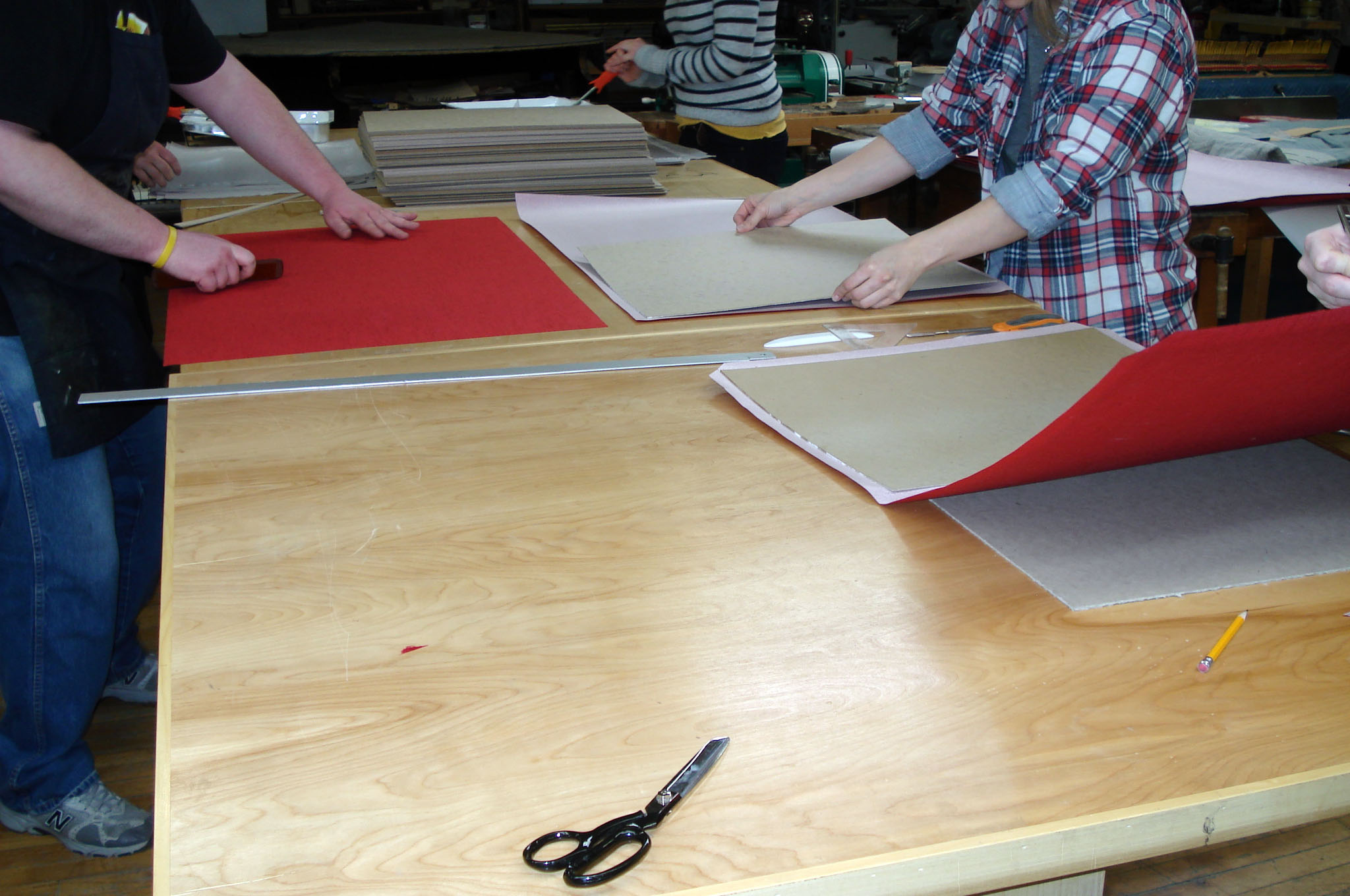
While there are a number of ways to fabricate an item like this, the design of this particular portfolio had to play to our strengths, but not be slowed by our equipment and space limitations. On the one hand, we had 15 individuals capable of churning out a huge amount of work rather quickly; however, our department has only a single standing press that would accommodate the portfolio’s final dimensions. In our case, we made use of a modular structure composed of individual parts that could be fabricated by small teams and nipped in smaller presses, then assembled en-mass at the end. Before beginning work, we planned the entire project on paper, built prototypes, and received approval from the client. Templates of the individual parts of the portfolios were created during the design phase and, using these, all of the materials were first cut to size.

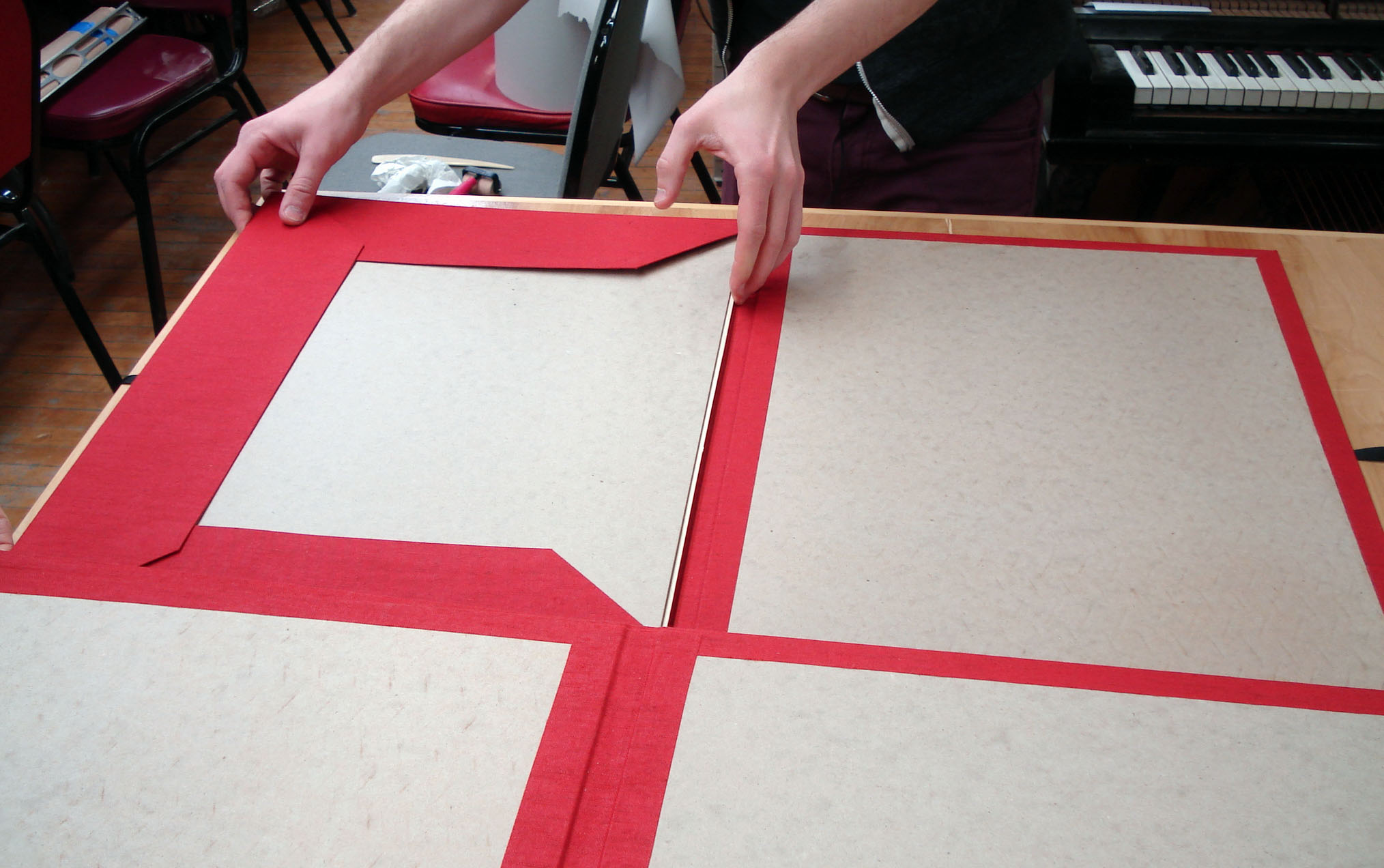
From these piles of individual parts, assembly began in stages.  Three flaps of 20 pt board covered in red Canapetta book cloth were created to fit the head, tail, and fore-edge of each portfolio.

A separate team went to work constructing the back out of matte board and Nideggen, a mouldmade paper.

The flaps were attached to the back board, leaving enough joint space to accommodate the thickness of the set of prints.

After placing a board of equal thickness to the prints inside the assembly…

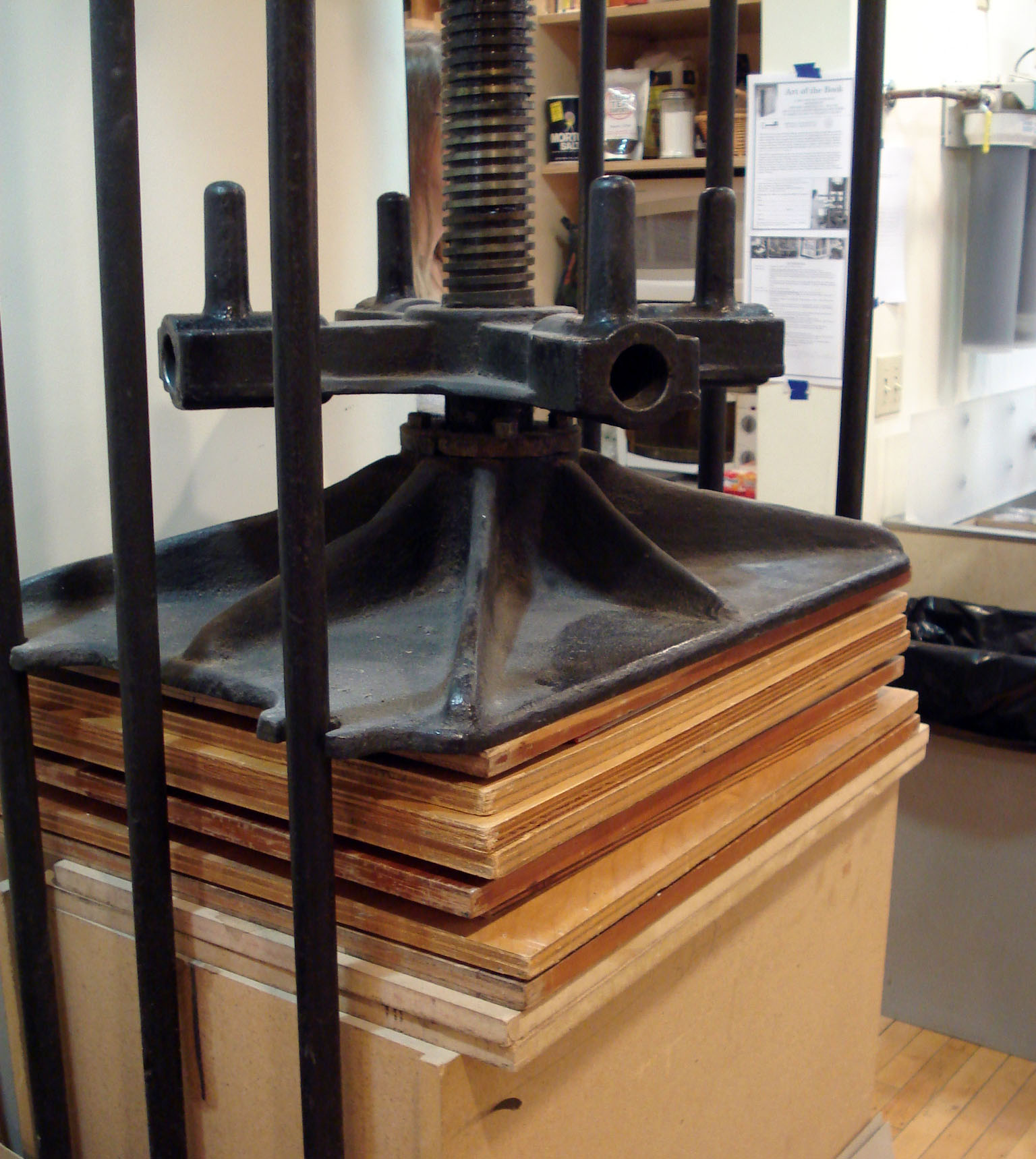
…the whole thing was put into the standing press.As the stack of “print trays” pressed and dried, we prepared the cases of the portfolios. A chisel was used to cut slots into the cover boards for lacing through the tying ribbons.

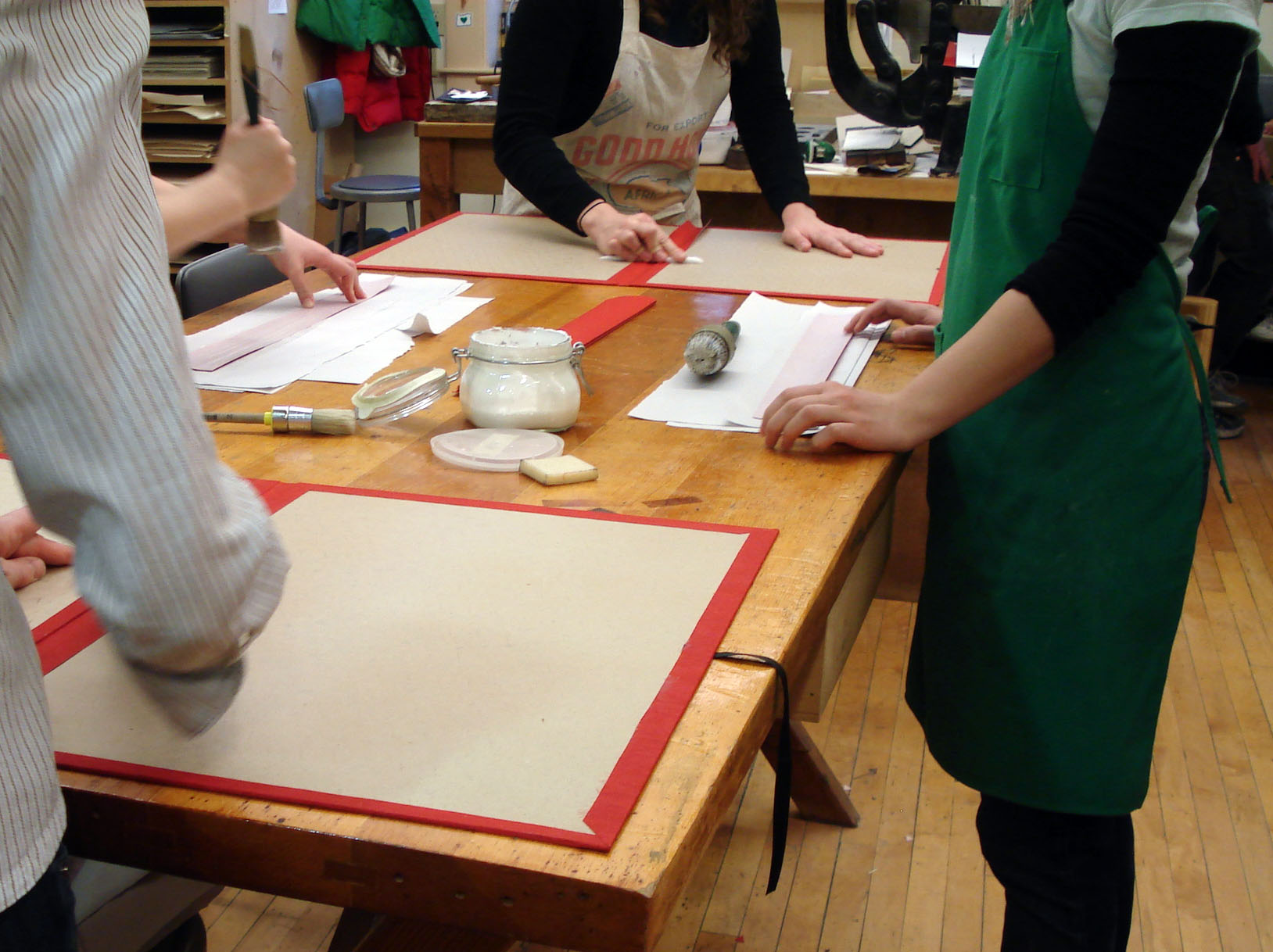
We then set up an assembly line for the case construction. Two students used foam rollers to give the boards a quick, even coat of PVA. Another student placed each board onto pre-cut cloth, using a jig to line them up and give consistent hinge space at the spine.  After working the cloth down with a case folder and cutting the corners from the cloth, the cases were quickly nipped in the press.

In the next stage, the ribbons were laced through  the boards and the turn-ins were done.

The inside hinge of the case was then finished off with a strip of cloth.

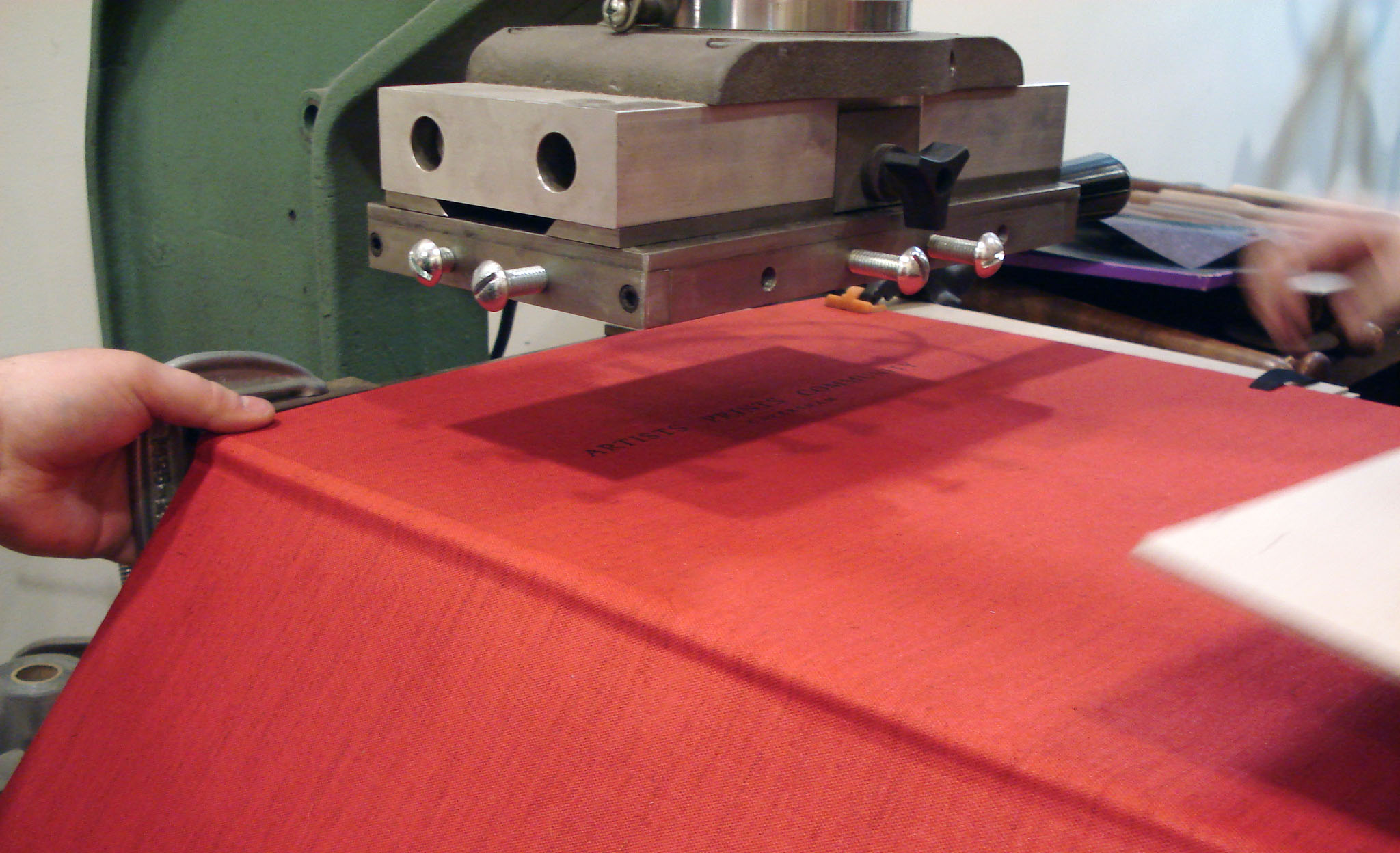
A custom die was made for carbon stamping the titling using the Kensol.

At this point, the two parts of the portfolios were ready to be assembled. The back of each print tray was glued out and carefully aligned in the case.
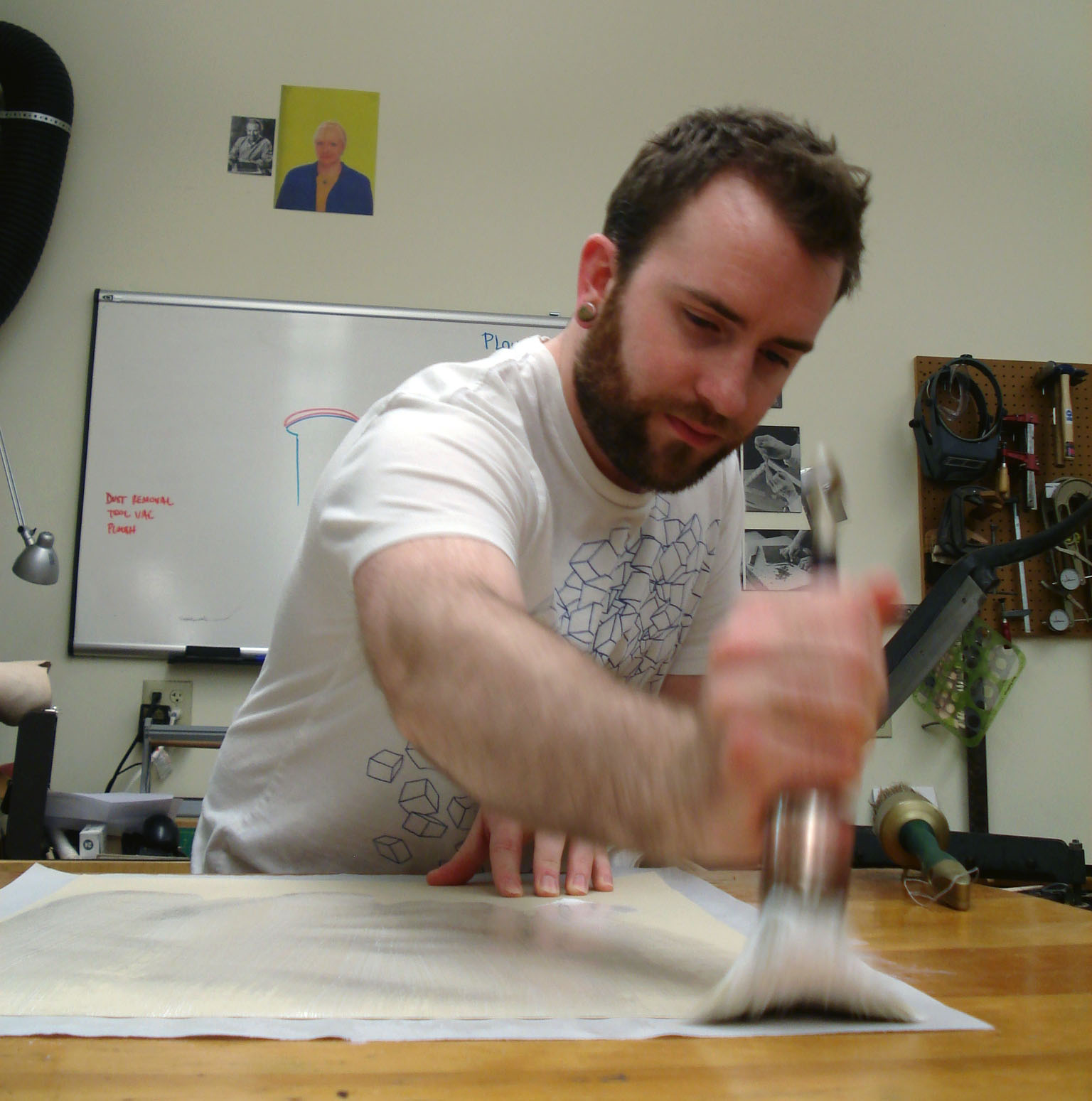
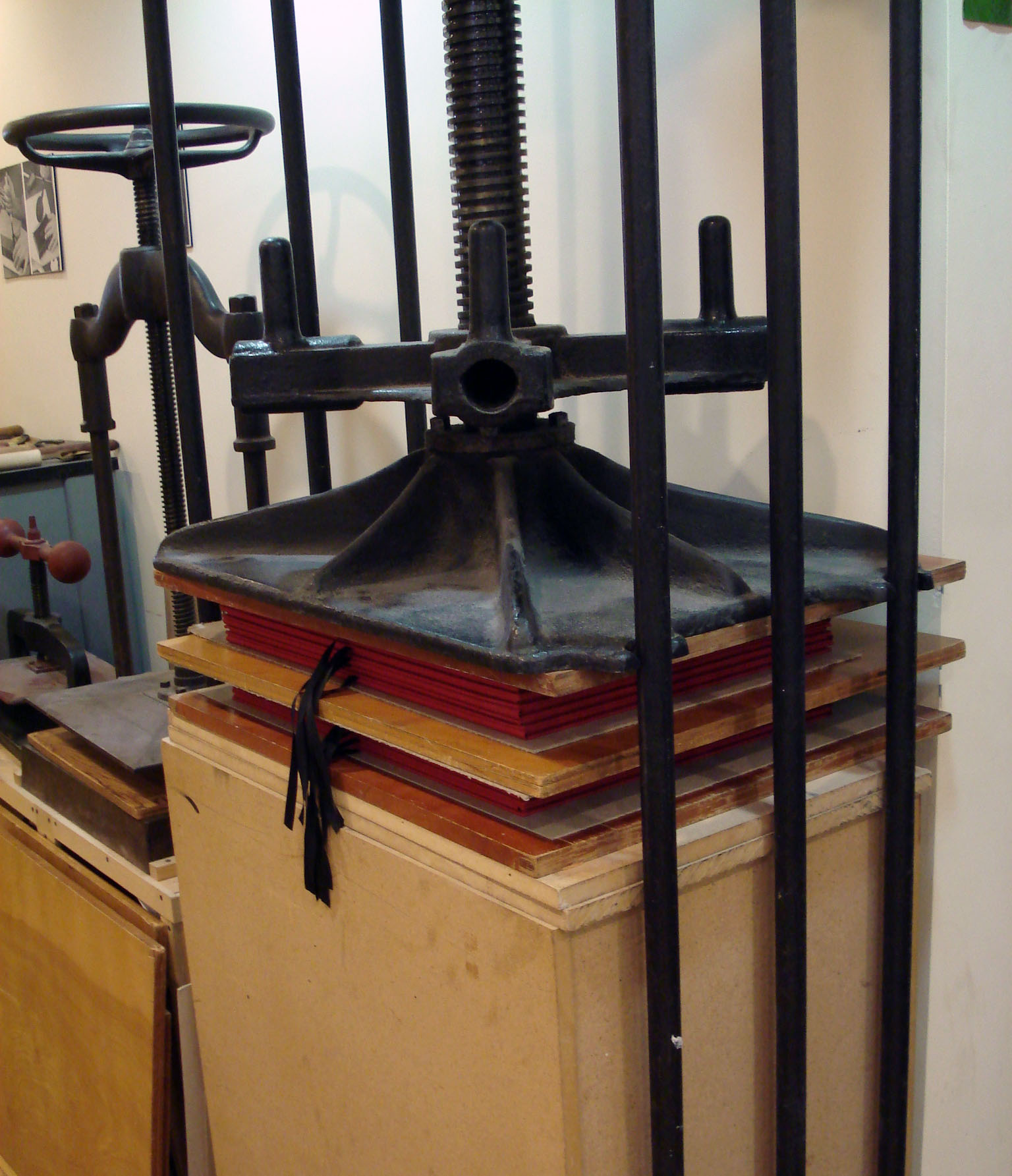
The portfolios were then nipped again between press boards to ensure a good bond between the tray and case. In the final step, the inside front board of the portfolio was trimmed out and finished with a Nideggen paste-down to match the tray back. Here I am, working quickly to glue out the paste-down. It’s somewhat comforting to know that, at NBSS, Tini Miura and Bill Anthony are always looking down upon you as you work.

The portfolios were given a final press and allowed to completely dry under weight.

As a group, we had a lot of fun doing this project. Most of our curriculum is focused on individual work, and we don’t often get the chance to work together on a single project or develop our production methodology and technique. While we did not get to see the items that eventually went inside these portfolios, and we do not know where they will go or who will eventually own them, I like think that through this project and our intra-departmental collaboration, we were able to contribute to an international collaboration of craft.

Leather Case Bindings

Bookbinding

Having just returned from a bookbinding pilgrimage to London, I’ve got loads to share about the many wonders we witnessed across the seas. But in the meantime as I sift through the trip photos, I’m going to try to get through a few quick posts about recent projects.

I thought an appropriate sequel to and co-mingling of the posts on case bindings and paper marbling would be to share the two leather case bindings that I finished using the textblocks with marbled edge treatment. In both cases, I used siding-up paper pulled from the same tray as the edges to get a marbled-all-over look. The results are a little over the top in that 19th century account book sort of way, but exude a certain degree of, shall we say, opulence.

I started out with the same basic form of textblock that I’ve used in other case bindings. The sections are sewn on flattened cord with a thick enough thread to get some swell. For these books I used an endpaper structure that included a waste sheet. As the leather is worked damp, I wanted to avoid any dye transfer to the endpapers during covering.

After sewing, the textblock was glued up and rounded and backed. The textblock forwarding did distort the edge marbling a bit: I ended up with a bit of stair-stepping on the fore-edge that produced some white lines through the pattern. I imagine this effect would be reduced if my rounding and backing were better. Practice, practice!

The case is constructed in much the same way as the “built-in” groove or Bradel-style case: a stiff spine strip adhered to strong paper that is attached to the boards before covering, with enough space between the spine and boards for an open joint. The leather-covered case structure has two adaptations: increased joint spacing to accommodate the thicker leather and a bit of a headcap “cheat” known as the Bart. To achieve this feature, the spine strip material is trimmed slightly longer than the height of the boards and given a rounded shape with many, small darts. The final shape looks like Bart Simpson’s head – thus the nickname. I failed to get a picture, but here is the diagram from my notes to illustrate.

A horizontal score line at the tips of the darts allow the shape to fold over after covering – but more on that later.

Arthur Johnson’s Manual of Bookbinding (1978) has a nice description of covering a quarter or half binding with an open joint (pp. 108-114). The method I used for covering and finishing these case bindings was similar, except for the formation of the headcaps and, of course, being done off the book. As a first year, I’m still grappling with the very basics of leather paring and covering. Quarter or half-style covering are excellent starting points for me because most of the paring can be done on the Scharf-Fix, and the pieces of leather are not very large – so any mistakes aren’t all that expensive. After flat paring the leather for the spine and the corners to the same thickness as my in-filling material (~0.5mm), I further pared the turn-ins German-style to a thickness that would easily hold a fold. Linda Blaser and Frank Mowery’s handout from the 1998 GBW Standards seminar has a good description of German paring with the Scharf-Fix (found here). As a final step, the head and tail turn-ins of the spine strip are further shaped and “feathered” out with the knife.

The leather is evenly dampened from the hair side with a sponge, thickly pasted up (with flour paste), and set aside for a moment. The paste is then carefully scraped off with a bit of board and a new thin layer of paste is applied. The corners and spine of the case are then covered and the headcaps set with the textblock in the case.

Of covering with leather, Johnson (1978) says, ” Leather is an amenable material: it can be modeled while wet and will retain its shape on drying. However, it is marked easily in its wet state and excessive use of the folder will cause scoring” (p. 108). I learned this lesson all too well while covering these books, and lo, it was a painful one to learn.

The headcaps made with “the Bart” are satisfying because they hug the endbands well, although I’ve got some improvements to make on mine.  Like many aspects of bookbinding, unrefined work early on compounds as you go along; Uneven and asymmetrical paring with the knife results in headcaps that are puffier on one side than the other.

The same headcap from the back.

When the leather has had ample time to dry, the case is then ready for siding up.  I did not edge pare the leather that goes down onto the board, and because it is quite thick. The face of each board must be in-filled to the same height so as to avoid unsightly lumps in the transition from leather to siding up material.  As a finishing touch to these case bindings, also I tooled thin, blind lines where the leather meets the siding up paper at both the corners and the spine edges. The image below shows some detail.

Ω

In the queue, I’ve got split board bindings, German paper bindings, a portfolio production, limp leather bindings, and our trip to England. Your patience, Gentle Reader, soon will be rewarded!

_____________

Blaser, L. & Mowery, J. F. (1998). “English and German Style Leather Paring. Guild of Book Worker Standards of Excellence Seminar, Greensboro, NC.

Johnson, A. W. (1978). Manual of Bookbinding. New York: Scribner.